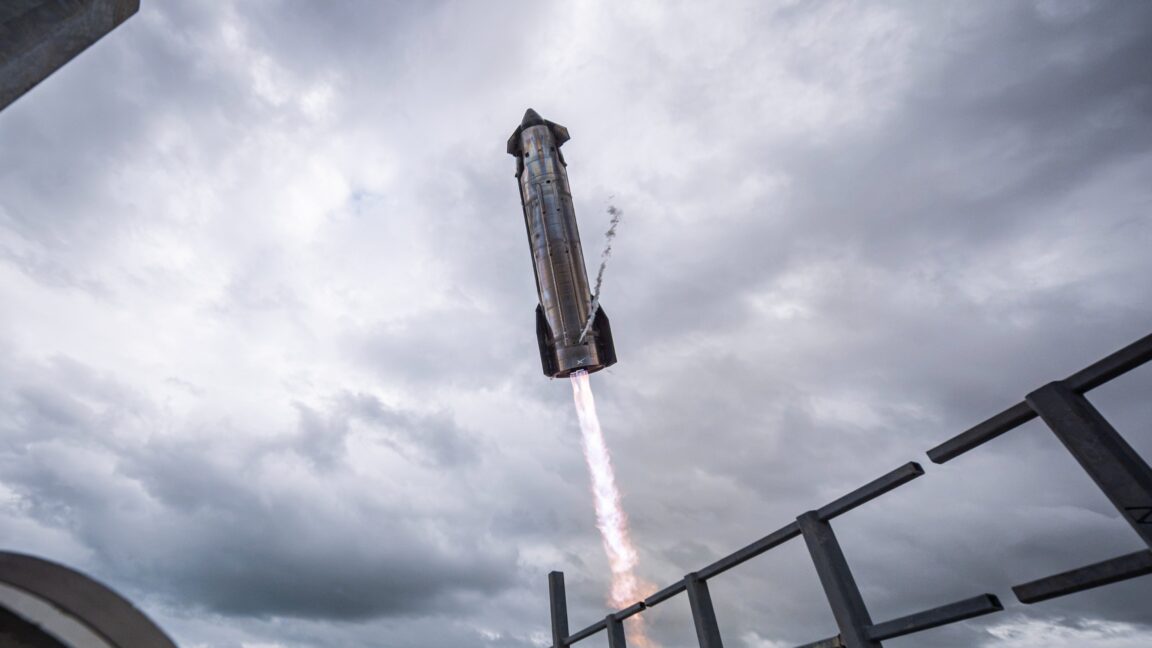
NASA Reshapes Artemis for Starship Refueling, Forcing Orion to Fly Backward and Redesign Tanks
NASA has reshaped the Artemis lunar architecture to accommodate SpaceX Starship refueling in low-Earth orbit before the lander meets Orion, a shift that forces the crew capsule to fly backward to the Moon and requires European Service Module tank modifications, Ars Technica reported.
The Tech TL;DR:
- Orion must fly tail-first to the Moon when docked to Starship, moving liquid propellant toward gas inlets and risking engine failure.
- Airbus and ESA are modifying Service Module tanks for the new attitude; the work is underway but not yet qualified for flight.
- SpaceX targets a “meaningful” cryogenic propellant transfer demo between two Starships in Q1 2025, the first of its kind in orbit.
The revised mission profile has SpaceX fueling a Starship Human Landing System in low-Earth orbit through a series of tanker flights, then raising the lander to a high-Earth orbit rendezvous with Orion. That docking configuration — Starship nose-to-nose with Orion — inverts the stack’s thrust vector during trans-lunar injection, pushing Orion’s European Service Module (ESM) engines to the top of the vehicle.
“When you push it the other way, the liquid goes to the gas end of the tank, and you don’t want the liquid in the gas part,” said Kirk Shireman, Human Spaceflight Exploration and Orion program manager at Lockheed Martin. “Bad things can happen to you,” he told Ars Technica.
Propellant management devices inside the ESM tanks were designed for forward acceleration, where liquid settles over the outlet. Under the new profile, the Service Module’s main engine and auxiliary thrusters fire toward the Moon, reversing the acceleration vector.
Liquid methane and oxygen would migrate toward the pressurant gas inlets, potentially ingesting gas into the engine feed lines — a condition known as vapor ingestion that can cause combustion instability or engine shutdown.

Tank redesign targets vapor ingestion
Airbus Defence and Space, the ESM prime contractor, is modifying the propellant tank internal geometry to manage slosh and ensure liquid acquisition under reversed thrust.
The changes involve repositioning baffles, sponges, and gallery structures inside the titanium alloy tanks that hold roughly nine metric tons of mixed oxides of nitrogen and monomethylhydrazine — storable hypergolics, not cryogenics — but the fluid dynamics challenge is analogous. ESA and Airbus have not disclosed whether the modified tanks will fly on Artemis III or a later mission.
Lockheed Martin, Orion prime contractor, is integrating the redesigned ESM into the spacecraft’s propulsion feed system. The Service Module provides Orion’s primary propulsion, power, thermal control, and life support consumables.
Starship refueling demo sets the schedule
The entire architecture hinges on SpaceX demonstrating orbital cryogenic transfer. NASA’s Amit Kshatriya, deputy associate administrator for the Moon to Mars Program, said the agency expects a “meaningful” propellant transfer between two Starships in the first quarter of 2025. One vehicle launches from Kennedy Space Center in Florida, the other from Starbase in Texas; they dock in low-Earth orbit and transfer liquid oxygen and liquid methane.
“That is going to be a big learning point if they pull that off, because their architecture depends on propellant aggregation and multiple propellant flights,” said Creech.
The test will quantify boil-off rates during the docking, transfer, and coast phases. Current Starship V3 vehicles carry 1,600 metric tons of propellant at full load but deliver well under 100 metric tons of payload to LEO.
Musk’s estimate of six to eight tanker flights per lunar mission assumes a future Starship V4 with nine Raptor engines and 100–200 metric tons LEO capacity. NASA’s conservative planning figure remains 20 tanker flights using V3 hardware. Starship V4 first launch was targeted for 2027 as of 2025; no updated schedule has been published.
Blue Origin Blue Moon shifts rendezvous to low-lunar orbit
NASA’s second HLS provider, Blue Origin, received a parallel contract modification moving its Orion rendezvous from the Near-Rectilinear Halo Orbit (NRHO) to low-lunar orbit (LLO).
The Blue Moon lander will descend from LLO, reducing the delta-v budget for the lander but increasing Orion’s propulsion requirement to enter and depart the lower orbit. The ESM modifications for Starship missions do not directly address the LLO profile, which imposes different thermal and radiation environments on Orion.
NASA characterized the moves as giving providers “more flexibility” while acknowledging increased burden on Orion.
Open questions on boil-off and flight rate
Cryogenic boil-off during the weeks-long aggregation campaign — multiple tanker launches, each adding propellant to a depot Starship — remains uncharacterized in flight. Ground tests at Marshall Space Flight Center and Glenn Research Center have modeled methane and oxygen stratification in microgravity, but orbital validation is absent. The Q1 2025 demo will provide the first empirical data on transfer efficiency, settle time, and residual gas entrainment.
NASA has not released an updated Artemis III launch target.