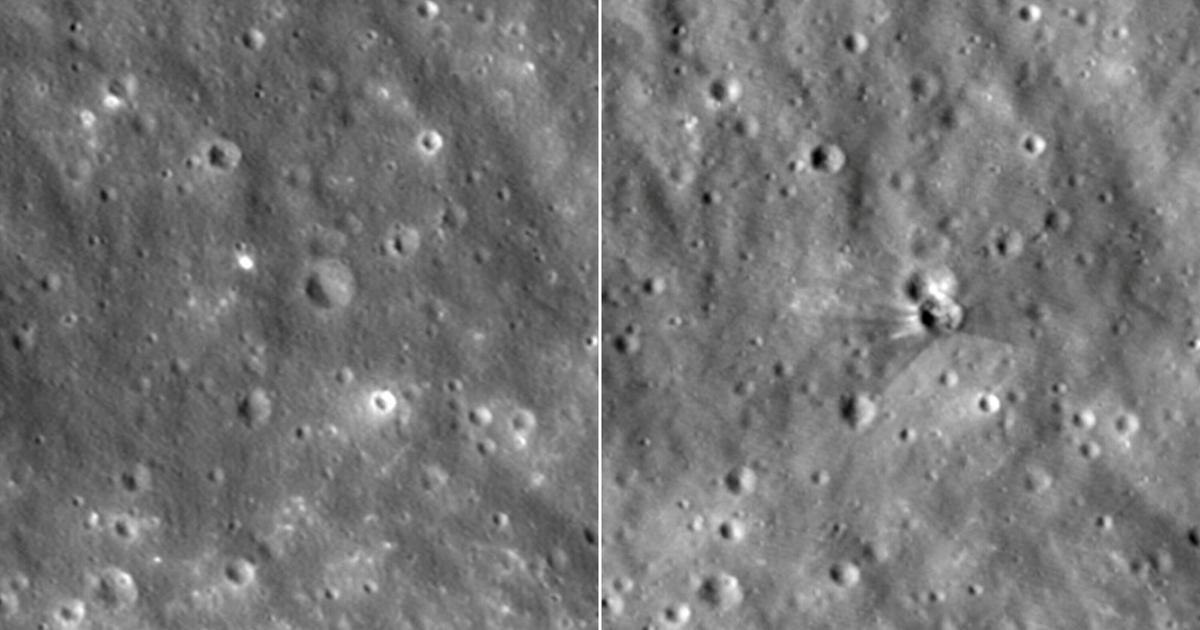
NASA Releases Images of Crater From SpaceX Rocket Moon Crash
NASA’s Lunar Reconnaissance Orbiter (LRO) has successfully captured imagery of a double crater on the Moon’s surface, identified as the impact site of a SpaceX Falcon 9 rocket stage that struck the lunar far side in March 2022. The collision, which occurred near the Hertzsprung crater, resulted in an unusual formation that has provided researchers with data on the physical properties of lunar impact events.
## Imaging the Impact Site
The LRO, managed by NASA’s Goddard Space Flight Center, identified the impact site by comparing orbital imagery taken before and after the expected collision date. The resulting scar consists of two overlapping craters: an eastern crater approximately 18 meters in diameter and a western crater approximately 16 meters in diameter.
According to NASA, the presence of the double crater is anomalous for typical lunar impacts. Most rocket bodies concentrate their mass at the engine end, leaving the remainder of the stage as a lightweight, hollow shell. The agency noted that this specific impact suggests that the Falcon 9 stage likely carried significant mass at both ends, contributing to the dual-crater formation rather than the single, more circular depression typically observed from spent rocket stages.
## Identification and Trajectory
The rocket stage was initially identified as part of the SpaceX Falcon 9 that launched the Deep Space Climate Observatory (DSCOVR) mission in February 2015. Following the completion of its primary mission, the second stage of the rocket lacked the necessary propellant to return to Earth’s atmosphere or achieve a stable heliocentric orbit. Instead, it followed a chaotic, long-term trajectory influenced by the gravitational pull of the Earth and the Moon.
Independent observers and astronomers, including Bill Gray, who operates the Project Pluto software used for tracking near-Earth objects, first calculated the collision trajectory. While initial reports suggested the object might be a piece of a Chinese Long March rocket, subsequent analysis by the Jet Propulsion Laboratory confirmed the debris originated from the 2015 SpaceX launch.
## Scientific Context of Lunar Debris
The impact serves as an unplanned experiment in lunar geology. NASA researchers utilize such events to study the density and composition of the lunar regolith, as the depth and shape of the craters produced by artificial objects provide information about the surface’s resistance.
The LRO has been in orbit around the Moon since 2009, tasked with mapping the lunar surface and identifying potential landing sites for future human exploration. The agency continues to monitor the site to determine how the ejecta pattern from the double crater compares to natural meteoroid impacts. No formal recovery mission or further investigation of the debris remains scheduled by SpaceX or NASA at this time.