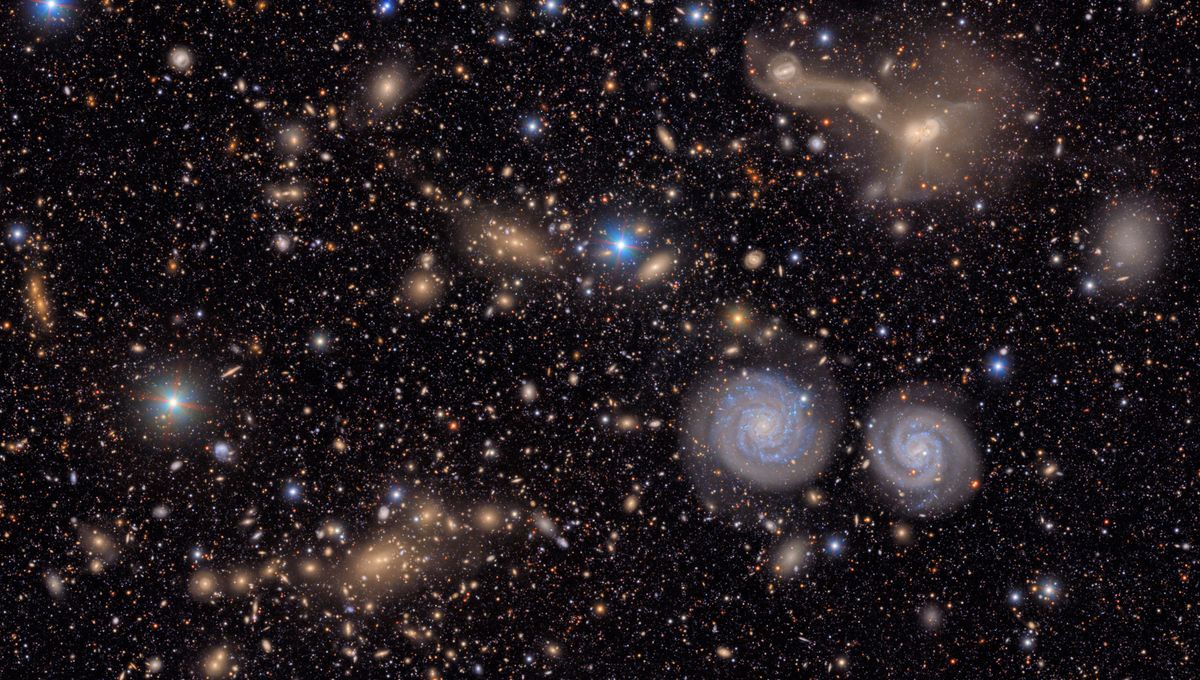
New Survey Reveals 2,000 Previously Unknown Galaxies in Virgo Cluster
Canadian Astronomers Discover Over 2,000 Previously Unknown Galaxies in the Virgo Cluster
Astronomers Laura Ferrarese and Patrick Côté led a team that discovered over 2,000 previously unknown galaxies in the Virgo Cluster, the closest major galaxy cluster to us, according to findings published in The Astrophysical Journal and reported by IFLScience. The Next Generation Virgo Cluster Survey revealed these objects, some of which measure two million times fainter than the cluster’s brightest galaxy, bringing the total recognized cluster members to over 3,680.
The Tech TL;DR:
- Researchers mapped over 2,000 new galaxies in the Virgo Cluster.
- The cluster sits approximately 53.8 million light-years away and contains a diverse range of galaxy morphologies.
- Data collected from the survey allows scientists to examine supermassive black hole mass ratios.
Mapping the Nearest Major Galaxy Cluster
The Virgo Cluster spans an enormous area of the sky because of its proximity to us at roughly 53.8 million light-years, creating significant observational challenges. While the brightest galaxies in the region, including M87 and its central supermassive black hole, have been known since the late 1700s, and an earlier major survey cataloged over 1,300 dimmer members decades ago, advanced imaging technology enabled researchers to probe deeper into smaller and dimmer structures.
Ferrarese noted that the Local Group, which contains the Milky Way and Andromeda among roughly 100 total members, lacks the morphological diversity needed to study galaxy evolution comprehensively. “The local group is not representative of the galaxy population as a whole or clusters as a whole,” Ferrarese told IFLScience. “Virgo is. Virgo is your run-of-the-mill cluster!” Because the Milky Way sits near this structure and feels its gravitational pull, the survey provides a nearby laboratory representing typical cosmic environments.
Small Galaxies Host Unexpectedly Large Black Holes
The newly expanded catalog allows researchers to investigate how small galaxies function as building blocks for larger systems, similar to historical events in the Milky Way like the Gaia-Enceladus-Sausage merger. Beyond structural assembly, the data challenges established models regarding supermassive black holes. Decades of observation have established a relationship between the mass of a host galaxy and the size of its central black hole. However, this survey identified compact, low-mass galaxies hosting black holes larger than expected for their current stripped-down size.
Ferrarese explained that as smaller galaxies fall into the cluster environment, interactions strip away their outer stellar envelopes, reducing the overall mass of the galaxy while leaving the central black hole unaffected. This dynamic provides new context for understanding how environmental factors alter galaxy morphology across evolutionary timelines.