NASA Discovers Complex Carbon on Mars: New Clues in the Search for Alien Life
NASA has detected complex carbon compounds on Mars in a discovery that scientists say could be the strongest evidence yet of potential past life on the planet, according to new data from the agency’s Curiosity rover.
NASA’s Curiosity rover has measured carbon isotope ratios in Martian rocks that differ significantly from those found in meteorites or volcanic processes, suggesting an alternative source. The data, collected over five years from samples in Gale Crater, show a pattern consistent with biological activity, though non-biological explanations—such as ultraviolet radiation or ancient hydrothermal vents—remain possible.
What the carbon isotopes reveal—and what they don’t
The study, published in the journal Proceedings of the National Academy of Sciences (PNAS), focuses on carbon-13 and carbon-12 ratios in sedimentary rocks. On Earth, such variations often indicate photosynthesis or methane-producing microbes. However, Mars lacks the oxygen-rich atmosphere needed for photosynthesis, leaving scientists to weigh other explanations.
“We’re not saying we’ve found signs of life,” said Paul Mahaffy, a co-author of the study. “But we’ve found something very intriguing that warrants further investigation.” The rover’s Sample Analysis at Mars (SAM) instrument detected the isotopic signatures in mudstone layers deposited billions of years ago, when Mars may have had liquid water.
Key findings include:
- A 10-fold enrichment in carbon-12 relative to carbon-13 in some samples, far exceeding ratios seen in Martian meteorites.
- Variations in carbon isotope ratios across different rock layers, suggesting multiple environmental processes at play.
- No direct evidence of organic molecules tied to life, but the isotopic patterns mirror those produced by microbial activity on early Earth.
Why this discovery matters—and what it doesn’t prove
The discovery builds on previous detections of organic molecules on Mars. However, organic compounds alone do not confirm life, as they can form through abiotic processes. The new carbon isotope data adds a layer of complexity, as such patterns are rare outside biological systems.
“This is the most compelling evidence we’ve seen so far for a potential biological signature on Mars,” said Jennifer Eigenbrode, a geobiologist and lead author of the study. “But it’s not smoking-gun proof—it’s more like a faint scent in the wind.”
Scientists emphasize that the findings do not confirm past life but narrow the possibilities. Alternative explanations include:
- Ultraviolet radiation: Mars’ thin atmosphere allows high-energy UV light to break down carbon dioxide, potentially altering isotope ratios.
- Hydrothermal vents: Ancient geothermal activity could have produced similar isotopic signatures through chemical reactions.
- Meteorite impacts: Shock waves from impacts might have fractionated carbon isotopes in ways that mimic biological processes.
What happens next: The hunt for definitive proof
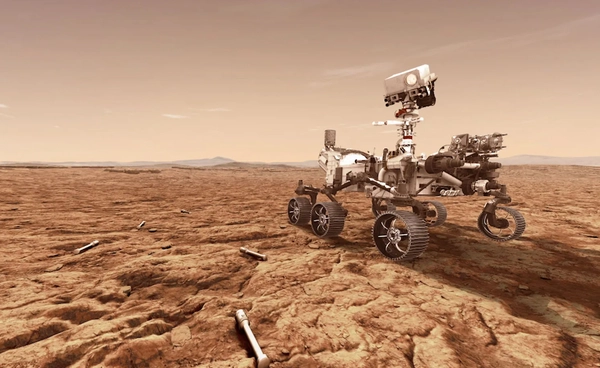
NASA’s upcoming missions, including the Mars Sample Return program, aim to bring Martian rocks to Earth for lab analysis. The agency’s Perseverance rover is already collecting samples from Jezero Crater, where signs of ancient water and organic matter have been detected. If future missions recover rocks with similar isotopic patterns—and additional biosignatures—scientists may gain stronger evidence of past life.

For now, the Curiosity rover continues its analysis in Gale Crater, while researchers debate whether the carbon isotope anomalies point to life—or to processes yet unknown. One thing is clear: The search for extraterrestrial life just got more intriguing.