
Interstellar Comet 3i/Atlas: A Visitor From Beyond Our Solar System
Table of Contents
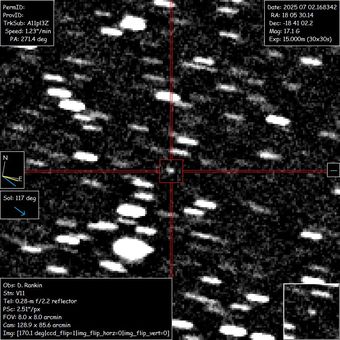
Astronomers have confirmed the existence of a new interstellar object, designated 3i/Atlas, making it only the third such discovery in the history of astronomical observation. This celestial visitor, potentially the largest comet ever detected from outside our solar system, is currently traversing our cosmic neighborhood, offering a unique opportunity for scientific study.
Discovery and Designation
The NASA survey system, Atlas (Asteroid Terrestrial-impact Last Alert System) in Hawaii, initially spotted this mysterious object on June 25, 2025. Following careful tracking by both professional and amateur astronomers globally, observations dating back to June 14, 2025, were identified. The Minor Planet Center of the International astronomical Union has officially designated it 3i/Atlas.
What Makes 3i/Atlas Special?
The defining characteristic of 3i/Atlas is its interstellar origin. Unlike most comets and asteroids,it is indeed not gravitationally bound to the sun.Jonathan McDowell,an astronomer at the Harvard-Smithsonian Center for Astrophysics,notes that the “fog or wrath” surrounding the object suggests it is indeed primarily composed of ice,rather than rock.
Did You Know? Interstellar objects are not bound by the gravity of our sun, making their trajectories unique compared to objects originating within our solar system.
trajectory and Safety
Richard Moissl, Head of Planet’s defense at the European Space Agency (ESA), indicates that 3i/Atlas will pass within the orbit of Mars.Despite this relatively close approach, Moissl assures that there is no risk of collision with either earth or Mars. The object’s extraordinary speed, estimated at over 60 kilometers per second, confirms that it is merely passing through the solar system on a trajectory back into interstellar space.
Size and Visibility
Estimates suggest that 3i/Atlas has a diameter of 10 to 20 kilometers, potentially making it the largest interstellar object ever observed. Its brightness is expected to increase as it approaches the sun, peaking around the end of October. Telescopic observations may be possible until the following year.
pro Tip: Keep an eye on astronomy news and resources for observation opportunities as 3i/Atlas reaches peak brightness.
A Comparison of interstellar Visitors
Prior to 3i/Atlas,only two interstellar objects had been detected:
| Object | Year of Discovery | Notable Characteristics |
|---|---|---|
| ‘Oumuamua | 2017 | Unusual elongated shape; initially speculated to be of artificial origin. |
| 2I/borisov | 2019 | Comet-like appearance; confirmed interstellar origin. |
| 3i/Atlas | 2025 | Potentially the largest interstellar object detected; high speed. |
Mark Norris, an astronomer from the University of Central Lancashire, notes that 3i/Atlas appears to be moving significantly faster than its predecessors and is currently located approximately at Jupiter’s distance from Earth.
Implications for the Search for Life
The study of interstellar objects like 3i/Atlas offers a rare opportunity to analyze material from beyond our solar system. The detection of life precursors, such as amino acids, could provide compelling evidence that the conditions for life may exist in other star systems.As Norris suggests, such a discovery would bolster the belief that life can arise elsewhere in the universe.
Future discoveries
Scientists estimate that thousands of interstellar objects traverse our solar system at any given time, but most are too small or faint to detect. The Vera C. Rubin Observatory in Chile, once fully operational, is expected to significantly increase the rate of interstellar object discoveries.
Are you excited about the potential for future discoveries of interstellar objects? What questions do you have about 3i/Atlas?
Evergreen Insights
The study of interstellar objects provides valuable insights into the formation and evolution of planetary systems beyond our own. By analyzing the composition and trajectories of these objects, scientists can gain a better understanding of the diversity of materials and processes that shape the cosmos. The discovery of 3i/Atlas highlights the importance of continued investment in astronomical observation and research.
frequently Asked Questions
-
What is Comet 3i/Atlas?
Comet 3i/Atlas is an interstellar object, meaning it originated from outside our solar system. It’s the third such object ever observed by humans.
-
How was Comet 3i/Atlas discovered?
The NASA survey system called Atlas (Asteroid Terrestrial-impact Last Alert System) in Hawaii first discovered 3i/Atlas on June 25, 2025. Astronomers worldwide then traced its path.
-
Is Comet 3i/Atlas a threat to Earth?
No, 3i/Atlas poses no threat to Earth. It will pass near Mars’ orbit but will not collide with either Earth or Mars.
-
how big is the interstellar object 3i/Atlas?
3i/Atlas is estimated to be between 10 to 20 kilometers in diameter, potentially making it the largest interstellar object detected to date.
-
When will Comet 3i/Atlas be visible?
3i/Atlas will continue to brighten as it approaches the sun until the end of october. It may be observable with telescopes until next year.
-
What can we learn from interstellar objects like 3i/Atlas?
These objects provide a rare opportunity to study material from other star systems. Finding life precursors like amino acids could suggest that conditions for life exist elsewhere in the universe.
Share this engaging discovery with your friends and family! Leave a comment below with your thoughts on interstellar exploration.
