
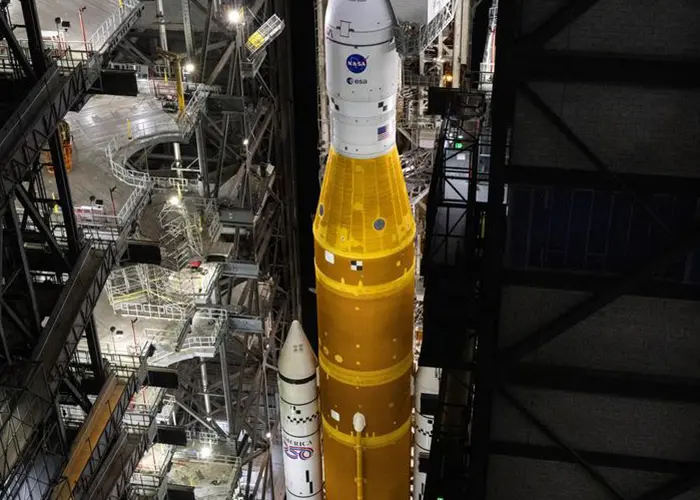
NASA’s Space Launch System rocket was rolled back to the Vehicle Assembly Building at Kennedy Space Center on February 25, 2026, to address a helium flow issue impacting the Artemis II mission, delaying the first crewed flight of the agency’s lunar program to no earlier than April.
The rollback, confirmed by NASA Administrator Jared Isaacman, comes after engineers detected a problem with the flow of helium to the rocket’s upper stage. The agency had been preparing to remove recently installed platforms in anticipation of high winds when the issue surfaced on February 21, prompting a decision to return the SLS and Orion spacecraft to the Vehicle Assembly Building for diagnosis and repair.
While the rollback initially threatened the April launch window, Isaacman framed the situation as an opportunity to accelerate the broader Artemis program. NASA announced a revised plan to add an additional mission in 2027 and commit to at least one lunar surface landing per year starting in 2028, aiming to increase launch cadence and standardize hardware configurations.
Artemis III, previously slated as the first crewed lunar landing, will now serve as a systems validation mission in low Earth orbit. The mission will focus on testing operational capabilities, including rendezvous and docking with commercial lunar landers developed by SpaceX and Blue Origin. NASA intends to use Artemis III to evaluate integrated life support, communications, propulsion systems, and the next-generation Extravehicular Activity (xEVA) suits.
Isaacman emphasized the demand for NASA to standardize its approach and increase flight rates, citing “credible competition from our greatest geopolitical adversary” as a key driver for the accelerated timeline. The agency plans to maintain the SLS in a configuration close to its current “Block 1” design for landing missions, avoiding immediate transitions to more evolved variants to minimize development risk and production complexity.
The revised plan also reflects a renewed focus on rebuilding in-house engineering capabilities. NASA intends to expand the role of civil servants alongside commercial partners to support safer and more reliable operations as flight frequency increases. Boeing, the prime contractor for the SLS core stage, stated its workforce and supply chain are prepared for increased demand.
The commitment to annual lunar landings from 2028 represents a significant shift for the Artemis program, which has faced schedule delays and budget constraints since its inception. Artemis I, an uncrewed test flight, launched in late 2022 after multiple postponements. Artemis II will mark the first crewed mission of the architecture, but its timeline has already been adjusted from earlier projections.
The agency’s increasing reliance on commercial lunar lander providers, including SpaceX’s Starship-based Human Landing System and Blue Origin’s Blue Moon lander, is also central to the revised plan. Both landers are still under development, with technical milestones remaining before operational readiness is achieved.
The Artemis II crew members were released from quarantine on February 21 and remain in Houston. NASA plans to hold a media event in the coming days to discuss the rollback and future plans for the Artemis II test flight. The agency has not yet announced a specific date for the media event or a revised launch target within the April window.
