Mycobacterium Tuberculosis Lipid Triggers ATP-mediated Neuronal Signaling and Cough
A specific lipid produced by hypertransmissible strains of Mycobacterium tuberculosis, known as phenolic glycolipid (PGL), triggers the cough reflex by activating sensory neurons. This process involves the release of extracellular ATP which stimulates purinergic receptors, potentially explaining why certain bacterial lineages spread more easily through aerosol transmission.
Researchers have identified a molecular mechanism where the PGL lipid engages host sensory neurons to drive coughing, according to reports from Europe PMC. This discovery builds on previous findings that another cell wall glycolipid, sulfolipid-1 (SL-1), also provokes coughing in guinea pigs, pmc.ncbi.nlm.nih.gov noted.
PGL activates sensory neurons
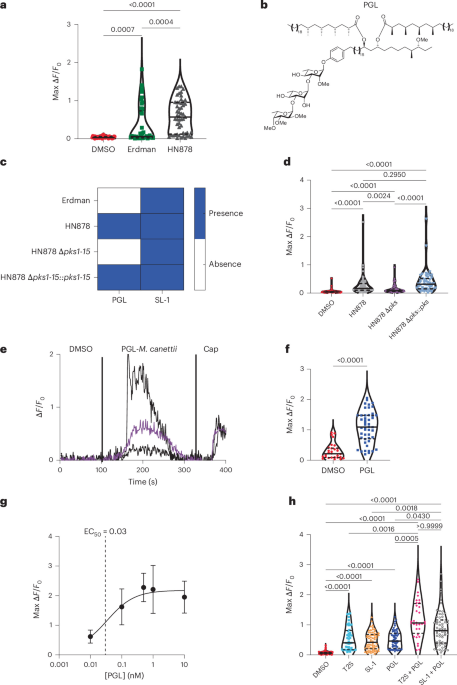
The study focused on lineage 2/Beijing strains of Mtb, which show a higher propensity for drug resistance, bacterial growth, and transmission frequency, pmc.ncbi.nlm.nih.gov reported. One representative strain, HN878, is considered hypervirulent because it produces PGL through the pks1–15 gene.
In laboratory tests, purified PGL elicited increased intracellular calcium in nociceptive neurons, Europe PMC stated. The lipid also triggered activation in primary mouse dorsal root ganglia and nodose ganglia neurons, as well as primary human DRG neurons, pmc.ncbi.nlm.nih.gov found. The MED17.11 neuronal cell line was cultured at 33 °C and 5% CO2 until differentiation before being used for live-cell calcium imaging.
When researchers exposed naïve guinea pigs to purified PGL, the substance was sufficient to induce the cough reflex, Europe PMC explained. This effect occurs because PGL stimulates the rapid release of extracellular ATP through pannexin channels, which then engages neuronal P2X3 purinergic receptors.
Mechanism of bacterial transmission
The research utilized organic synthesis to create various PGL analogs to study their activity, Europe PMC reported. These studies showed that neuroactivity is proportional to the structure and length of the saccharide chain, even though the full lipid chain is not required for the activation to occur.
The presence of both SL-1 and PGL appears to work cooperatively to activate neurons, pmc.ncbi.nlm.nih.gov stated. Because the signaling pathway relies on P2X3 receptors, the effect was blocked when researchers used a P2X3 antagonist, Europe PMC observed.
Identifying this pathway suggests that inhibiting purinergic signaling could serve as a potential strategy to block the airborne spread of Mtb, Europe PMC noted.
Researchers uncover PGL-driven cough mechanism
The hypothesis was driven by the observation that lineage 2 strains have a higher propensity for bacterial growth, drug resistance, and transmission frequency compared to other lineages, Europe PMC noted.
When naïve guinea pigs were exposed to purified PGL, the substance alone was sufficient to induce the cough reflex, confirming its role as a potent tussive agent.
ATP release and purinergic signaling mediate effect
The findings suggest that inhibiting this signaling cascade could serve as a strategy to block airborne transmission of Mtb.
Structure-activity relationship studies using synthetically derived PGL analogs showed that neuroactivity is proportional to the structure and length of the saccharide chain, while the full lipid chain is dispensable for activation, Europe PMC reported. The presence of both SL-1 and PGL appears to work cooperatively to potentiate neuronal activation, pmc.ncbi.nlm.nih.gov stated, indicating a combined mechanism that enhances the cough reflex in infections caused by PGL-producing strains.
Experimental methods
Mtb strains used in the study included Erdman, HN878, and HN878 Δpks1-15, as well as a complemented HN878 Δpks1-15::pks1-15 strain generated using a plasmid from the laboratory of M. Reed at McGill University. For experiments comparing surfactants, bacteria were grown with 0.05% Tween-80 or tyloxapol.
Lipids were extracted from 400 ml cultures grown to an optical density of 0.8–1.0 using a chloroform:methanol method at 58 °C for 16 hours, with equal pellet weights ensured across strains. Animal protocols were approved by the Institutional Animal Care and Use Committees at the University of Texas at Dallas and the University of Texas Southwestern Medical Center.
| Mtb Strain | SL-1 Production | PGL Production |
|---|---|---|
| HN878 | Yes | Yes |
| Erdman | Yes | No |
| H37Rv | Yes | No |
| CDC1551 | Yes | No |