
Musk vs. Bezos: The Battle for Lunar Dominance and Space-Based AI Infrastructure
Elon Musk’s SpaceX and Jeff Bezos’ Blue Origin are competing for NASA’s lunar landing contracts to establish a permanent moon base by 2028. This rivalry transcends space exploration, pivoting toward the deployment of orbital AI data centers to solve Earth-bound energy constraints and regulatory bottlenecks for high-compute infrastructure.
The fiscal reality of this “space race” is a brutal exercise in capital intensity. We aren’t just talking about rockets; we are talking about the colonization of the compute layer. The problem is that terrestrial AI scaling has hit a wall—specifically, the power grid. As hyperscalers struggle with energy procurement and zoning laws, the “off-planet” pivot becomes a strategic hedge against terrestrial operational risk. For the C-suite, this creates a massive vacuum in specialized aerospace insurance and regulatory compliance, forcing firms to engage top-tier international regulatory consultants to navigate the murky waters of the Outer Space Treaty and FCC spectrum allocations.
The momentum is undeniable. With the successful Artemis II flyby this month, the timeline for the Artemis III mission in mid-2027 is now the primary catalyst for valuation shifts in the private aerospace sector.
The Capex War: SpaceX’s Scale vs. Blue Origin’s Precision
SpaceX isn’t just a launch provider; it is a vertically integrated logistics monopoly. By dominating 85% of American orbital launches, Musk has achieved a cost-per-kilogram ratio that Blue Origin is still chasing. The Falcon 9 is the industry’s gold standard for reusable architecture, providing a level of liquidity in launch frequency that allows for rapid iterative testing. SpaceX’s Human Landing System (HLS), a 15-story behemoth, represents a high-risk, high-reward approach to lunar logistics.
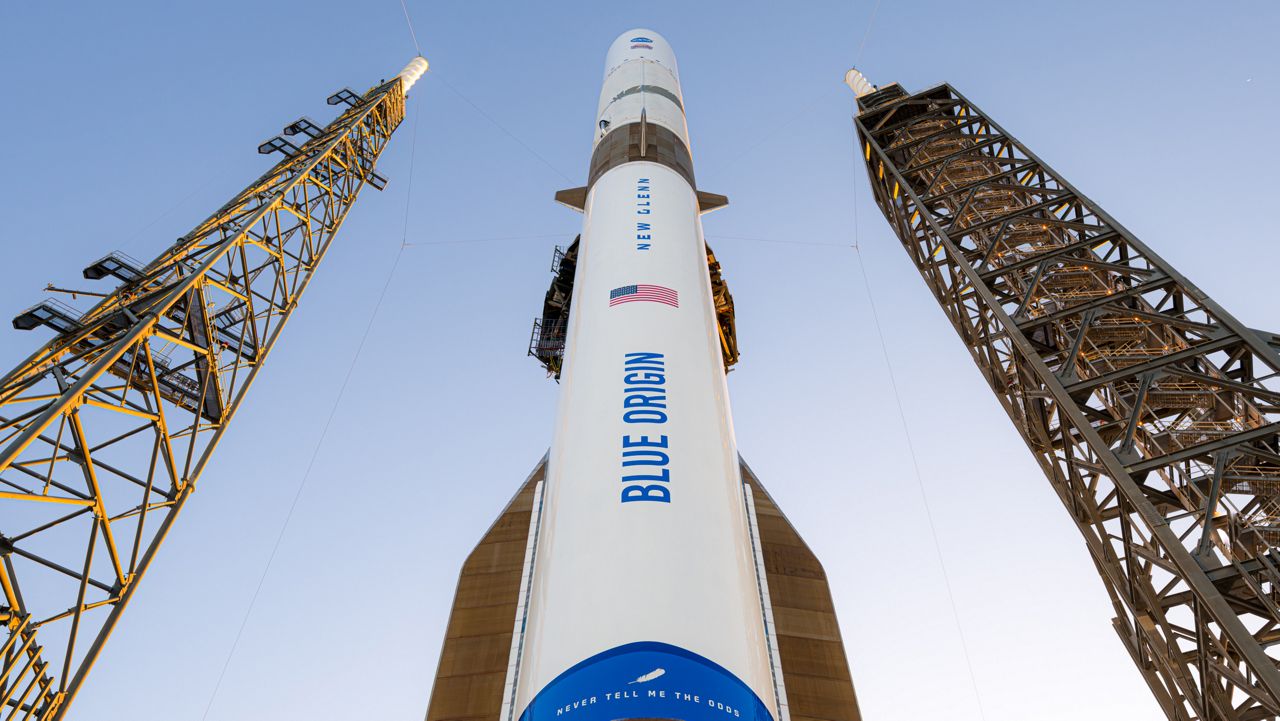
Bezos is playing a different game: the long-term infrastructure play. Blue Origin’s “slow and steady” mantra is essentially a strategy of risk mitigation. Their Blue Moon lander, equipped with advanced LIDAR for hazard avoidance, is designed for reliability over raw speed. From a balance sheet perspective, Blue Origin operates as a private equity venture with an almost infinite runway, funded by Bezos’ liquidation of Amazon shares. They aren’t chasing quarterly margins; they are chasing the “Blue Economy” of the lunar surface.
“The transition from Earth-based data centers to orbital compute is not a matter of ‘if,’ but a matter of energy arbitrage. When you remove the cost of cooling and the restriction of the terrestrial grid, the ROI on AI compute shifts exponentially.” — Marcus Thorne, Managing Director at Aegis Space Capital
The race to beat China’s 2030 lunar goal adds a geopolitical urgency that transforms these companies from mere contractors into strategic national assets. This elevates the need for specialized government procurement advisors who can manage the complexities of multi-billion-dollar NASA awards and the stringent audit requirements of the Federal Acquisition Regulation (FAR).
The Macro Shift: Orbital AI and the Compute Arbitrage
The most disruptive element of this rivalry isn’t the moon landing—it’s the filing for AI-capable satellites. SpaceX’s bid for 1 million satellites and Blue Origin’s request for 52,000 are not about communication; they are about distributed computing. By moving the “brain” of AI into orbit, these firms are attempting to bypass the “power wall” facing NVIDIA-dependent data centers on Earth.
- Energy Arbitrage: Space-based solar arrays provide unfiltered, 24/7 energy, eliminating the intermittency of terrestrial renewables and the carbon footprint of coal-heavy grids.
- Regulatory Hegemony: Orbital data centers exist in a legal gray zone, free from the “Not In My Backyard” (NIMBY) protests and zoning restrictions that currently plague AI build-outs in Virginia and Iowa.
- Latency Optimization: A distributed orbital compute layer could theoretically reduce latency for global AI inference, creating a modern tier of “Edge Computing” that operates at the atmospheric ceiling.
However, the financial hurdles are staggering. The cost of launching hardware remains an order of magnitude higher than building a warehouse in the Midwest. To bridge this gap, these firms are leveraging aggressive internal financing and strategic partnerships. According to recent FCC filings, the focus has shifted toward “compute-capable” constellations, suggesting a move toward a decentralized orbital cloud.
This shift creates a secondary market for high-reliability hardware. As the demand for space-hardened semiconductors grows, we are seeing a surge in B2B demand for precision aerospace engineering firms capable of producing chips that can withstand cosmic radiation and extreme thermal cycling.
The Bottom Line: Who Owns the Future Infrastructure?
If SpaceX wins the race to the moon, they don’t just win a contract; they establish the primary logistics pipeline for the next century of commerce. The ability to move cargo and humans reliably between Earth and the lunar surface is the ultimate “moat.” Blue Origin, however, is positioning itself as the “utility company” of space—building the foundational infrastructure that others will eventually pay to use.

The risk is systemic. A single catastrophic failure during the Artemis III docking tests in 2027 could trigger a massive re-evaluation of private space valuations and a pivot back to state-led exploration. But for the institutional investor, the play is clear: the integration of AI and aerospace is the new frontier of the “Industrial Revolution 4.0.”
The winners will be those who can synchronize their capital expenditures with the rapid evolution of AI model efficiency. We are moving toward a world where the “cloud” is no longer a metaphor for a server farm in the desert, but a literal description of where our data resides. For enterprises looking to hedge against this volatility or enter the supply chain, the only move is to secure vetted partners. Whether you are seeking legal counsel for space law or engineering for orbital hardware, the World Today News Directory remains the definitive source for identifying the B2B entities capable of scaling at the speed of the cosmos.