
## Satellites Optimize Task Management via Edge Computing
New system aims for efficient resource use and faster processing through satellite networks.
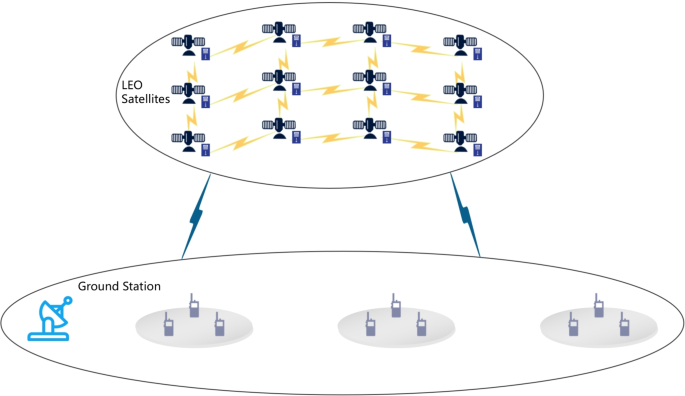
The task of managing resources efficiently in satellite networks may have a solution. A novel system employs edge computing via LEO satellites. This system optimizes task processing, improves completion rates, and balances load within the satellite cluster, all while maintaining user quality of service.
### Satellite Network Model
The satellite network is represented mathematically. Satellites act as nodes, and inter-satellite connections are edges. The positions and connections of these nodes change over time. The satellite network topology is defined as (G=left( V,E,W_Vleft( tright) ,W_Eleft( tright) right)). Here, (V=(V_1,V_2,cdots ,V_n)) is the set of satellite nodes, and (E=(e_{11},e_{12}, cdots , e_{nn})) represents the links between satellites. (W_V(t)=left{ w_{v_i}left( tright) | v_iin Vright}) describes the weight attributes of the nodes, like resource type and capacity. (W_E(t)=left{ w_{e_{ij}}left( tright) | e_{ij}in Eright}) represents the weight attributes of the links at time t. The dynamic nature of satellite networks requires a method to address topology changes.
To simplify this, time slicing divides the network into discrete time slots. Within each slot, the topology is considered static, enabling effective task offloading. This approach reduces the complexity of task management.
### Resource Allocation
Each satellite node is defined by a five-tuple: (V_i=left( ID,f_c,R_c,R_s,R_Lright)). ID is the unique identifier, (f_c) is the computing speed, (R_c) is the computing resource capacity, (R_s) is the storage capacity and (R_L) describes the connections between nodes, shown as a matrix.
### Task Modeling
The model handles large-scale task offloading requests originating from multiple terminals. A sequence of task requests is represented as (Tasks=left{ T_1,T_2,cdots ,T_mright}). Each task is indivisible and characterized by a seven-tuple: (T_i=left{ P,Data,T_C,T_S,T_L,T_{start},T_{dl}right}). Here, P is the task priority, Data is the data size, (T_C) is the computational resources needed, (T_S) is the storage resources, (T_L) is the link resources, (T_{start}) is the start time, and (T_{dl}) is the maximum tolerable latency.
### Task Offloading Optimization
Task offloading assigns tasks to suitable satellite nodes. Latency considerations are crucial. The computation latency for satellite j to process task i is (T_{i,proc}^j=frac{T_{C,i}}{f_{j,i}}+T_{i,que}). Transmission latency from terminal i to satellite j is (T_{i,trans}=frac{{Data}_i}{r_{T_i,V_j}^{uplink}}). Thus, total processing latency is (T_{i,total}=T_{i,proc}^j+T_{i,trans}^j).
### Constraints and Resource Management
Resource node constraints ensure that ECS nodes have sufficient resources. Link bandwidth constraints prevent exceeding link capacity. Response time constraints ensure tasks complete within their maximum latency. Satellite visibility time constraints limit offloading to satellites currently covering the region during the time slice. System resource utilization is defined as (Rate_{total}=alpha Rate_C+beta Rate_S+gamma Rate_L), where (alpha), (beta), and (gamma) are weights for computational, storage, and link resources, respectively.
Load balancing, denoted as (r_{lb}), quantifies resource utilization uniformity, ranging from 0 to 1. The optimization problem minimizes task processing latency, maximizes resource utilization, and maximizes load balancing. The reward function is (Reward=-alpha T_{i,total}^*+beta Rate_{total}+gamma r_{lb}), with weights (alpha) = 0.4, (beta) = 0.3, (gamma) = 0.3.
According to a 2023 report by the European Space Agency, optimizing resource allocation and task management in satellite networks is becoming increasingly critical as the volume of data transmitted and processed in space continues to grow exponentially (ESA 2023).
### Outlook
This innovative approach enhances satellite network performance, balancing resource use and quick task completion.
