
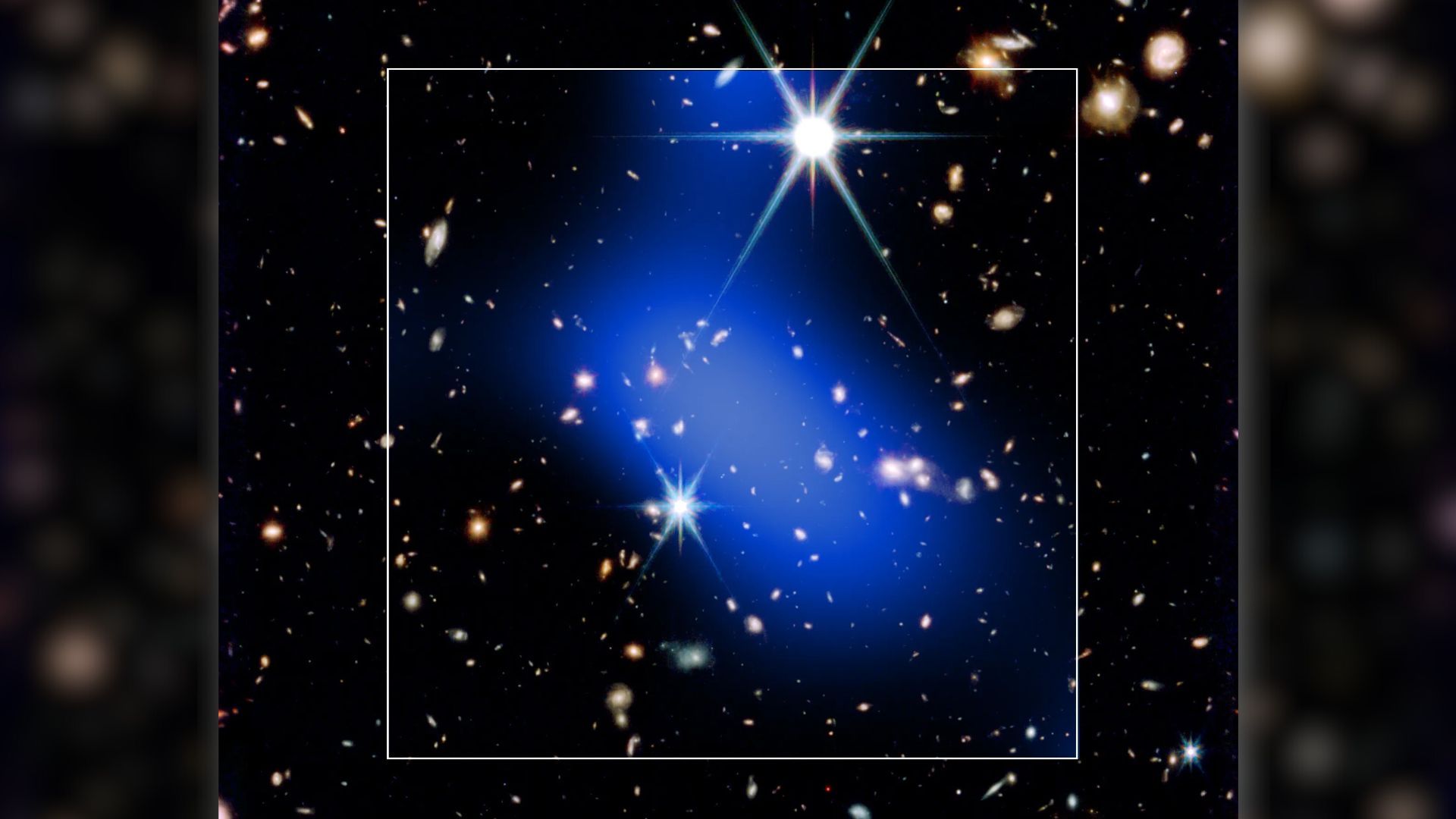
Astronomers have identified a remarkably mature protocluster of galaxies, dubbed JADES-ID1, existing just one billion years after the Big Bang, a finding that challenges current cosmological models. The discovery, announced February 15, 2026, suggests the universe may have accelerated its developmental pace earlier than previously understood.
Located 12.7 billion light-years from Earth, JADES-ID1 appears as a collection of glowing galaxies embedded within a large cloud of hot gas. The protocluster’s existence was confirmed through combined observations from the James Webb Space Telescope (JWST) and the Chandra X-ray Observatory. JWST’s infrared capabilities detected at least 66 galaxies gravitationally bound within the region, while Chandra identified X-ray emissions from the surrounding heated gas, solidifying the structure as a single, coalescing entity.
The mass of JADES-ID1 is estimated at 20 trillion times that of our sun, spanning approximately 1.1 million light-years. This size and mass present a significant anomaly. Existing models predict that protoclusters of this magnitude should not have formed until between 2 and 3 billion years after the Big Bang, leaving scientists questioning the mechanisms driving its rapid development.
“This may be the most distant confirmed protocluster ever seen,” said Akos Bogdan, lead author of the study and researcher at the Harvard & Smithsonian Center for Astrophysics (CfA), in a statement. “JADES-ID1 is giving us new evidence that the universe was in a huge hurry to grow up.”
Protoclusters, as opposed to fully formed galaxy clusters, represent an earlier stage of galactic development. While mature clusters exhibit tightly packed galaxies, protoclusters feature galaxies more loosely connected, surrounded by gas not yet hot enough to emit easily detectable X-rays. This makes identifying protoclusters particularly difficult, requiring the combined power of instruments like JWST and Chandra.
The discovery of JADES-ID1 is prompting further investigation into the conditions of the early universe and the processes that governed the formation of large-scale structures. Astronomers are now focused on understanding how such a massive protocluster could have assembled so quickly, given the limited time and number of galaxies available in the universe’s infancy. The findings were published January 28, 2026, in the journal Nature.
