
iSpace Plans New Lunar Missions After Initial Setback; ESA’s FLYEYE Telescope Scans for Asteroids
Table of Contents
- iSpace Plans New Lunar Missions After Initial Setback; ESA’s FLYEYE Telescope Scans for Asteroids
- iSpace Forges Ahead with Lunar Ambitions
- ESA’s FLYEYE Telescope: A Sentinel Against Asteroid Threats
- Milky Way and Andromeda Collision: A Revised timeline
- Key Space Exploration Milestones
- Evergreen Insights: The Broader Context of space Exploration
- Frequently Asked Questions about Space Exploration and Planetary Defense
Japanese company iSpace is undeterred after its initial lunar landing attempt failed on June 5.The company plans to launch another lunar lander in 2026, followed by a subsequent mission in 2027. Concurrently, the European Space Agency (ESA) has launched NEOSTEL, more widely known as FLYEYE, a new telescope in Italy designed to detect asteroids and comets that could pose a threat to Earth.
iSpace Forges Ahead with Lunar Ambitions
Despite the initial setback, iSpace is committed to lunar exploration. In addition to the planned lander missions, iSpace is among the companies selected by the Japan Aerospace Exploration agency (JAXA) to develop a satellite that will orbit the Moon and map ice deposits. These deposits could potentially be used to produce water and oxygen on-site for future lunar missions.
Did You Know? NASA’s Artemis program also aims to establish a long-term human presence on the Moon, with plans for lunar habitats and resource utilization.
ESA’s FLYEYE Telescope: A Sentinel Against Asteroid Threats
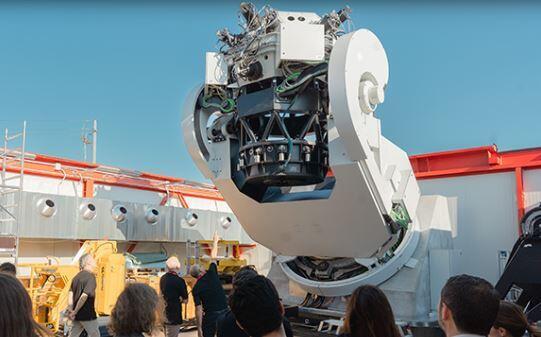
The Near Earth Object Survey Telescope (NEOSTEL), nicknamed FLYEYE, is now operational in Italy. This telescope is designed to scan the skies for near-Earth objects (NEOs) that could potentially impact our planet. FLYEYE’s unique design, inspired by an insect’s compound eye, allows it to survey a wide area of the sky with high sensitivity.
Equipped with a one-meter primary mirror,FLYEYE efficiently collects light and splits it into 16 channels,each connected to a high-sensitivity camera. This advanced system enables the telescope to detect faint objects as small as a few dozen meters across. FLYEYE’s 45-square-degree field of view is approximately 200 times larger than the apparent size of the full Moon, allowing it to scan nearly the entire visible sky each night.
Image processing is fully automated, with potential findings reviewed by astronomers for verification. Confirmed detections are forwarded to ESA’s near-Earth Object Coordination Centre, and details of newly identified objects are reported to the IAU Minor Planet Center, the international authority for tracking potentially hazardous space objects.
Pro Tip: Citizen science projects like Asteroid Zoo allow volunteers to help astronomers identify asteroids in telescope images.
After initial testing in Matera, Italy, FLYEYE will be moved to the Monte Mufara Observatory in Sicily. ESA plans to expand the FLYEYE network with three additional telescopes at sites around the world, providing comprehensive sky coverage for early detection of potential Earth-impact threats.
“The earlier we spot potentially hazardous asteroids, the more time we have to assess them and, if necessary, prepare a response,” said Richard Moissl, Head of ESA’s Planetary Defence Office. “ESA’s Flyeye telescopes will be an early-warning system, and their discoveries will be shared with the global planetary defence community.”
Milky Way and Andromeda Collision: A Revised timeline
While the cosmos holds potential threats, it also presents grand, slow-motion events. For decades, scientists believed that the Milky Way and Andromeda galaxies were destined for a head-on collision in approximately 4.5 billion years.Though, a recent study based on data from the Hubble and Gaia space telescopes suggests that this collision may not be inevitable.
The study indicates that there is only a 50 percent chance that the two galaxies will collide within the next 10 billion years. till Sawala of the University of helsinki, along with physicists from the UK, France, and Australia, led the research, examining 22 variables influencing galactic motion and using computer simulations to model possible scenarios.
“Because there are so many variables that each have their errors, that accumulates to rather large uncertainty about the outcome, leading to the conclusion that the chance of a direct collision is only 50% within the next 10 billion years,” Sawala explained.
The gravitational influence of satellite galaxies, such as the Large Magellanic Cloud orbiting the Milky Way and M33 orbiting Andromeda, further complicates the calculations. These satellite galaxies exert a gravitational tug-of-war that could ultimately prevent a direct collision.
In half of the simulations, the galaxies miss each other by more than 500,000 light-years. If a collision does occur, it could trigger new star formation and accelerate the demise of existing stars. However, this event is unlikely to affect our Sun directly, as it is expected to become a red giant in about 5 billion years.
Key Space Exploration Milestones
| Organization | Mission | Target Date | Objective |
|---|---|---|---|
| iSpace | Lunar Lander Mission | 2026 | Soft landing on the Moon |
| iSpace | Lunar Lander Mission | 2027 | Further lunar exploration |
| JAXA & iSpace | Lunar Orbiting Satellite | TBD | Map lunar ice deposits |
| ESA | FLYEYE Telescope Network Expansion | TBD | Global sky coverage for NEO detection |
what are your thoughts on the future of space exploration and planetary defence? How should resources be allocated between these two critical areas?
Evergreen Insights: The Broader Context of space Exploration
Space exploration has evolved from a Cold War-era race to a collaborative, multi-national endeavor. Private companies like iSpace are playing an increasingly important role, driving innovation and reducing costs. planetary defense, once a fringe topic, is now recognized as a critical area of research and development, with telescopes like FLYEYE serving as sentinels against potential asteroid impacts. The ongoing exploration of the Moon and the study of NEOs are essential for understanding our place in the universe and protecting our planet.
Frequently Asked Questions about Space Exploration and Planetary Defense
- What is iSpace’s primary goal?
- iSpace aims to provide commercial lunar transportation services and contribute to the development of a lunar economy.
- How does the FLYEYE telescope detect asteroids?
- The FLYEYE telescope uses a wide-field camera system to scan large areas of the sky, detecting faint objects that could be asteroids or comets.
- What is the purpose of mapping ice deposits on the Moon?
- Mapping ice deposits on the Moon is crucial for identifying potential sources of water,which can be used for life support,fuel production,and other resources for future lunar missions.
- What are the potential consequences of a Milky Way-Andromeda collision?
- A Milky Way-Andromeda collision could trigger new star formation, alter the structure of both galaxies, and potentially eject stars from their orbits.
- How is planetary defense being addressed globally?
- Planetary defense is being addressed through international collaborations,such as the International Asteroid Warning Network (IAWN) and the Space Mission Planning Advisory Group (SMPAG),which coordinate efforts to detect,track,and characterize NEOs.
- What technologies are being developed for planetary defense?
- Technologies being developed for planetary defense include advanced telescopes for NEO detection, spacecraft for asteroid deflection, and impact modeling software for assessing potential threats.
- Why is early detection of potentially hazardous asteroids important?
- Early detection of potentially hazardous asteroids allows for more time to assess the threat and, if necessary, develop and implement mitigation strategies, such as asteroid deflection missions.
Stay informed about the latest developments in space exploration and planetary defense. Share this article and join the conversation!
