Monkeypox Virus Clade IIb and Lineage Co-circulation in Republic of the Congo
The detection of monkeypox virus (MPXV) clade IIb lineage A.2.2 in the Republic of the Congo marks a critical pivot in the epidemiological landscape of Central Africa. This discovery, confirmed through whole-genome phylogenetic analyses, reveals a complex co-circulation of three distinct viral lineages that heightens the risk of genomic instability and novel viral evolution.
Key Clinical Takeaways:
- Laboratory confirmation of MPXV clade IIb lineage A.2.2 in Pointe-Noire indicates the expansion of a lineage previously emerging in West Africa, specifically Sierra Leone.
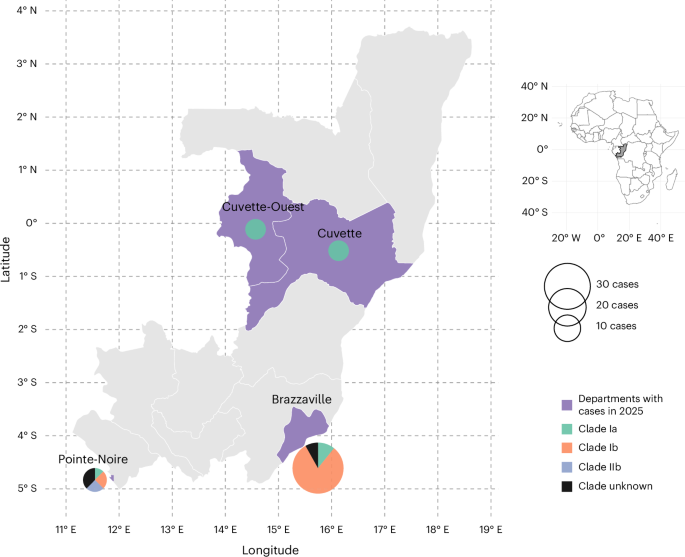
- Passive surveillance in 2025 identified the simultaneous presence of clade Ia (16 cases) and clade Ib (32 cases), alongside clade IIb, in the Republic of the Congo.
- The World Health Organization has already documented recombinant strains comprising clade Ib and IIb genomic elements in the United Kingdom and India, signaling a tangible risk of viral recombination.
The current clinical challenge is not merely the presence of a single strain, but the overlap of multiple clades within a single geographic population. According to a study published in Nature Medicine on April 3, 2026, the identification of clade IIb in Pointe-Noire—the second largest city in the Republic of the Congo—establishes a dangerous precedent for regional viral diversity. This environment creates a biological “mixing bowl” where the pathogenesis of the virus could be altered through recombination.
The Mechanism of Viral Recombination and Genomic Risk
Recombination occurs when two related viruses infect the same individual, allowing them to exchange genetic material and produce a new, hybrid strain. This represents not a theoretical risk. the World Health Organization (WHO) has already reported two cases of a recombinant strain combining clades Ib and IIb. The first case was detected in the United Kingdom in December 2025, involving a patient with travel history to South-East Asia. A second case in India, originally detected in September 2025, was retrospectively reclassified as a closely related recombinant strain after sequencing data became available.
“Recombination is a known natural process that can occur when two related viruses infecting the same individual exchange genetic material, producing a new virus.” — World Health Organization (WHO)
The fact that these two individuals, separated by months and geography, fell ill with the same recombinant strain suggests that these hybrid viruses may be circulating more widely than currently reported. While the clinical presentation in these cases remained similar to other clades and did not result in severe outcomes, the potential for such events to alter the morbidity or transmissibility of the virus remains a primary concern for global health security.
Epidemiological Shifts: From South Kivu to Pointe-Noire
The movement of these clades reflects a broader shift in the viral geography of Africa. As detailed in the New England Journal of Medicine, MPXV clade Ib emerged in South Kivu, Democratic Republic of Congo, in 2023, characterized by a rapid eastward spread. The subsequent identification of 32 cases of clade Ib in the Republic of the Congo via passive surveillance in 2025 demonstrates the efficient regional transmission of this specific subclade.
The addition of clade IIb lineage A.2.2—a lineage currently emerging in West African nations like Sierra Leone—into the Republic of the Congo complicates the diagnostic picture. Historically, clade I was the dominant force in Central African nations including the Republic of the Congo, Gabon, and Cameroon, while clade II was largely observed in West African nations such as Nigeria and Ghana. The erosion of these geographic boundaries means that clinicians can no longer rely on regional assumptions to predict the clade of an infection.
Managing this complexity requires a shift in the standard of care. For clinicians facing an increase in atypical presentations or suspected poxvirus infections, immediate consultation with board-certified infectious disease specialists is essential to ensure that treatment protocols are aligned with the specific clade’s behavior.
Surveillance Gaps and the Need for Molecular Precision
The reliance on passive surveillance in 2025—which captured 16 cases of clade Ia and 32 cases of clade Ib—highlights a significant vulnerability in current public health infrastructure. Passive systems only capture cases that are reported by clinicians, often missing a substantial portion of the actual viral burden. The discovery of clade IIb in Pointe-Noire was only possible through whole-genome phylogenetic analysis, a high-resolution tool that identifies specific lineages and mutations.
Strengthening regional capacity for case detection and contact tracing is an urgent priority. The ability to distinguish between clade Ia, Ib, and IIb is not just an academic exercise; It’s a clinical necessity for monitoring the emergence of recombinant strains. This requires a robust partnership between government health agencies and advanced molecular diagnostic centers capable of performing rapid genomic sequencing.
“The detection of clade IIb mpox marks the third distinct MPXV clade and lineage co-circulating in the human population… This underscores the need for improved surveillance and diagnostic strategies.” — Nature Medicine
The WHO maintains a moderate public health risk assessment for men who have sex with men with new or multiple partners and for sex workers, while the risk remains low for the general population without specific risk factors. However, the potential for recombination events could theoretically shift these risk profiles, making the role of public health consultants critical in designing adaptive containment strategies.
The Path Toward Regional Stabilization
Reducing the global risk posed by both clade I and clade II MPXV depends on the rapid deployment of affordable vaccines and the scaling of diagnostic accessibility. The co-circulation of three lineages in the Republic of the Congo serves as a warning: the virus is evolving, and its geographic footprint is expanding. The clinical community must move toward a model of proactive genomic surveillance rather than reactive case reporting.
As we monitor the potential for further recombinant strains, the priority must remain the integration of high-resolution sequencing into routine clinical workflows. The ability to identify a lineage like A.2.2 in real-time will be the difference between a contained outbreak and a widespread epidemic. To ensure the highest standard of patient care and public safety, healthcare providers are encouraged to utilize vetted medical directories to connect with the diagnostic and specialized expertise required to manage these evolving viral threats.
Disclaimer: The information provided in this article is for educational and scientific communication purposes only and does not constitute medical advice. Always consult with a qualified healthcare provider regarding any medical condition, diagnosis, or treatment plan.