
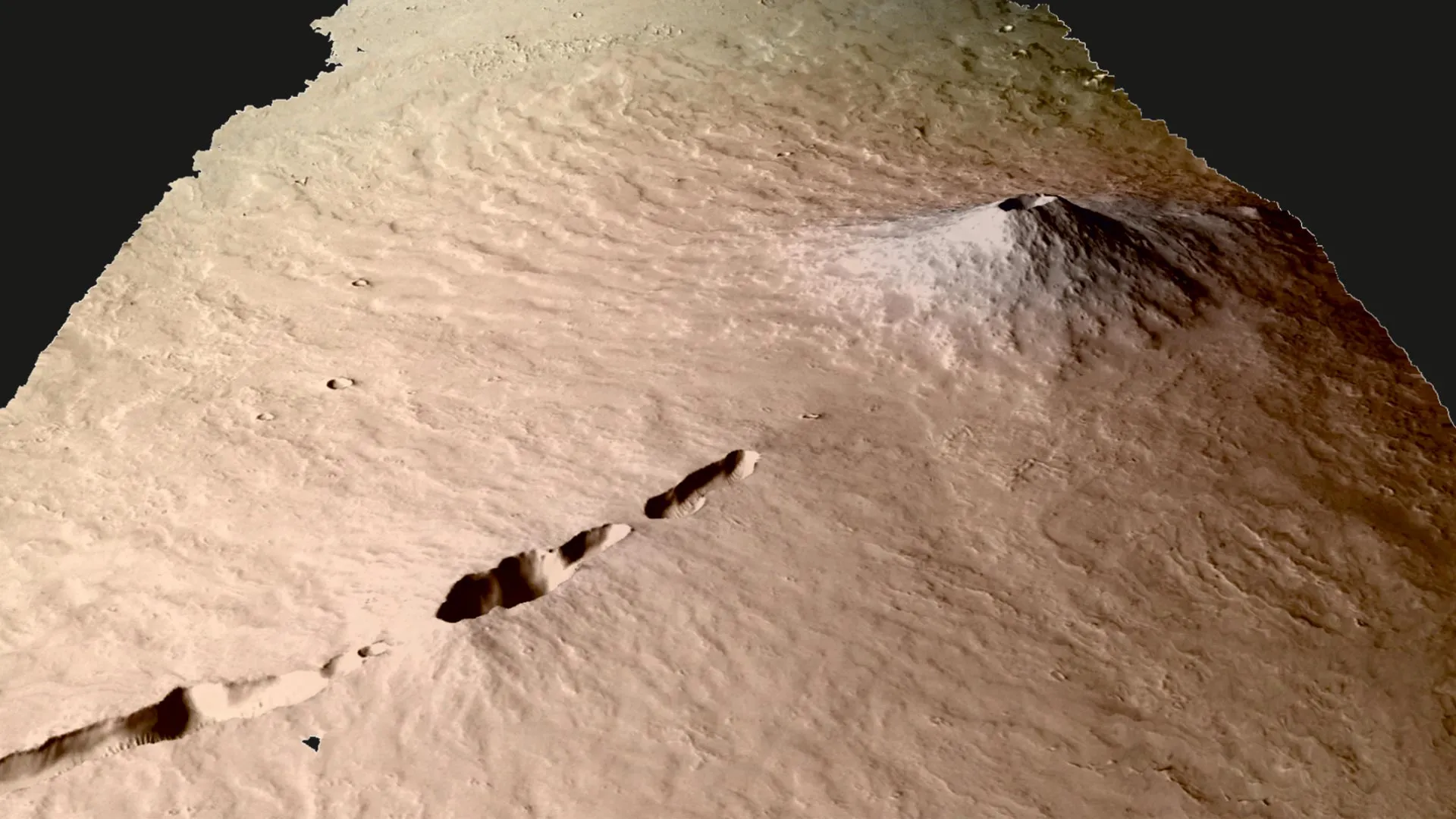
Recent analysis of Martian volcanic landscapes reveals a more complex history than previously understood, suggesting that some of the planet’s youngest volcanic regions were not formed by single, brief eruptions, but by magma systems that remained active and evolved over extended periods.
An international team of researchers, including scientists from Adam Mickiewicz University in Poznań and the University of Iowa, focused their study on a volcanic system south of Pavonis Mons, one of the largest volcanoes on Mars. By combining detailed surface mapping with mineral data collected by orbiting spacecraft, the team reconstructed the volcano’s development and the underlying magma system with precision.
“Our results show that even during Mars’ most recent volcanic period, magma systems beneath the surface remained active and complex,” said Bartosz Pieterek of Adam Mickiewicz University. “The volcano did not erupt just once – it evolved over time as conditions in the subsurface changed.”
The research indicates the volcanic system progressed through distinct phases. Initial activity involved lava flowing from fissures, followed by eruptions from focused vents that built cone-shaped features. Despite the differing appearances of these lava deposits, they were all supplied by the same underlying magma reservoir. Each phase left behind a unique mineral signature, allowing researchers to track changes in the magma’s composition over time.
“These mineral differences tell us that the magma itself was evolving,” Pieterek explained. “This likely reflects changes in how deep the magma originated and how long it was stored beneath the surface before erupting.”
The findings are particularly significant because scientists currently lack the ability to directly collect rock samples from Martian volcanoes. This study demonstrates the power of orbital observations in uncovering the hidden structure and long-term evolution of volcanic systems, not only on Mars but also on other rocky planets. Understanding the behavior of magma is crucial to understanding the explosiveness of volcanic eruptions, as gas bubbles within magma play a key role, according to research on Earth’s subduction zones and explosive volcanic eruptions.
Tremor activity, which provides insights into magma movement, is also a key area of study for scientists seeking to better understand volcanic activity on Earth and potentially on Mars, according to recent research.
