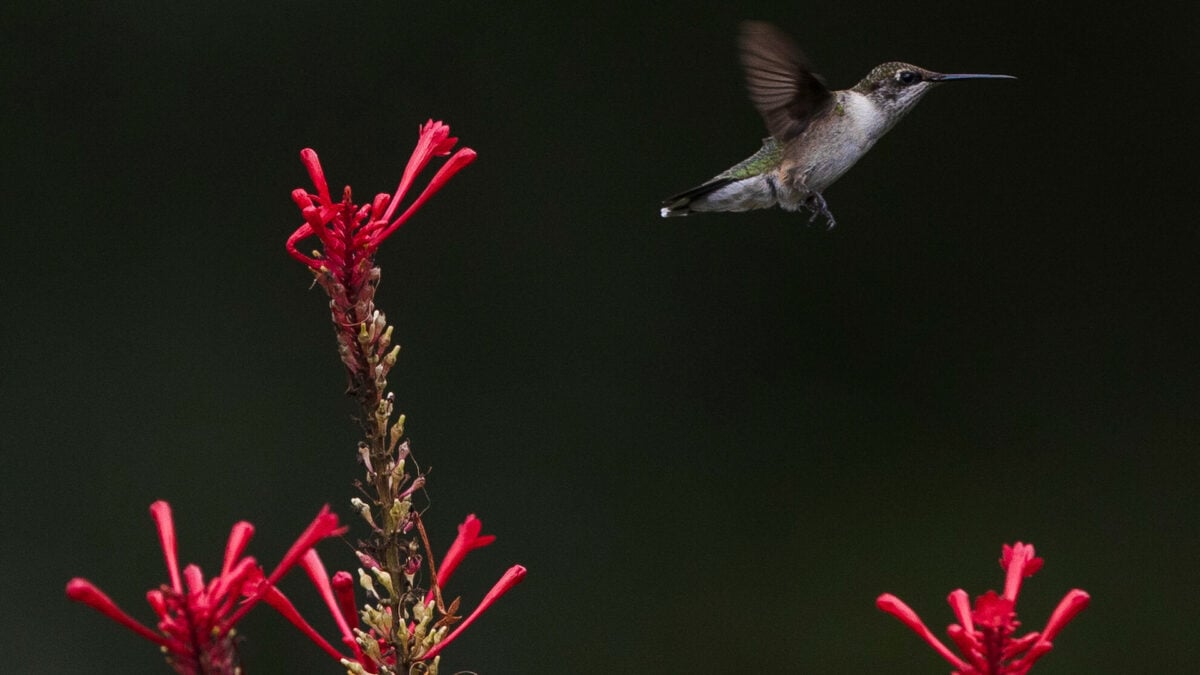
Male Rufous Hummingbird Flies 4,055 Miles Alabama to Alaska, Longest Recorded Track
A male Rufous hummingbird flew 4,055 miles from Alabama to Alaska in 38 days, the longest migration track ever recorded for a hummingbird, researchers reported Thursday.
- The BlūMorpho transmitter weighs 0.06 grams and uses solar-powered Bluetooth signals relayed by nearby smartphones.
- Eleven hummingbirds were tagged in coastal Alabama and Florida during spring 2025.
- The previous record was a 3,500-mile straight-line distance between a banded bird in Florida and its recapture in Alaska in 2010.
- Researchers documented 23,784 location points across 23 U.S. states, Mexico and Canada.
The journey, reconstructed from Bluetooth detections picked up by phones and other devices on a compatible network, began March 27, 2025, when the bird was released in Lillian, Alabama, and ended with its last detection in Juneau, Alaska, on May 3, according to the study published Nov. 16 in Ecology and Evolution.
The cumulative track totaled 6,526 kilometers, while the straight-line distance between endpoints was 4,730 kilometers. The authors’ record claim compares two different kinds of distance. The researchers presumed it was breeding in Juneau; they did not confirm that.
“With both Rufous and Ruby-throated Hummingbirds experiencing recent population declines, this new technology will provide critical insights for species management, conservation, and to understand the current population shifts,” the authors wrote in the study.
The BlūMorpho transmitter, developed by a team led by Emma M. Rhodes of the University of Memphis, weighs 0.06 grams — about 0.002 ounces — and carries no battery, relying on a tiny capacitor to store solar energy for transmissions every three seconds. Tags were glued to trimmed feathers between the birds’ shoulders and kept at no more than 3% of each bird’s body mass.
The transmitter carries no battery and stores no onboard data. When there is enough light, it broadcasts a unique signal every three seconds. Bluetooth and location services must be switched on. These devices relay detections with their own GPS coordinates. The bird brings the signal; nearby electronics handle the location reporting. Coverage therefore favors more populated places.
Researchers attached transmitters to four Rufous and seven Ruby-throated hummingbirds. The devices emit a unique Bluetooth signal detectable by compatible smartphones, tablets or computers within about 200 meters, which then relay the location data anonymously to an online database. This “Internet-of-Things” approach allowed near real-time tracking without recapturing the birds, the study abstract states.
The data revealed individual variation in migration routes. Another Rufous hummingbird made a 214-mile loop through Tennessee and Missouri before heading east, while a Ruby-throated hummingbird flew southeast from Alabama into Florida instead of following the expected northward path. Two other Ruby-throated birds traveled north along remarkably similar routes.
“Currently, it is not longevity of the unit itself that is a limitation but retention time on the individual,” the study authors wrote. The paper also notes it was not designed to quantify potential behavioral, physiological or survival effects of the transmitters and attachment. Keeping tags attached is another obstacle. Immediate post-release observations could not establish longer-term effects. The 3% attachment limit is a protocol, not a safety verdict.
Several coauthors are affiliated with Cellular Tracking Technologies, which manufactures the BlūMorpho and supported the research alongside the Banding Coalition of the Americas. The authors declared no conflicts of interest.