
Ancient Human Ancestors Were Leopard Prey, AI Reveals
New research published September 16, 2025, in the Annals of the New York Academy of Sciences confirms that Homo habilis, one of the earliest species in the human genus, was likely preyed upon by leopards. The study utilizes artificial intelligence (AI) to analyze ancient human fossils, shedding light on the dangers faced by our ancestors.
For years, scientists have suspected that Homo habilis was vulnerable to attacks from predators like lions, crocodiles, and leopards, based on bite marks found on fossilized bones. Tho, definitively identifying the animal responsible proved arduous using customary methods.Physical examination of bones often lacks the detail needed to distinguish between the bite patterns of different species, leading to only general conclusions.
This new research overcomes that limitation through the power of AI. Professor Manuel Domínguez-Rodrigo of the University of Alcalá, Spain, and Rice University, Texas, and his team employed computer vision technology trained on hundreds of bite mark examples from modern carnivores – hyenas, crocodiles, and leopards. The AI model achieved over 90% accuracy in identifying the animal based on bite patterns in blind tests.
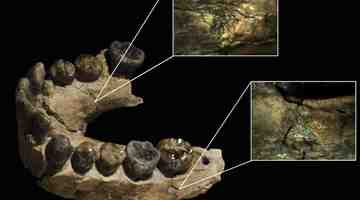
The team focused on two well-preserved Homo habilis fossils discovered in Olduvai Gorge, Tanzania: OH 7, a young individual dating back 1.85 million years, and OH 65, an adult from around 1.8 million years ago. AI analysis of these fossils revealed bite marks consistent with leopards on the lower jaw of OH 7 and the upper jaw of OH 65.
This finding, combined with the limited skeletal remains of both individuals, suggests they were not merely attacked, but consumed by the predator.Domínguez-Rodrigo explains that the leopard likely targeted these individuals because they were fresh kills. “If another predator preys on them frist, the leopard will no longer be interested, because this animal only eats fresh meat.”
Specifically, the damage to OH 7’s mandible suggests the leopard tore away flesh and the tongue, indicating a deliberate attempt to consume the entire body – “clear evidence of consumption, not just a bite to kill.”
This research underscores a crucial point: before humans became dominant, we were vulnerable members of the food chain. It highlights the constant life-or-death struggle faced by our ancestors and demonstrates how the threat of predators shaped early human survival instincts. Thanks to advancements in AI, we are now able to reconstruct this past with greater clarity, revealing the harsh realities of prehistoric life.
