

The story of Kofola began to be written long before her name appeared on the stock terminals. This winter, ten years have passed since the domestic manufacturer of iconic lemonade entered the Prague Stock Exchange.
For investors from 2015, however, it was a test of patience. The shares of Kofola have been under the price of 510 crowns for years, for which the company entered the stock exchange. Only this summer brought a breakthrough – the shares climbed to their maximum and for the first time exceeded the level of primary subscription. The brand thus celebrates not only among customers on the shelves of shops, but also among investors.
“In the first seven years, Kofola was undergoing a relatively difficult period. She faced an increase in the prices of inputs, especially sugar, and the financial results continued to negatively affect the long -term loss of business in Poland,” recalls Vladimir Vávra, broker from Wood & Company.
Similarly, the stock analyst Jan Raška from Fio banka also recalls. “The shares of Kofola have been on the Prague Stock Exchange for ten years. It was interesting and often, not always due to society itself, a miserable journey.”
The first stock chapter in Poland
Table of Contents
The journey of Kofola to the Prague Stock Exchange was definitely not straightforward. The company has made its first experience with the stock market in Poland. In 2003, the Polish Lemonade company Hoop entered the Warsaw Stock Exchange, which later became part of the Kofola group.
The combination of both companies came in 2008 and the newly established group Kofola-Hoop remained flinoped in Warsaw. Poland was to be a gate for growth in Central Europe. But after the world financial crisis, it turned out that the market was not as profitable as Kofola expected. Therefore, the company again began to concentrate mainly on the Czech Republic and Slovakia.
“The Polish market has been loss -making for a long time and has become one of the main brakes of Kofola,” Vávra says. And when it finally seemed that the company was going on to better tomorrows, it was hit by the Covid Pandemie. “It was essential for the company. For almost two years, the segment of hotels, restaurants and catering – a key segment of Kofola,” adds the broker.
Move to Prague
The fundamental turnover occurred in 2015. Kofola underwent restructuring, a new holding structure of Kofola Czechoslovakia was created and gradually withdrew from the Warsaw Stock Exchange, but also the local market as such. On December 2, 2015, she started trading in Prague.
“The entry to the Prague Stock Exchange was actually just moving from Warsaw, where our society was scared several years before,” explains CEO Daniel Buryš. “It was the requirement of our Private Equity shareholder, who eventually sold a larger part of his share over the market. I will not evaluate how successful it, but this reason in the public market has met its goal,” he adds.
The primary subscription of the shares was not a big show. The company offered a total of 1.5 million shares, of which only a smaller part – about 275 thousand pieces – represented newly issued shares that raised money for further development. Most of the shares in the offer were sold by the then shareholder, the Private Equity Fond Enterprise Investors, which partially emerged from his investment.
But Free Float, a volume of publicly traded shares, was only six to seven percent, causing poor liquidity. Therefore, the following years were not easy for shares. The price gradually fell to two hundred before 2020.
“The financial world is evaluated by numbers and the course has been a decade below the surface. Kofola is not a big title and the initial volume of publicly traded shares was very low. This caused poor liquidity. In addition, we could not ‘resuscitate’ the business in Poland and did not bring the expected growth.
And when Burys “finally” there was an increase in Free Float to today’s 27 percent, the pandemic came and the markets flew down again. “And we lost up to half of the original value,” he recalls.
Yet, according to the analyst Raška of Fio banka, the company managed relatively steadily. “It should be noted that the farming of Kofola itself did not pass through any deep slumps in this difficult period. On the contrary, it showed more or less stability. Kofola, up to 2022, also held a stable dividend,” he adds.
Wood & Company Vávra praises the management of the company that has been able to respond quickly. “Management has successfully navigated. It was able to quickly adjust the costs and changed trends in consumers’ consumers flexibly reflect the innovations of the product portfolio, such as the success of the UGO Salatery or the acquisition of Leros Tea manufacturer.”
Turn for the better
Since 2021 the card has turned. The shares of Kofola began to rise, helped the return of demand and successful acquisitions. “Another milestone is the disappearing of the crisis period and macroeconomic stabilization. And we are already in 2023, when we see a very solid increase in the profitability of Kofola,” says Raška.
According to Daniel Buryš, the company has been doing not only in the traditional Czechoslovak non -alcoholic business, but also in new areas.
“We are meaningfully adding other acquisitions – breweries or coffee. We manage challenges of today’s world and grow healthy. And what is positive, we regularly pay dividends,” he says. Moreover, the current share of free -tradable shares attracted more institutional and small investors.
“The development of the shareholders’ structure is joy, when we grew up on the current 16,000 shareholders of the number of low thousands. Kofola is more suitable for minor domestic shareholders.
At the same time, he admits that the company has not yet needed large acquisitions. “We are quite easy to finance the growth of cheaper banking financing. But mainly we consider the price of our shares still undervalued. In such a situation, the issue of other shares would be disadvantageous for existing shareholders. We would simply sell them on the market under real value,” he explains.
On the other hand, the Kofole exchange also brings a significant benefit. “It is a high responsibility to shareholders. This is associated with significant pressure on improving, growth, innovation and transparency. We openly present every quarter of what we have succeeded and what is not.
Record dividend
In addition to the growth of the stock price, Kofola also ranks among the stable dividend companies. The share of profits has been regularly paid since 2016. In recent years, it has distributed around CZK 300 million per year to shareholders, which corresponds to CZK 13.5 per share. An exception was the year 2022, when due to the uncertainty on the energy market, it reduced the dividend to 11.3 crowns.
This year, however, the company pleasantly surprised the investors with a record dividend of 21 crowns per share, which was not expected by some analysts. Already last October it paid a deposit of 7.50 crowns, this year it will pay the remaining 13.50 crowns per share.
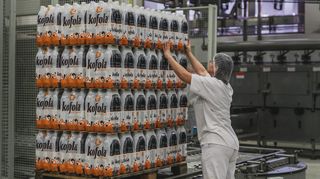
Currently, Kofola is over 12 billion crowns on the stock exchange. Her shares have grown up by 39 percent this year, have added an impressive 80 percent in the last 12 months, and in the last five years, investors have been happy with a yield of 139 percent.
However, the analyst Raška of Fio banka points out that the current stock price can already be on the edge. “I am surprised by the current shift to CZK 550. They basically call or even overcome competitors – often multinational groups with a global brand by their appreciation. This is unprecedented from Kofola,” he says.
According to Vladimir Vávra from Wood & Company, the Kofola stock price has several key drivers. “Among the factors affecting the price of the shares of Kofola, I would introduce the development of the input prices.
It is also necessary to realize that the business kofola is strongly seasonal, where 70 percent of the operating profit will generate during the second and third quarters.
“The company’s results can be significantly influenced by seasonal weather fluctuations. Dividend policy and expected decrease in debt can be a certain anchor for shares.
