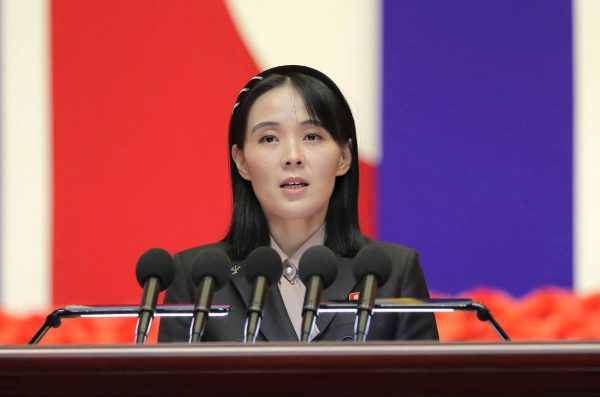
Kim Yo Jong Issues Over 80 Statements, Becomes Primary Channel
North Korean external communication has shifted as Kim Yo Jong has issued more than 80 statements since March 3, 2020, becoming a primary channel for messages directed at Japan, the United States, and South Korea, The Diplomat reported.
Expansion of Official Statements
The frequency of statements attributed to Kim Yo Jong, Director of General Affairs of the Central Committee of the Workers’ Party of Korea and younger sister of supreme leader Kim Jong Un, has increased this year.
Her statements first gained international prominence with the bombing of the inter-Korean liaison office in June 2020. A June 13 statement that month announced in advance that the office would be destroyed, and the demolition followed three days later.
Recent months have seen a widening array of targets and topics. On August 5, an official statement directed at Japan accused Tokyo of pursuing pre-emptive strike capabilities and warned that North Korea would introduce clear military options as countermeasures. Statements targeting the International Atomic Energy Agency on September 17 and 19 asserted that North Korea’s status as a nuclear-armed state remains unshakeable.
Matters that previously fell under the purview of the Ministry of Foreign Affairs or the Ministry of National Defense are now routinely handled through Kim’s statements. The language shows clear variation depending on the intended audience. Direct condemnation of U.S. President Donald Trump has been consistently avoided, leaving open the possibility of future negotiations with Washington.
The Response to South Korea
By contrast, statements directed at South Korea utilize heavily charged language and dismissals of official accounts. Following a landmine explosion near the military demarcation line on September 21 that injured three South Korean soldiers—an incident attributed to North Korean mines by the South Korean military and the United Nations Command—Kim dismissed the explanation in a September 29 statement as a staged farce.
An October 2 statement expressed deep hostility regarding South Korea, stating that the mere thought of that group makes her flesh crawl. On October 8, Kim reacted to South Korea’s plan to provide medical equipment under a UN sanctions exemption by framing both the landmine claims and the humanitarian offer as parts of a unified farce.
“The mere thought of that group called South Korea makes my flesh crawl.” Kim Yo Jong told The Diplomat.”
The following day, on October 9, an unusual statement was issued presenting an official position of the government of the Democratic People’s Republic of Korea directly through a party Central Committee department director.
The political weight behind these communications stems from familial ties rather than institutional titles alone, as Kim became Director of General Affairs at the 9th Congress of the Workers’ Party of Korea in February. Issuing warnings through Kim allows North Korea to project force while keeping Kim Jong Un’s policy options unconstrained.
North Korea, officially the Democratic People’s Republic of Korea, occupies the northern half of the Korean Peninsula bordered by China and Russia to the north and South Korea at the Demilitarized Zone established by the 1953 Korean Armistice Agreement. The state was founded in 1948 after the peninsula was divided along the 38th parallel following Japan’s 1945 surrender, and the North Korean invasion of the South in 1950 started the Korean War.
Under founding leader Kim Il Sung, the country adopted Juche as its state ideology and developed nuclear weapons; its active-duty army of 1.28 million is the world’s fourth largest. In 2024, North Korea formally abandoned reunification efforts and designated South Korea a separate, hostile state.
This routine deployment introduces the risk of statement inflation. As warnings multiply across diverse topics, individual declarations may lose their shock value, though past precedent demonstrates that genuine threats can still be embedded within the rhetoric. Governments in Seoul, Tokyo, and Washington continue to evaluate whether individual releases represent standard posturing, authorized warnings, or genuine indicators of upcoming military countermeasures.