JWST ‘Little Red Dots’ May Indicate Early Black Holes, Researchers Model’
Researchers are using “little red dots” to investigate whether primordial black holes existed in the early universe, according to a study published in Physical Review Letters.
The team from Johns Hopkins University used data from the James Webb Space Telescope to test if specific high-redshift sources could contain these theoretical objects. Unlike standard black holes, which form from the gravitational collapse of dying stars, primordial black holes are thought to have originated from the physics of the expanding early universe before the first stars ever formed.
“A black hole is an object born from the gravitational death of a star. Primordial black holes are a very different story,” said Valerio De Luca, a postdoctoral researcher in the physics and astronomy department at Johns Hopkins University.
Testing the QSO1 hypothesis
To test this theory, researchers focused on a specific source called QSO1. This “little red dot” existed roughly 700 million years after the Big Bang and consists almost entirely of hydrogen and helium, lacking the heavier elements that appeared later in cosmic history, hub.jhu.edu reported.
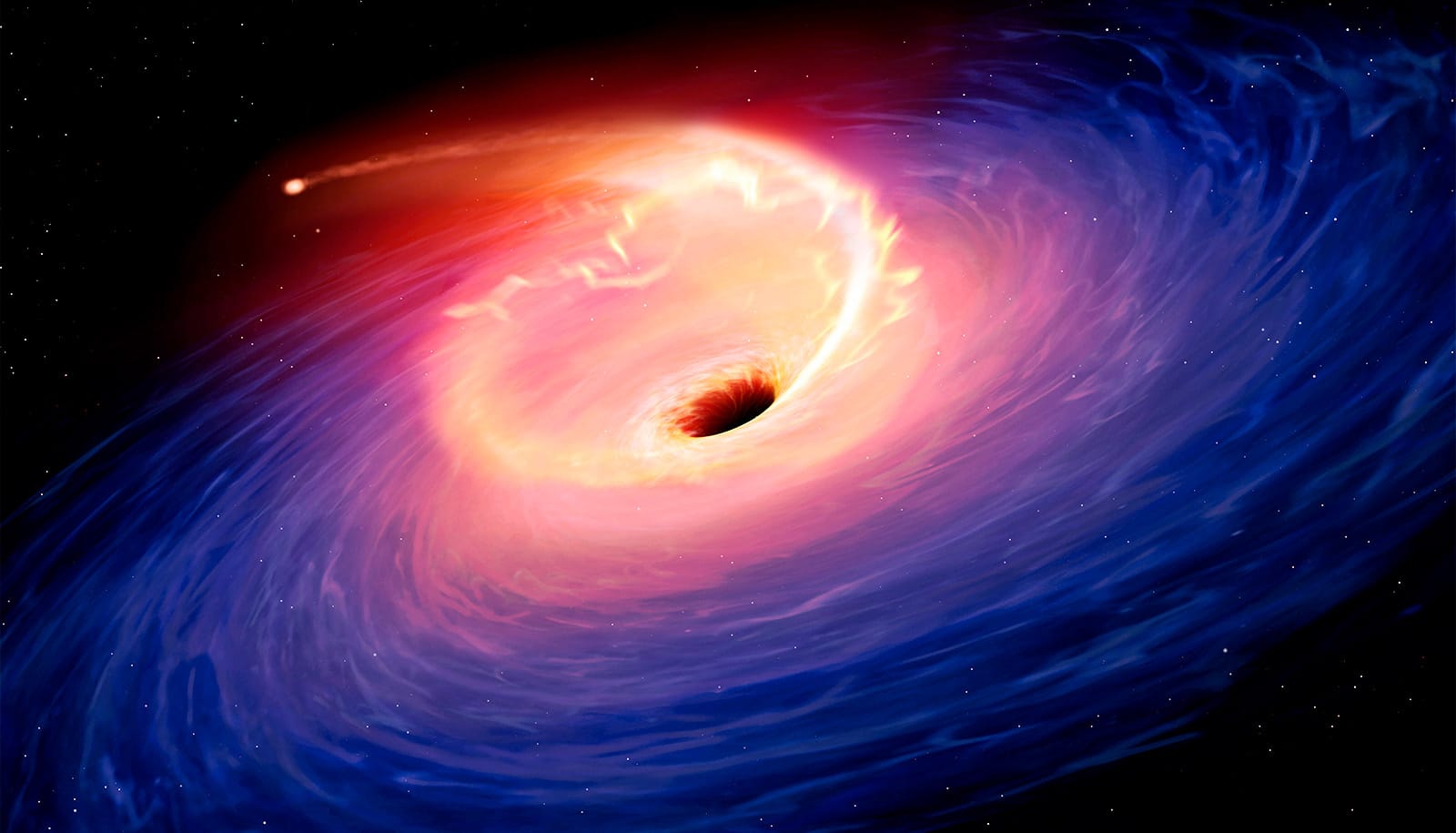
The researchers modeled three different scenarios to determine if a primordial black hole could grow to the size of QSO1 and develop its surrounding disc of gas and energy. The most probable model suggests a smaller primordial black hole grew by consuming surrounding gas and energy, Futurity reported.

“The door was open on this theory, that little red dots could be primordial black holes. We’ve now cracked it open a little farther by showing some scenarios are more likely than others,” said Loris Del Grosso, a postdoctoral researcher in the Department of Physics and Astronomy at Johns Hopkins University.
Constraints shape formation scenarios
Cosmic microwave background measurements rule out the direct formation of Little Red Dot black hole masses in the early universe, according to the Physical Review Letters study. The authors also tested whether lighter primordial black holes could merge hierarchically to build the observed masses, but found this channel struggles to explain the observations because the required high-redshift dark matter halos are too rare.
Instead, the team modeled gas accretion onto intermediate-mass primordial black holes while tracking metallicity evolution. They identified regions of parameter space where such growth could reproduce the observed properties of Little Red Dots, the study reports.
QSO1 provides a stringent test
The researchers focused on the strongly lensed source QSO1 as a special case because its extremely low metallicity and large mass provide a stringent test of formation channels, the Physical Review Letters paper states.
Of the three scenarios modeled, the most probable involves a smaller primordial black hole growing by consuming surrounding gas and energy until it reached QSO1’s size, Futurity and the Johns Hopkins Hub reported.
Survey of catalogued dots planned
Definitive proof would require finding a black hole either too light to be astrophysical or so old it pre-dates the existence of stars.
“We don’t have a clear understanding of what happens in the early universe right after the Big Bang,” De Luca said.
Searching for definitive proof
While these findings suggest a possible pathway, scientists have not yet found direct evidence for primordial black holes. Identifying them requires finding an object that is either too old to have been formed by a star or too light to be an astrophysical black hole, Futurity reported.
The research team plans to analyze the remaining 100 catalogued little red dots to see how many might fit the primordial profile.
Their work, reported by hub.jhu.edu and Futurity, identified the most probable pathway involving a smaller primordial black hole consuming surrounding gas and energy to reach QSO1’s observed size and metallicity.
Johns Hopkins University’s Department of Physics and Astronomy hosts the research team analyzing the remaining 100 catalogued little red dots to test the primordial profile, with De Luca noting that confirming these objects would represent a groundbreaking discovery in physics.
“If primordial black holes do exist, then something had to happen to make them in the first place, which would be a groundbreaking discovery in physics,” De Luca said.