JWST Discovers New Type of Cosmic Object: The Black Hole Star
James Webb Space Telescope Identifies Supermassive Black Hole Cocoons in the Early Universe
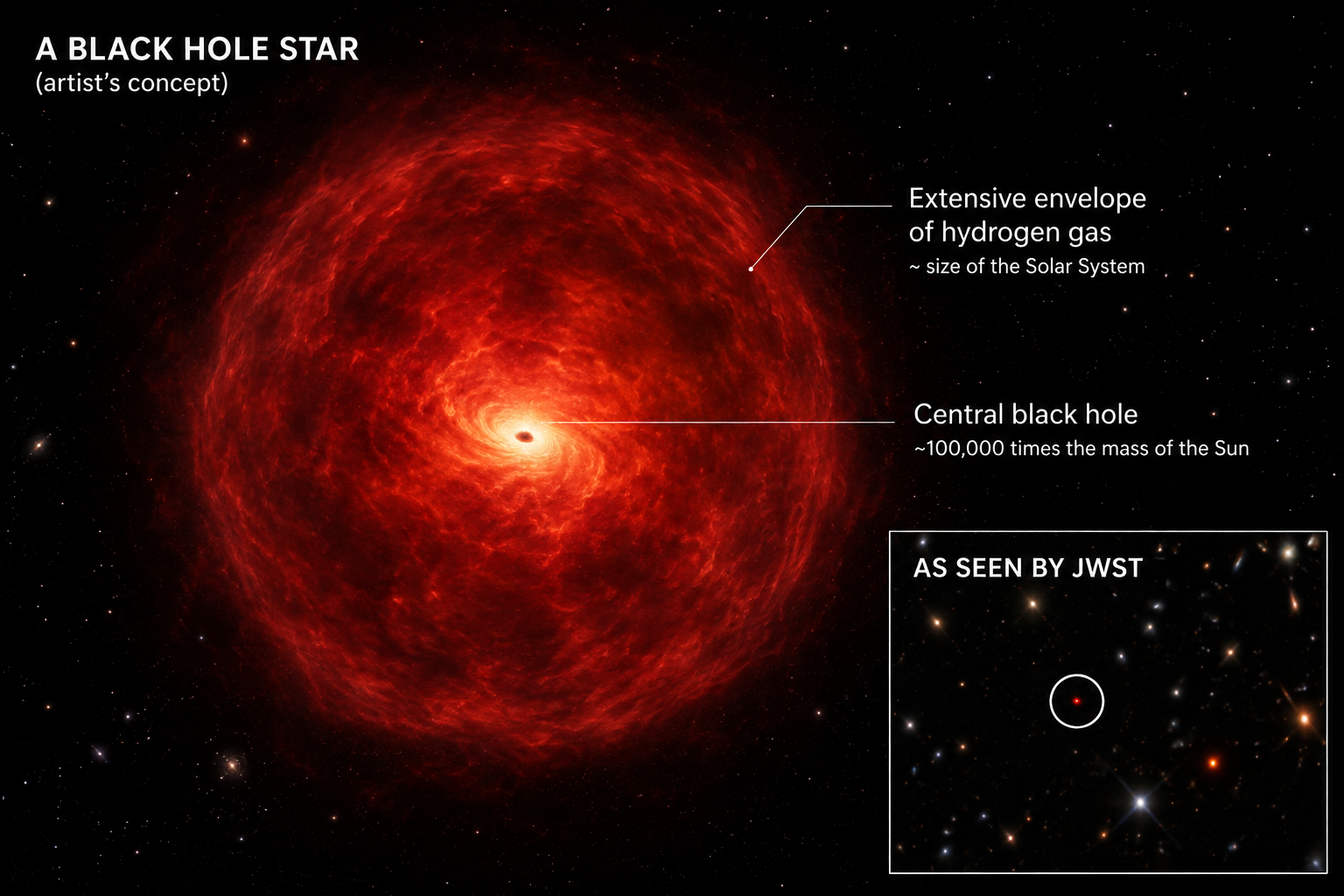
Astronomers using the James Webb Space Telescope (JWST) have published findings indicating that mysterious “little red dots” observed in the early universe are actually young supermassive black holes shrouded in dense gaseous cocoons, according to a study published Wednesday (Jan. 14) in the journal Nature. These objects, first detected shortly after the spacecraft began collecting data in 2022, exhibit characteristics of both galaxies and supermassive black holes, presenting a puzzle for standard models of cosmic evolution.
The Tech TL;DR:
- The Discovery: JWST infrared spectra of 30 “little red dots” reveal they are young, growing supermassive black holes rather than dense star-filled galaxies.
- The Architectural Catch: Dense clouds of surrounding gas act like a physical firewall, trapping X-ray and radio emissions and masking the objects’ true mass and signatures.
- The Computational Shift: Recalculated mass estimates show these objects are roughly 100 times less massive than initial projections, bringing them into alignment with standard cosmic evolution theories.
Parsing the Infrared Spectra and Gas Dynamics
When the James Webb Space Telescope first captured data from the early universe, researchers wrestled with an apparent timeline paradox. The objects possessed too much mass to have formed so early under prevailing models of galaxy evolution. Light emitted by energized hydrogen atoms surrounding the dots indicated gas moving at thousands of miles per second, pulled along by a central gravitational well. Rodrigo Nemmen, an astrophysicist at the University of São Paulo in Brazil, noted in an accompanying article published in Nature that such extreme speeds serve as a signature of an active galactic nucleus—a hungry supermassive black hole accreting matter.
However, these targets lacked the expected X-ray and radio wave signatures typically associated with active galactic nuclei. By analyzing high-resolution spectra from 30 little red dots gathered by JWST’s infrared instruments, the research team determined that a dense gaseous cocoon surrounds each object. This containment layer effectively blocks high-energy emissions from reaching the telescope’s sensors. When investigators adjusted their algorithms to account for the gas absorption, the recalculated mass metrics dropped significantly. According to the study, these represent the lowest mass black holes identified at high redshift.
Validating High-Redshift Signatures via API and Spectroscopic Pipelines
from astropy.io import fits
import numpy as np

def analyze_redshift_spectrum(file_path, redshift_limit=5.0):
    hdul = fits.open(file_path)
    header = hdul[0].header
    data = hdul[1].data

    redshift = header.get('Z', 0.0)
    if redshift > redshift_limit:
        wavelength = data['WAVELENGTH']
        flux = data['FLUX']
        continuum_subtracted = flux - np.median(flux)
        return {"status": "High-Z Target Flagged", "z": redshift, "peak_flux": np.max(continuum_subtracted)}
    return {"status": "Below Threshold", "z": redshift}

# Execution against local FITS pipeline
# result = analyze_redshift_spectrum('jwst_obs_spectrum.fits')
Observational Challenges and Future Deployment Roadmap
Confirming whether this cocoon phase represents a universal bottleneck in black hole growth requires expanding the sample size of analyzed red dots. Because these objects exist at significant cosmic distances—where light is stretched toward the redder end of the electromagnetic spectrum—detecting them demands continuous tuning of infrared observation schedules.

The findings offer a pathway to reconcile early universe observations with established cosmological frameworks, proving that heavy gas obfuscation can temporarily hide rapidly growing galactic engines from direct electromagnetic detection.