
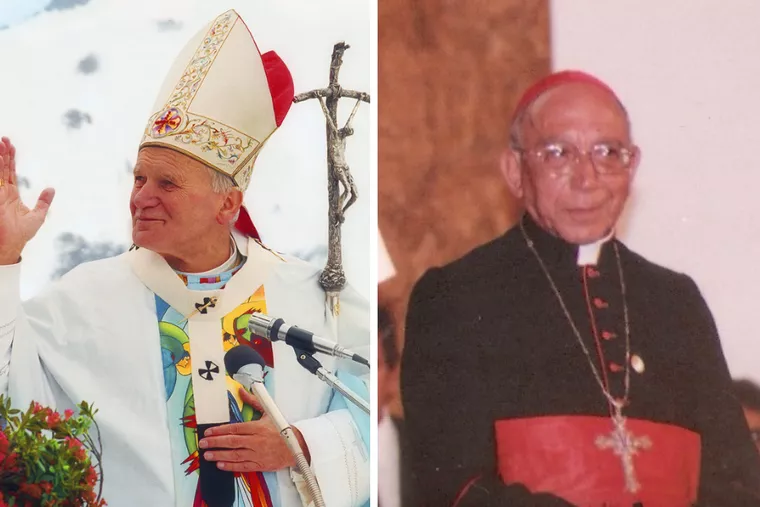
Pope Francis’s recent assertion that the late Cardinal Agostino Casaroli serves as his diplomatic role model has prompted renewed scrutiny of the Vatican’s controversial Ostpolitik strategy during the Cold War. While some Vatican and Italian ecclesiastical circles credit Casaroli’s approach with contributing to the fall of European communism, newly surfaced details from a 1979 meeting convened by Pope John Paul II suggest a profound disagreement with that assessment.
Cardinal Casaroli, who served as Vatican Secretary of State from 1979 to 1990, and prior to that, as the principal architect of Pope Paul VI’s Ostpolitik, initially resisted requests for an interview from biographer George Weigel for his book, Witness to Hope. Weigel had previously published The Final Revolution, a critical analysis of the Ostpolitik strategy, which advocated for engagement and accommodation with communist regimes. According to Weigel, Casaroli eventually agreed to speak, displaying “wit and charm” but remaining critical of Weigel’s work.
A key moment in assessing Casaroli’s approach centers on Pope John Paul II’s first papal pilgrimage to Poland in June 1979. Casaroli successfully negotiated the terms of the visit, securing a nine-day duration from Polish authorities who initially favored a shorter trip, particularly objecting to the inclusion of the feast day of St. Stanisław, a Polish martyr whose example of resistance to state power was viewed as destabilizing.
Once the visit commenced, Casaroli attempted to mitigate concerns from communist officials regarding Pope John Paul II’s addresses in Warsaw’s Victory Square, and Gniezno. He reportedly suggested to the authorities that the Pope’s remarks were driven by “emotional impulse,” attributing them to his Polish identity rather than a considered, “universal” perspective.
Still, unknown to Casaroli, Pope John Paul II convened a private meeting of the General Council of the Polish episcopate in Częstochowa on June 5, 1979. No Vatican officials, including Casaroli, were present. A memorandum summarizing the discussion, penned by Bishop Bronisław Dąbrowski, the conference general secretary, remained sealed in the archives of the Archdiocese of Warsaw for decades until recently accessed by Weigel.
The memorandum reveals John Paul II’s sharp critique of the Vatican’s understanding of communist regimes. He asserted that the Vatican possessed “no shortage of experts” on Warsaw Pact countries, but suffered from “a shortage of people who have experience [of life under communism].” He further stated that his visit to Poland carried a risk of providing communist authorities with “an alibi” they “didn’t deserve” – a point he repeatedly made to Casaroli.
The Pope also emphasized the importance of acknowledging the historical grievances of Ukrainians, stating that the Vatican had “no right to take their historical truth away from them in the name of ecumenism [i.e., with Russian Orthodoxy].” He specifically condemned the suppression of the Ukrainian Greek Catholic Church as “a crime.” John Paul II believed the Polish pilgrimage held “a global significance” and that the Polish experience of faith-based resistance to tyranny offered a vital lesson for the global Church.
Cardinal Stefan Wyszyński, the Polish primate, echoed this sentiment, describing the papal pilgrimage as “a kind of breakthrough” that would “awaken” Lithuania, Latvia, Estonia, Belarus, and Ukraine, fostering “a revival of hope” and a “spiritual mobilization.” John Paul II concurred, sensing “another process [underway] that is not yet visible, namely the process of freeing oneself from political alienation.”
These insights, largely absent from current discourse within certain Vatican and Italian ecclesiastical circles, challenge the narrative that Casaroli’s Ostpolitik was instrumental in the collapse of communism. Instead, the Pope’s observations suggest that a firm stance rooted in spiritual strength proved to be a more effective counter to tyranny, a lesson with continued relevance in the context of Russia and China.
