
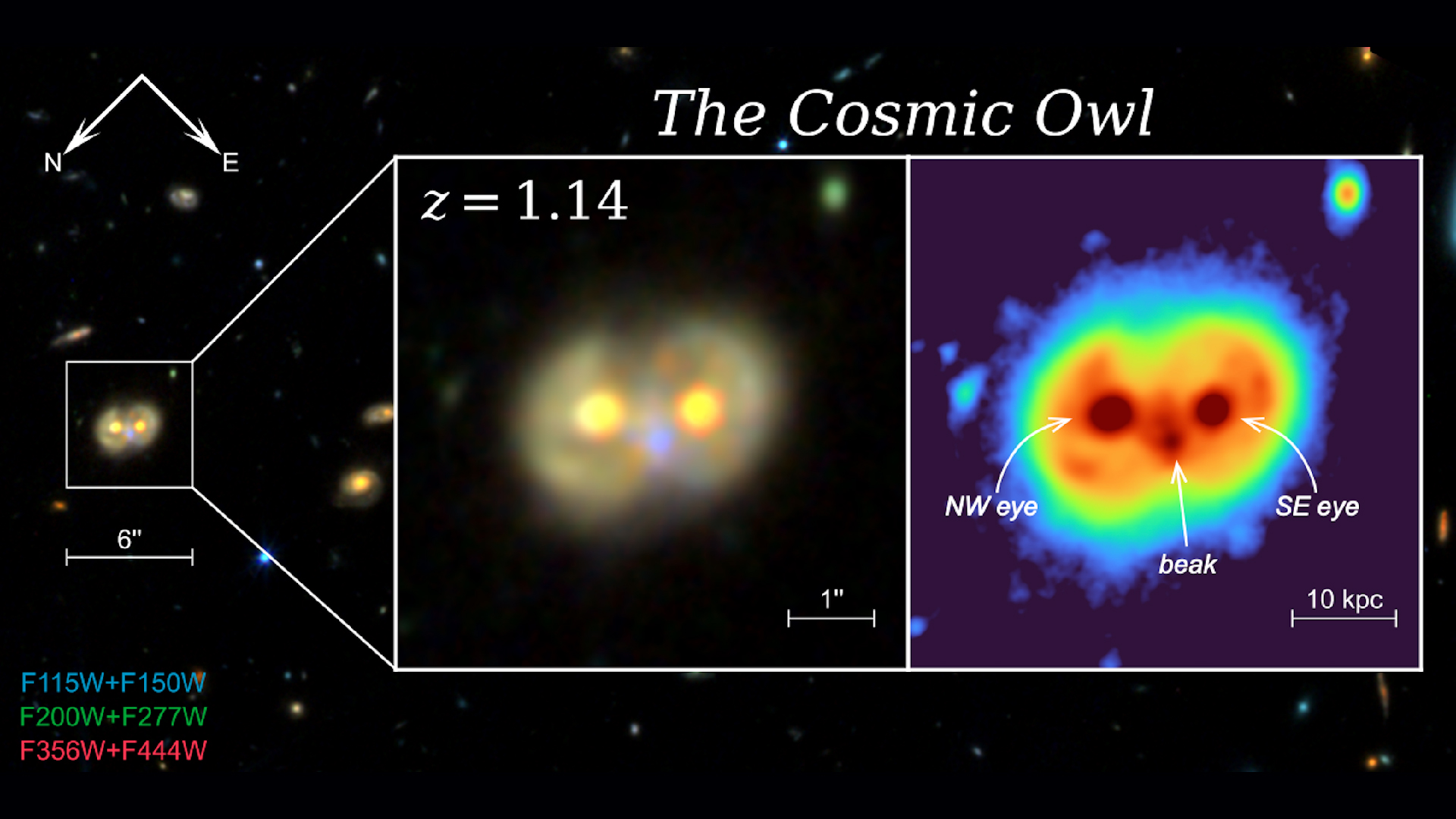
“Cosmic Owl” Spotted by James Webb Telescope
Rare galactic collision reveals insights into star formation.
The James Webb Space Telescope (JWST) has captured images of a bizarre cosmic phenomenon: a celestial structure resembling an owl’s face. This “Cosmic Owl” is the result of a rare collision between two ring galaxies, offering scientists a unique opportunity to study galactic evolution.
Discovery of the Unusual Object
A team led by doctoral student Mingyu Li at Tsinghua University in China stumbled upon the “Cosmic Owl” while analyzing public JWST data in the COSMOS field. Li noted that the high-resolution imaging capabilities of the JWST made the colliding galaxy pair immediately stand out.
According to a preprint posted on arXiv June 11, the colliding galaxies have been dubbed the “Cosmic Owl.” Another team independently confirmed the collision, referring to it as the “Infinity galaxy” in their paper posted to arXiv June 19.
Ring Galaxies and Their Rarity
Galaxies exhibit diverse shapes, ranging from spirals like the Milky Way to cigar-shaped forms such as M82. Ring galaxies, like Hoag’s Object, are formed when a smaller galaxy passes through a larger one, creating a ring of stars and gas around a central core.
Ring galaxies are exceptionally rare, constituting only 0.01% of all known galaxies. The collision of two ring galaxies, as seen in the “Cosmic Owl,” is an even more infrequent occurrence.
Details of the Cosmic Collision
The JWST images show that the two ring galaxies are relatively small, each with a diameter of approximately 26,000 light-years, about a quarter of the Milky Way’s diameter. The cores of both galaxies, packed with old stars and supermassive black holes, form the “eyes” of the owl.
Data indicates that the black holes, each exceeding 10 million times the sun’s mass, are actively pulling in surrounding matter, classifying the galactic cores as “active galactic nuclei.”
A Stellar Nursery in the “Beak”
The “beak,” representing the collision front between the galaxies, is a site of intense activity. Observations from the Atacama Large Millimeter/submillimeter Array (ALMA) revealed a massive clump of molecular gas in this region. Li described it as “the raw fuel for star formation,”
compressed by the shock wave from the galactic collision.
According to NASA, ALMA is the largest ground-based astronomical project in existence, comprising 66 high-precision antennas spread over distances of up to 16 kilometers. Furthermore, the ALMA data places the owl’s redshift at 1.14, equivalent to approximately 11 billion light-years away.
Radio-frequency observations from the Very Large Array suggest that a jet of charged particles emanating from one galaxy’s black hole is impacting and further compressing the molecular gas cloud. This has “triggered a massive burst of star formation,”
transforming the beak into a stellar nursery, according to Li.
Significance of the Discovery
Li emphasizes that the owl is not only visually remarkable but also “an exceptional natural laboratory because it allows [researchers] to see several critical galaxy evolution processes happening simultaneously in one system.”
The bursts of star formation in the beak region may represent a crucial mechanism for the rapid conversion of gas into stars, potentially explaining how galaxies amassed stellar mass early in the universe’s history.
Further Research
Researchers intend to continue studying the “Cosmic Owl” to better comprehend the physical processes that led to its formation. Simulations of the galaxies’ gas dynamics could reveal the specific conditions that resulted in the formation of such a rare, symmetric twin-ring structure, says Li.
The “Cosmic Owl” joins other peculiar astronomical phenomena previously identified by the JWST, including a question-mark-shaped structure formed by galaxies and a gas wisp from a newborn star resembling a cat’s tail.
