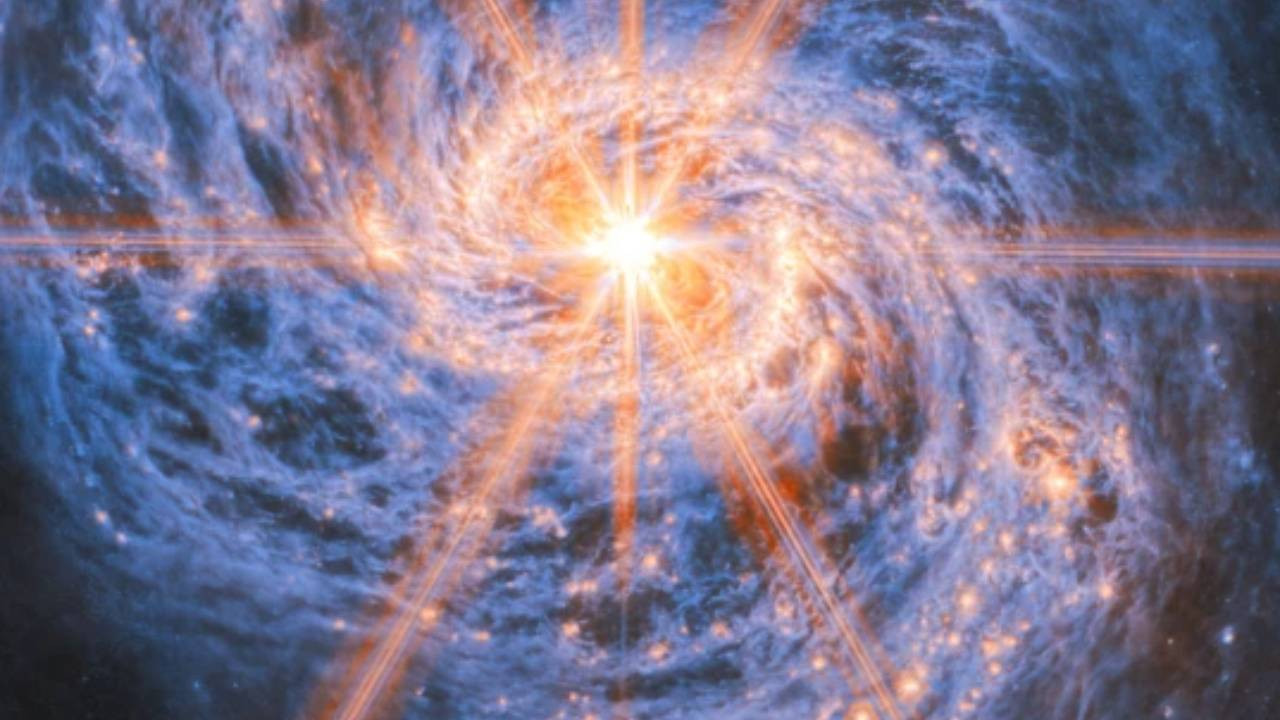
James Webb Telescope Images Massive Black Hole 8 Million Times the Size of the Sun
NASA’s James Webb Space Telescope has captured the first direct imaging evidence of a supermassive black hole with a mass equivalent to 8 million suns, located in the heart of a distant galaxy. The discovery, published in recent astronomical observations, challenges long-held assumptions about the behavior of active galactic nuclei and the role of black holes in shaping their host galaxies.
The black hole, identified in a galaxy approximately 13 million light-years from Earth, was observed using Webb’s innovative infrared imaging techniques. Until now, astronomers believed that the dominant source of infrared emissions near such black holes came from high-speed outflows of superheated matter. However, Webb’s data suggests that the majority of the observed infrared radiation originates from the accretion disk—the swirling ring of gas and dust feeding the black hole—rather than the outflows themselves. This reversal of scientific consensus was detailed in a study published in Nature on Tuesday, marking a significant milestone in black hole research.
The findings were made possible by Webb’s ability to penetrate dense clouds of dust and gas surrounding the black hole, revealing structures previously obscured even by Hubble Space Telescope observations. The telescope’s high-resolution images allowed researchers to distinguish between the accretion disk and the outflowing material, a feat described by the NASA Webb Mission Team as “the sharpest image of a black hole’s surroundings ever taken.” The data also introduces a new method for analyzing the dynamics of black hole feeding and ejection processes in nearby galaxies.
While the discovery is rooted in recent observations, it builds on a broader trend in astrophysics: the use of Webb to probe the earliest and most extreme cosmic phenomena. Earlier this year, Webb confirmed the presence of an actively growing supermassive black hole in a galaxy from the early universe, further demonstrating its capability to unravel the mysteries of these enigmatic objects. The latest findings, however, focus on a closer system—the Circinus Galaxy—where the black hole’s influence on its host galaxy is still unfolding.
The implications of the study extend beyond theoretical astrophysics. Understanding the balance between accretion and outflows in active galactic nuclei could provide critical insights into galaxy evolution, including how supermassive black holes regulate star formation and distribute energy across cosmic scales. Researchers involved in the project emphasized that Webb’s observations not only refine existing models but also open new avenues for studying black holes in other galaxies.
As the data continues to be analyzed, astronomers anticipate that Webb’s observations will refine models of black hole activity and its impact on galactic environments. The telescope’s ongoing mission promises to deliver further revelations about these cosmic powerhouses, potentially reshaping our understanding of the universe’s most extreme objects.