
Israeli Airstrikes Target Iranian Nuclear Facilities Amid Rising Tensions
Table of Contents
Amid escalating tensions, Israeli military forces have conducted airstrikes targeting key nuclear facilities within Iran, including the Arak heavy water reactor and the Natanz enrichment site. The strikes, which occurred on the seventh day of the ongoing conflict between the two nations, have raised international concerns about the potential impact on Iran’s nuclear program and regional stability.
Arak Reactor Targeted to Prevent Nuclear Weapons Progress
The Israeli military stated that the arak heavy water reactor’s core seal was specifically targeted to prevent its use for “nuclear weapons development.” The International Atomic Energy Agency (IAEA) has confirmed that the reactor was hit, but clarified that it did not contain any nuclear material at the time of the strike.Though, spent fuel from heavy water reactors can contain plutonium suitable for creating a nuclear bomb.
Iran, which maintains that its nuclear program is solely for peaceful purposes, had agreed under a 2015 agreement with world powers to redesign and rebuild Arak to prevent the production of weapons-grade plutonium. In the following year, the IAEA verified that Iran had removed Arak’s calandria, or reactor core, rendering it “inoperable.” Despite this, the IAEA’s latest quarterly report from late May indicated that minor civil construction work was ongoing at the reactor, with Iran anticipating commissioning it this year and commencing operations in 2026.
According to the Israeli military, the Iranian goverment had “deliberately ordered [workers] not to complete the conversion… in order to exert pressure on the West.” The strike, they asserted, “targeted the component intended for plutonium production, in order to prevent the reactor from being restored and used for nuclear weapons development.”
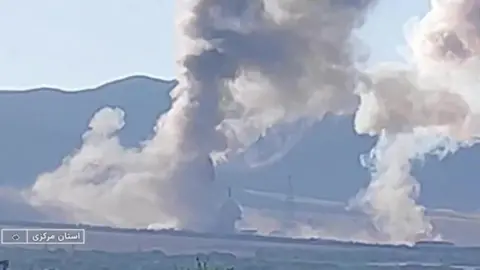
Footage released by the Israeli military showed a bomb hitting the domed roof of the reactor building, followed by several large explosions. iranian state TV also broadcast daytime video showing plumes of white smoke rising from the facility, with officials stating that the site had been “secured in advance” and that there was “no contamination resulting from the attack.” Satellite imagery analysis revealed a large hole in the reactor building’s roof,as well as damage to distillation towers belonging to the adjacent heavy water production plant.
Did You Know? Heavy water reactors use deuterium oxide as a neutron moderator, which allows them to operate with unenriched uranium. This can make them attractive for countries seeking nuclear capabilities without relying on external uranium enrichment services.
Natanz Nuclear Site Also Hit
In addition to the Arak reactor, the Israeli military announced that its fighter jets had also struck a “nuclear weapons development site” at Natanz, the location of Iran’s main plant producing enriched uranium. Enriched uranium can be used to make reactor fuel for power stations, but if further enriched, it can be used in nuclear weapons.
The initial wave of Israeli strikes last Friday resulted in the destruction of the above-ground part of Natanz’s Pilot Fuel Enrichment Plant (PFEP), where cascades of centrifuges were enriching uranium, as well as electricity infrastructure at the site.The IAEA also found indications of direct impacts on the underground enrichment halls.
Rafael Grossi, the IAEA director general, told the BBC that the sudden loss of power at the underground enrichment halls was likely to have severely damaged, if not destroyed, the centrifuges operating there. Furthermore, four buildings were destroyed in a separate attack on Friday on the Isfahan Nuclear Technology Center.Though, minimal damage was observed at Iran’s underground enrichment plant at fordo.
Pro Tip: Monitoring open-source intelligence (OSINT) such as satellite imagery and social media can provide valuable insights into the extent of damage and potential consequences of such attacks.
International Reactions and Implications
The recent events have reignited discussions about the 2015 nuclear deal, which President Donald Trump abandoned in 2018, reinstating US sanctions that crippled the Iranian economy. In response, Iran has increasingly breached the restrictions, particularly those related to the production of enriched uranium.
The IAEA has expressed concern that Iran has amassed enough uranium enriched up to 60% purity – a short technical step away from weapons grade – to possibly make nine nuclear bombs.Israeli Prime Minister Benjamin Netanyahu stated that the strikes targeted the Iranian nuclear program as “if not stopped, Iran could produce a nuclear weapon in a very short time.”
Iranian Foreign Minister abbas Araghchi condemned the attacks, stating that Israel had “crossed a new red line in international law” by attacking nuclear sites.He also insisted that Iran’s doctrine was “rooted in our belief in the prohibition and illegitimacy of nuclear weapons.”
The israeli air strikes have also reportedly destroyed Iranian military facilities and weapons, and killed senior military commanders and nuclear scientists. Iran’s health ministry reported that at least 224 people had been killed, while a human rights group put the unofficial death toll at 639 on Thursday.In response, iran has launched hundreds of ballistic missiles at Israel, resulting in at least 24 deaths, according to the prime minister’s office.
Key Metrics of the Conflict
| Metric | Value |
|---|---|
| Reported Deaths in Iran | 224+ (official), 639 (unofficial) |
| Deaths in Israel from Iranian Missiles | 24+ |
| Uranium Enrichment Level | Up to 60% |
| Potential Nuclear Bombs | 9 |
How will these attacks impact the future of the Iran nuclear deal? What steps can be taken to de-escalate tensions in the region?
Background and Context
The conflict between Israel and Iran is deeply rooted in historical and political tensions. Israel views Iran’s nuclear program as an existential threat,citing concerns about Iran’s regional ambitions and support for militant groups. Iran, conversely, maintains that its nuclear program is solely for peaceful purposes, such as energy production and medical research.
The 2015 nuclear deal, formally known as the Joint Extensive Plan of Action (JCPOA), aimed to limit Iran’s nuclear activities in exchange for the lifting of international sanctions. However, the deal has been in jeopardy since the US withdrawal in 2018 and the subsequent reimposition of sanctions. Efforts to revive the JCPOA have stalled,further exacerbating tensions between Iran and its adversaries.
Frequently Asked Questions
- What is the significance of the Arak heavy water reactor?
- The Arak heavy water reactor is important because it could potentially produce plutonium, which can be used in nuclear weapons. The 2015 nuclear deal aimed to redesign the reactor to prevent this.
- why did Israel target the Natanz nuclear site?
- Israel targeted the Natanz nuclear site because it is Iran’s main plant for producing enriched uranium, which can be used for both peaceful purposes and in nuclear weapons if enriched to a high enough level.
- What is the role of the IAEA in this situation?
- The IAEA is responsible for monitoring Iran’s nuclear activities and verifying compliance with international agreements. They have confirmed the damage to the Arak reactor and Natanz site.
- What are the potential consequences of these airstrikes?
- The potential consequences include further escalation of tensions between Israel and Iran,a setback for efforts to revive the nuclear deal,and increased concerns about nuclear proliferation in the region.
- How much enriched uranium does Iran possess?
- The IAEA has expressed concern that Iran has amassed enough uranium enriched up to 60% purity to potentially make nine nuclear bombs.
- What is the current status of the Iran nuclear deal?
- The Iran nuclear deal, or JCPOA, is in jeopardy as the US withdrawal in 2018. Efforts to revive the deal have stalled, leading to increased tensions.
- What international laws are being violated by these attacks?
- Iran claims that Israel has violated international law by attacking nuclear sites, crossing a “new red line.” The specific laws violated are subject to interpretation and debate among international legal experts.
Disclaimer: This article provides factual information and does not constitute legal or policy advice.
Share your thoughts on this developing story. What actions should the international community take? Subscribe for more updates.
