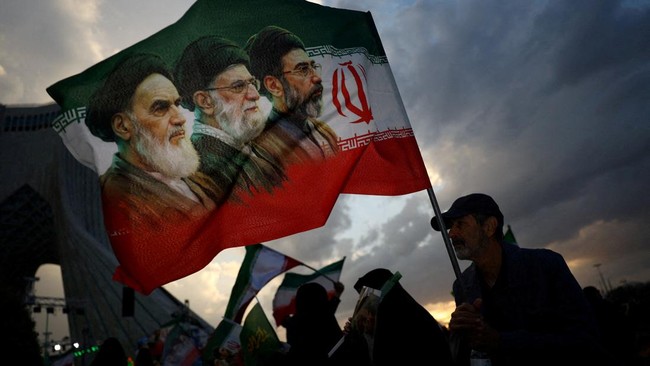
Iran Warns of New Escalation: U.S. Conflict Unavoidable as Tensions Rise
Iran’s military leadership has declared that a renewed war with the U.S. Is “unavoidable,” escalating tensions as indirect negotiations stall and Tehran warns of irreversible consequences for global energy markets. With President Donald Trump extending a fragile ceasefire while Israel-Hezbollah clashes persist, Iran’s Revolutionary Guard (IRGC) insists any U.S. Demand for total surrender is non-negotiable. The standoff risks destabilizing the Strait of Hormuz—a chokepoint for 20% of global oil shipments—while multinational firms scramble to mitigate supply chain disruptions and sanctions-related financial exposure.
The Unspoken Rules of the Game: What’s Really at Stake
This isn’t just another Middle East proxy war. The Iran-U.S. Confrontation operates on three parallel tracks: nuclear deadlock, regional dominance, and economic warfare. Each track has its own set of unspoken rules—and breaking them could trigger cascading effects.
- Nuclear Track: Iran’s refusal to discuss its uranium enrichment beyond 60% (a threshold that could enable weapons-grade material in weeks) mirrors its 2015 stance. The difference now? The U.S. Has abandoned the JCPOA framework entirely, leaving only unilateral pressure points.
- Regional Track: Iran’s IRGC has embedded itself in Lebanon (Hezbollah), Yemen (Houthi rebels), and Syria (Assad’s survival network). Disrupting these alliances risks a multi-front conflict—something even Israel’s Netanyahu is reluctant to provoke.
- Economic Track: The U.S. Blockade of Iranian oil exports (already at ~1.2 million barrels/day pre-war) has sent shockwaves through Asian refiners. China’s reliance on Iranian crude (10% of its imports) and India’s strategic purchases make both nations reluctant to fully enforce sanctions.
Why the Strait of Hormuz is the Global Economy’s Achilles’ Heel
As of June 2, 2026, tanker tracking data shows a 40% increase in premiums for insurance policies covering ships transiting the Strait. The last time tensions flared (2019), oil prices spiked by $10/barrel in 48 hours. This time, the baseline is already elevated due to Russia’s lingering export caps.
“The Strait of Hormuz isn’t just a geopolitical flashpoint—it’s a financial accelerator. A single incident could send oil above $120/barrel overnight, triggering margin calls across global commodity futures markets.”
For maritime risk consultants, the current environment is a goldmine of new clients. Shipping firms are now demanding real-time geospatial monitoring of Iranian naval drills, while trade finance specialists are advising exporters to diversify routes via the Suez Canal—despite the 10-day transit penalty.
The Diplomatic Chessboard: Who’s Moving Where
Tehran’s public posturing masks a private calculus. Supreme Leader Mojtaba Khamenei’s recent engagement in talks—unprecedented since 2018—suggests Iran is testing U.S. Resolve. But the IRGC’s hardline stance reflects a domestic power struggle: any concession on nuclear enrichment would undermine the regime’s revolutionary narrative.
| Power Player | Current Leverage | Potential Weakness |
|---|---|---|
| U.S. (Trump Administration) | Control of global sanctions architecture; Israel as regional enforcer | Divided Congress on Iran policy; risk of overreach in Lebanon |
| Iran (Khamenei + IRGC) | Proxy networks in Iraq/Syria/Yemen; control of Hormuz chokepoints | Economic isolation; internal dissent over nuclear concessions |
| China | Oil import dependency; veto power in UN Security Council | U.S. Secondary sanctions on Chinese firms trading with Iran |
| Russia | Shared opposition to Western hegemony; arms sales to Tehran | Overstretched military in Ukraine; reliant on Iranian oil for refineries |
The Sanctions Tightrope: How Firms Are Already Adapting
Multinational corporations face a trilemma: comply with U.S. Sanctions, maintain Iranian business, or pivot to neutral markets. The first option is increasingly costly. A May 30 Reuters analysis found that Iranian oil exports have dropped by 50% since U.S. Strikes began, forcing refiners in Malaysia and Singapore to scramble for alternatives.
“We’re seeing a two-tiered market emerge. European firms are cutting ties with Iranian entities entirely, while Asian players are using shell companies in Dubai to maintain trade. The problem? U.S. Financial intelligence is getting better at tracing these flows.”
For firms caught in the crossfire, sanctions compliance specialists are becoming indispensable. One Middle East-based trading house recently engaged a cross-border legal firm to restructure its Iranian contracts under a “force majeure” clause—only to have the U.S. Treasury flag the transaction as a sanctions violation. The lesson? No gray area exists anymore.
The Long Game: What Happens If Talks Collapse
Three scenarios are now on the table:
- Limited Escalation: targeted U.S. Strikes on IRGC bases paired with Iranian cyberattacks on Gulf port infrastructure. Outcome: Oil prices surge, but no kinetic war.
- Regional Conflagration: Iran retaliates by arming Houthis to attack Red Sea shipping. Outcome: Global supply chains fragment; Suez Canal traffic halts.
- Diplomatic Breakthrough: Iran agrees to freeze enrichment at 60% in exchange for partial sanctions relief. Outcome: Asian refiners rush to reopen trade channels.
The most likely path? A prolonged stalemate. Iran’s economy is hemorrhaging $40 billion annually from sanctions, but the regime’s survival depends on maintaining the perception of strength. Meanwhile, Trump’s political calculus favors a managed crisis—one that keeps tensions high without triggering a full-blown war.
The Bottom Line: Who Wins in the End?
No one. But geopolitical risk consultants are already advising clients to diversify away from Iran-dependent supply chains. The real losers? Consumers (higher energy bills), investors (volatile commodity markets), and regional stability (another decade of proxy wars).
The only certainty? The firms that prepare now—with contingency logistics, crisis PR, and sanctions-mapping tools—will outmaneuver their competitors when the next shockwave hits.