
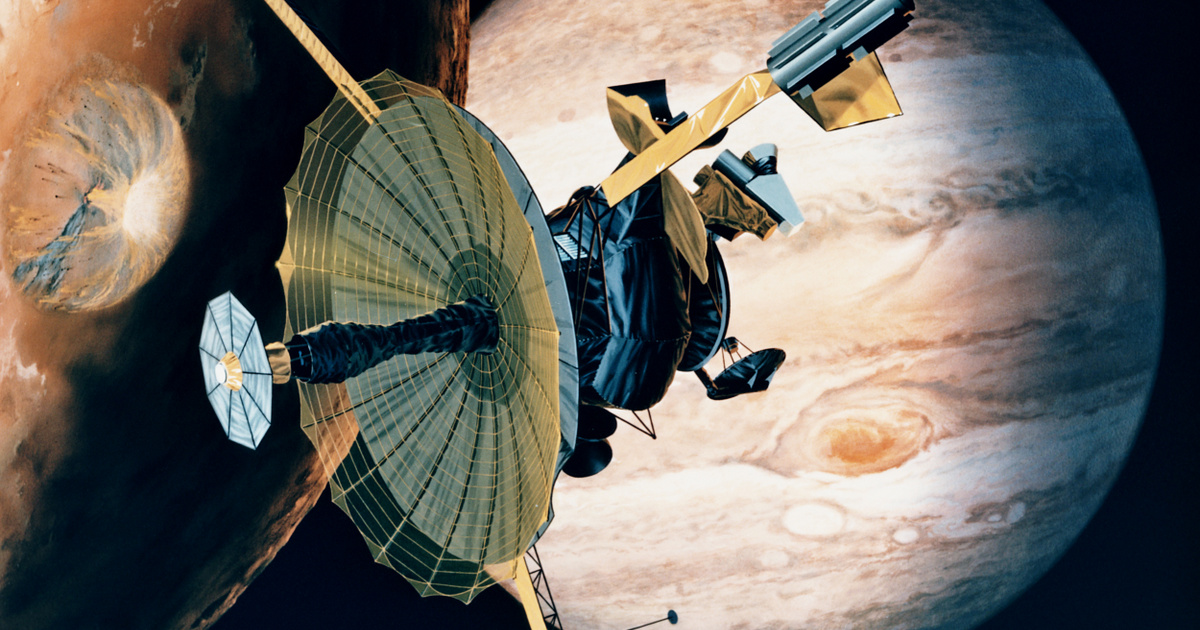
Galileo Probe’s Epic Jupiter Dive Revolutionized Solar System Science
Decades Later, Its Legacy Fuels New Search for Life
The daring maneuvers of NASA’s Galileo spacecraft, plunging into Jupiter’s crushing atmosphere at tremendous speeds, provided unprecedented insights into the gas giant and its enigmatic moons. This groundbreaking mission, launched in 1989, redefined our understanding of the outer solar system.
Pioneering Jupiter Exploration
Galileo’s journey was anything but ordinary. Initially en route to Venus for a gravity assist, it ultimately became the first spacecraft to orbit an outer planet in 1995, ushering in a golden era of Jupiter system exploration. Its discoveries were nothing short of astonishing.
The probe detected evidence of subsurface liquid water on Europa, captured dramatic footage of Io’s rampant volcanic activity, and revealed that Ganymede, the solar system’s largest moon, possesses its own magnetic field.
An extraordinary cosmic bonus arrived when Galileo became the sole observer of the Shoemaker-Levy 9 comet’s cataclysmic impact with Jupiter, a celestial event unseen by human eyes at the time.
A Fiery Descent into Jupiter
Upon arrival, Galileo executed a daring maneuver, deploying an atmospheric probe into Jupiter’s depths. This “wok-shaped” instrument endured conditions twice as hot as the sun’s surface and pressures 23 times that of Earth’s, transmitting invaluable data for nearly an hour.
It provided critical measurements of pressure, temperature, currents, and atmospheric composition, offering insights still vital for understanding planetary evolution.
Sacrificial End Preserves Europa’s Secrets
Galileo’s mission concluded in 2003 not with a drift into obscurity, but with a deliberate, heroic act. To prevent potential contamination of Europa’s subsurface ocean—a potential haven for life—NASA guided the probe into Jupiter’s atmosphere.
Traveling at approximately 108,000 kilometers per hour, Galileo met its fiery end, ensuring the pristine nature of Europa. This self-sacrifice cemented Galileo’s place in space history, leaving behind a legacy of revolutionary data and enduring inspiration.
Europa Clipper Continues the Quest
The legacy of Galileo is being carried forward by the Europa Clipper mission, which launched on October 14, 2024. Its objective is to conduct a detailed investigation of Jupiter’s moon Europa and its environment, specifically targeting the potential for life.
With a wingspan of thirty meters, Europa Clipper is the largest planetary probe ever constructed. It is expected to reach Jupiter in April 2030, embarking on a four-year mission to study Europa’s icy shell and assess its habitability.
Scientists believe Europa holds the three key ingredients necessary for life as we know it. For context, Earth’s deep-sea hydrothermal vents, which host thriving ecosystems independent of sunlight, illustrate how life can flourish in extreme environments, similar to what might exist beneath Europa’s ice (National Geographic, 2023).
