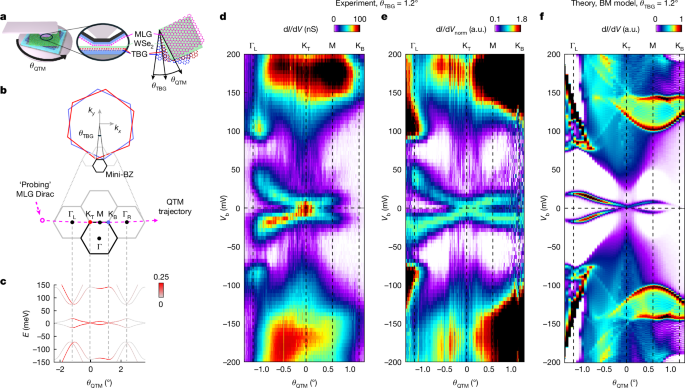
Imaging the Electronic Structure of Magic-Angle Graphene
The dream of room-temperature superconductivity usually dies in a whitepaper, but the latest data on magic-angle twisted bilayer graphene (MATBG) suggests we are finally getting a high-resolution map of the electronic terrain. By deploying a quantum twisting microscope (QTM), researchers have moved past theoretical conjecture to directly image how electron interactions reshape energy bands.
The Tech TL;DR:
- The Breakthrough: The Quantum Twisting Microscope (QTM) provides unprecedented momentum and energy resolution to visualize interacting energy bands in MATBG.
- The Discovery: Electrons in MATBG exhibit a “dual nature,” split into light and heavy electronic characters depending on their position in momentum space.
- The Impact: This resolves long-standing disputes over whether MATBG’s quantum states are local or topological, paving the way for precision engineering of topological phases.
For years, the industry has treated MATBG as a black box of “magic” properties. The bottleneck wasn’t the material itself, but the lack of high-resolution momentum-space probes. We’ve had the theories—predicting that twisting two sheets of graphene to a specific “magic angle” would flatten the electronic bands and trigger superconductivity—but we lacked the observability to verify the mechanism. The problem is essentially a telemetry issue: you cannot optimize a system you cannot see.
The Hardware Spec: Single-Particle Theory vs. Interacting Bands
According to the research published in Nature, the behavior of MATBG shifts violently based on the twist angle. When the material is away from the magic angle, the electronic bands behave predictably, following standard single-particle theory. But, at the magic angle, the physics breaks. The bands are completely transformed by electron-electron interactions, creating a hybrid system where electrons exhibit both “light” and “heavy” characteristics.
This duality is the core of the MATBG puzzle. The “heavy” sector is linked to Mott-like cascades and a persistent low-energy excitation, suggesting a degree of freedom that previous models ignored. Meanwhile, the “light” sector enables Dirac revivals upon doping. For those of us focused on the hardware stack, this is equivalent to discovering that a processor’s electrons can switch between high-mobility and high-correlation states within the same topological band.

| Metric/Behavior | Non-Magic Angle (Standard) | Magic Angle (MATBG) |
|---|---|---|
| Band Profile | Single-particle theory alignment | Interaction-reshaped flat bands |
| Electron Character | Uniform mobility | Dual (Light and Heavy sectors) |
| Doping Response | Linear scaling | Bandwidth renormalization & Dirac revivals |
| Quantum Phase | Standard semi-metal | Topological/Superconducting potential |
From an implementation standpoint, this level of control over electronic correlation is the “holy grail” for next-gen quantum materials. However, the precision required to maintain this magic angle across a wafer is a nightmare for fabrication. Enterprises looking to transition these findings from the lab to a prototype will demand to engage specialized hardware prototyping firms capable of sub-degree angular precision and atomic-layer deposition.
The Observability Stack: How QTM Solves the Telemetry Gap
The Quantum Twisting Microscope (QTM) functions as the ultimate debugger for quantum materials. By providing the resolution necessary to see how bands are reshaped by interactions, it eliminates the guesswork involved in tuning Moiré superlattices. This isn’t just a win for physics; it’s a blueprint for how we develop new semiconductors. If People can image the interaction-induced bandwidth renormalization in real-time, we can begin to treat electronic correlation as a programmable variable rather than a random occurrence.
“The ability to resolve the dual nature of electrons in momentum space transforms our understanding of flat-band systems from a theoretical curiosity into an engineering challenge.”
To visualize the geometry that leads to these flat bands, developers often apply Moiré lattice simulations to predict the interference patterns of the two graphene layers. While the QTM provides the empirical data, the underlying math remains a matter of reciprocal lattice vectors. Below is a simplified Python implementation using NumPy to simulate the Moiré periodicity that defines the “magic” environment.
import numpy as np import matplotlib.pyplot as plt def simulate_moire_period(theta_deg): # Convert angle to radians theta = np.radians(theta_deg) # Lattice constant of graphene (approx 2.46 Angstroms) a = 2.46 # Moiré period formula: L = a / (2 * sin(theta/2)) period = a / (2 * np.sin(theta / 2)) return period # Test the "Magic Angle" (~1.1 degrees) magic_angle = 1.1 period_l = simulate_moire_period(magic_angle) print(f"Moiré Period at {magic_angle} degrees: {period_l:.2f} Angstroms") # Visualization of the scaling effect angles = np.linspace(0.5, 5.0, 100) periods = [simulate_moire_period(ang) for ang in angles] plt.plot(angles, periods) plt.xlabel('Twist Angle (Degrees)') plt.ylabel('Moiré Period (Angstroms)') plt.title('Sensitivity of Moiré Period to Twist Angle') plt.show()Architectural Implications: Beyond the Lab
The transition from “observing” to “utilizing” these flat bands requires a total rethink of our current materials pipeline. We are moving toward a world of “twistronics,” where the functionality of a device is determined not by the chemical composition of the material, but by its geometric orientation. This introduces a new category of failure points: angular drift and interlayer slippage.

As these materials move toward integration in quantum sensors or superconducting interconnects, the risk of decoherence and thermal noise remains high. For CTOs planning a long-term roadmap into quantum-enhanced computing, the focus should shift toward quantum computing consultants who specialize in topological protection. The “heavy” electron sector identified by the QTM provides a potential pathway to create qubits that are inherently more stable against local perturbations.
the QTM has stripped away the “magic” and replaced it with a measurable, technical specification. We now know that the dual nature of MATBG electrons originates from different momenta within the same topological heavy-fermion-like flat bands. This is no longer a mystery; it’s a benchmark. The question is no longer *if* we can manipulate these states, but how quickly we can scale the fabrication of Moiré superlattices without losing the precision that makes the magic angle work. For those managing the infrastructure of tomorrow’s compute, the move toward advanced nanofabrication auditors is now a prerequisite for staying competitive in the quantum race.
*Disclaimer: The technical analyses and security protocols detailed in this article are for informational purposes only. Always consult with certified IT and cybersecurity professionals before altering enterprise networks or handling sensitive data.*