
China Drives the Future: Electric Vehicles Take Over
How China’s strategic EV push is reshaping the global automotive landscape.
China has seized a commanding lead in the electric vehicle sector, transforming itself from a nation once synonymous with bicycles into the world’s foremost EV powerhouse. This shift is reshaping the automotive industry, influencing both consumers and global markets.
A Quiet Revolution on Guangzhou’s Roads
In Guangzhou, electric vehicles have become commonplace. Drivers like Lu Yunfeng, a private hire driver, have adopted EVs to reduce costs. Sun Jingguo also finds that switching from gasoline to electric saves him money, while also being better for the environment.
China’s Strategic Vision
China’s leaders set out to dominate future technologies, and electric vehicles became a primary focus. The shift has been rapid, with Guangzhou’s traffic now marked by a quieter hum. Auto sector analyst Michael Dunne suggests China is significantly ahead of other nations in the EV space.
The Master Plan and Its Execution
The strategy began with **Wan Gang**, China’s Minister of Trade and Science, who realized that local brands couldn’t compete with established foreign brands in the combustion engine market. The plan was to “flip the script by moving to electrics,” according to Michael Dunne.
Starting in the 2010s, the Chinese government invested heavily in the EV industry. This approach allowed China to mobilize vast economic resources towards its goals. The government provided assistance to every segment of the EV sector, from consumers and carmakers to battery suppliers and electricity providers.
The Rise of Chinese EV Giants
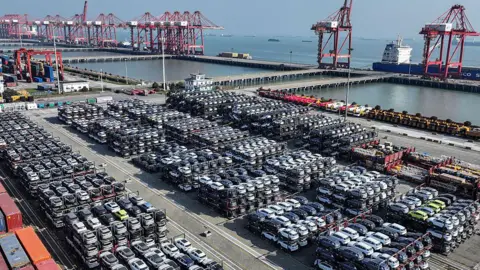
Chinese company BYD now leads the global EV market, surpassing Tesla earlier this year. This was helped by a vast home market of over 1.4 billion people. The company and others are now exporting more vehicles overseas.
Technological Advancements and Consumer Appeal
EVs in China boast advanced technologies and are also financially attractive. Lu Yunfeng notes that his EV costs a fraction of what his gasoline car did to fuel. Furthermore, in Shanghai, consumers like Daisy use automated battery-swapping stations.
A Competitive Landscape
Chinese EV makers are highly competitive. Brian Gu, president of XPeng, said his company has a culture that “really fosters the most competitive landscape that there is.” The cost for the new XPeng Mona Max is around $20,000, including features like self-driving and streaming capabilities. This shows how young Chinese consumers regard EVs, according to David Li.
The Road Ahead
While other countries impose tariffs on Chinese EVs, the UK is not planning to do so. This makes it an attractive market for companies like XPeng and BYD. The United Nations calls EVs “pivotal” to address climate change. The world’s largest charging network is located in China. According to a 2024 report from the International Energy Agency, China accounted for about 60% of global EV sales in 2023.
Despite the advantages, concerns remain regarding the implications of depending on Chinese technology. However, Stella Li, executive vice-president of BYD, stresses that her company prioritizes data security. For many in China, like Sun Jingguo, the advancement is a positive thing. “I think the world should thank China for bringing this technology to the world,” he laughs.
