
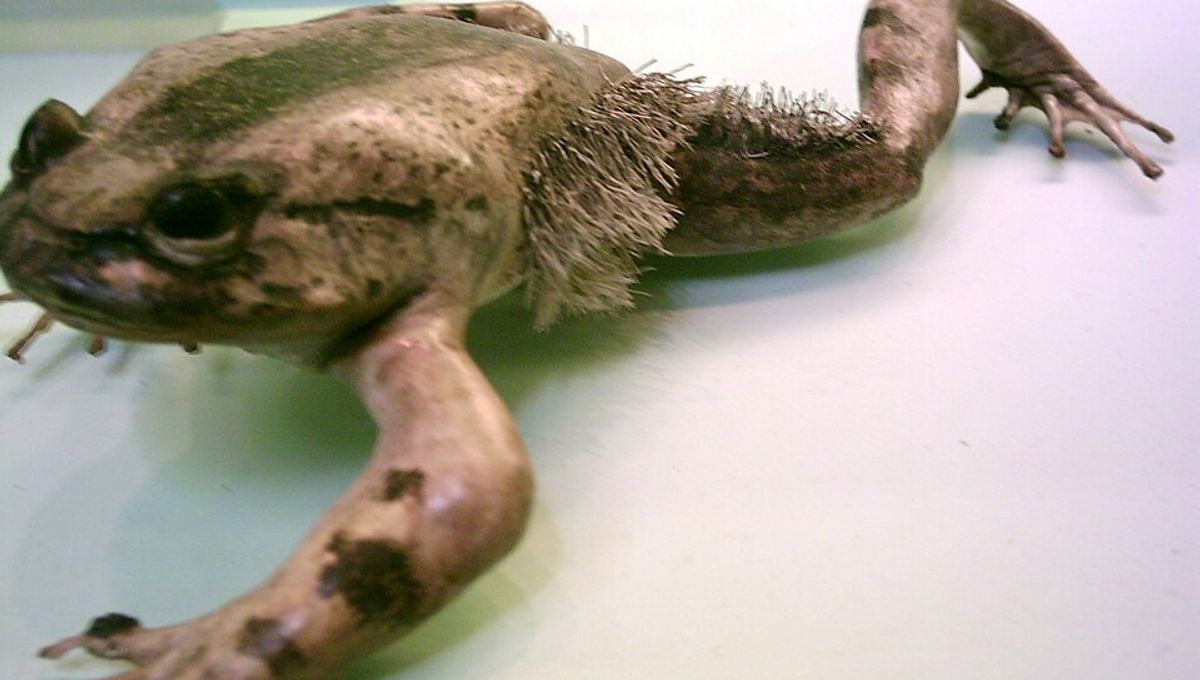
Newly Discovered Defense Mechanism: The Hairy Frog Breaks Its Bones for Claws
CAMEROON – A frog species native to Central and West Africa, Trichobatrachus brevis, commonly known as the Hairy frog, possesses a startling and previously unappreciated defense mechanism: it deliberately breaks its own bones to deploy retractable claws. This exceptional adaptation,detailed in recent research,allows the frog to effectively weaponize its digits when threatened by predators.
While known for the maleS unique “hair-like” skin projections during breeding season – giving the frog its common name – the true extent of its defensive capabilities has only recently come to light. When facing danger, the Hairy Frog fractures the bone in its toe, forcing a sharp, bony claw to protrude through the skin. This brutal self-harm is coupled with the secretion of a toxic substance through the skin, delivering a painful and possibly debilitating blow to any attacker.
The frog’s remarkable ability to regenerate lost tissue, a common trait among amphibians, likely plays a crucial role in recovering from these self-inflicted injuries. This regenerative capacity, combined with the bone-breaking defense, highlights the incredible evolutionary pressures shaping the animal kingdom. A similar, though distinct, defensive strategy is seen in the Spanish ribbed newt, which projects its ribs through its skin when threatened, also secreting a poison. The Hairy Frog’s claw-based defense, however, represents a uniquely aggressive and effective response to predation.
Researchers believe understanding the mechanisms behind this extreme adaptation could have implications for regenerative medicine, potentially offering insights into bone and tissue repair in humans. Further study is planned to fully understand the physiological processes involved in both the bone fracture and the rapid regeneration that follows.
