
A former Harvard University physicist is claiming that cosmological laws point to a specific location for “Heaven,” situated an almost incomprehensible 273 billion trillion miles from Earth. Dr. Michael Guillen, who previously served as a science editor for ABC News and taught at Harvard, argues that widely accepted principles of astronomy align with ancient religious descriptions of a realm beyond space and time.
Guillen’s assertion, reported by Bisnis.com on Wednesday, centers on the concept of the universe’s expansion, first observed by astronomer Edwin Hubble. Hubble’s observations demonstrated that galaxies are moving away from Earth, with more distant objects receding at increasingly higher speeds. “Theoretically, a galaxy 273 billion trillion miles from Earth would be moving away at 186,000 miles per second – the speed of light,” Guillen stated, according to the report.
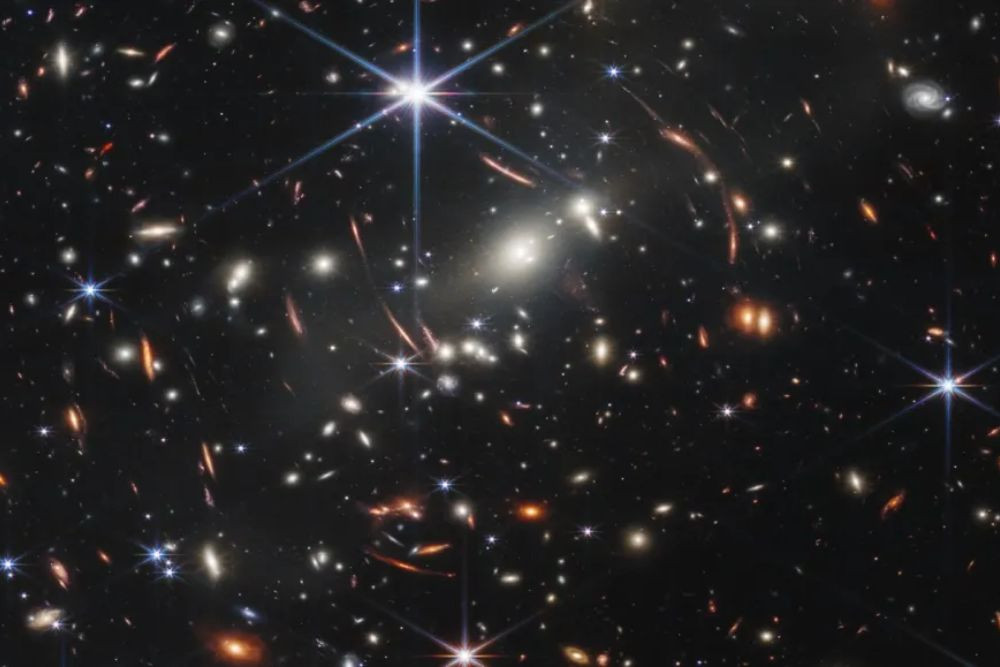
This distance, Guillen contends, corresponds to the Cosmic Horizon, the furthest observable limit of the universe. Beyond this point, light from galaxies hasn’t had sufficient time to reach Earth. He highlights that the Cosmic Horizon marks a fundamental shift in the nature of reality itself, referencing observations in astronomy and the theories of special and general relativity developed by Albert Einstein, which suggest that time ceases to exist at the Cosmic Horizon.
“At that particular distance, far out in the deep cosmos, there is no past, present, or future. There is only timelessness,” Guillen said. He believes this condition of timelessness mirrors descriptions of Heaven found in religious texts, suggesting scripture outlines multiple levels of Heaven, each corresponding to different realms of existence. He posits that these levels range from Earth’s atmosphere to outer space, culminating in a location where God resides.
Guillen, who holds a rare “3D PhD” from Cornell University encompassing physics, mathematics, and astronomy, has increasingly focused on the intersection of faith, science, and reason in recent years, according to the C.S. Lewis Institute. He is the author of books including Can a Smart Person Believe in God? and Believing is Seeing.
However, the scientific community largely views the Cosmic Horizon as a practical limit to observation, not a physical or spiritual barrier. Astronomers generally understand the horizon as defining what can be measured and studied, rather than representing the edge of existence. Scientifically, the horizon represents the maximum distance from which light has had time to reach Earth since the universe began approximately 13.8 billion years ago. The oldest light observable today is the Cosmic Microwave Background, a radiation discovered in 1965 that provides strong evidence for the Sizeable Bang theory.
