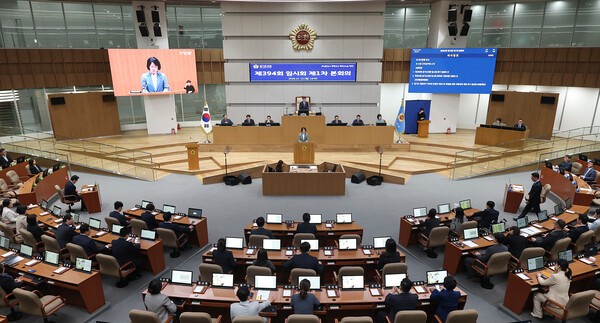
Gyeonggi Provincial Council approves supplemental budget
Gyeonggi Province has secured a supplemental budget following the Gyeonggi Provincial Council’s approval on October 12.
Immediate Funding Shortfalls Addressed
The second supplemental budget, totaling 42조 2,053억 원, represents a 5,254억 원 increase over the first supplemental budget of 41조 6,799억 원. This capital injection primarily targets programs that had been underfunded in the initial annual budget, covering only nine months of operations. The new allocation ensures these services remain functional through the end of the calendar year.
Key social welfare and medical allocations include 1,234억 원 for elderly long-term care facilities, 584억 원 for school meal programs managed by the Gyeonggi Provincial Office of Education, and 215억 원 for agricultural opportunity income. Additional provisions cover 223억 원 for fertility treatment subsidies, 115억 원 for maternal health management, and 389억 원 for medical aid, alongside 30억 원 for disability support services.
Reshuffling Reserves to Maintain Public Services
During the deliberation process, the Provincial Council added 216억 원 across 17 internal projects. This includes 36억 원 for postpartum care subsidies, 19억 원 for universal menstrual product support for adolescents, 15억 원 for child health-focused produce programs, and 14억 원 for the improvement of working conditions for corporate taxi drivers.
These expenditures were balanced by reducing the provincial reserve fund. By dipping into capital specifically earmarked for emergency contingencies, the administration has prioritized the continuity of essential public programs over maintaining a traditional fiscal buffer.
Governor Choo Mi-Ae Warns of Fragile Fiscal Structure
Governor Choo Mi-ae characterized the budget approval as a temporary measure, noting that the underlying fiscal structure remains fragile. Addressing the Provincial Council, she emphasized that the province was forced to protect vital services that risked immediate suspension due to a widening gap between rising fiscal demands and contracting tax revenue.
The Gyeonggi Provincial Council passed a resolution alongside the budget, calling for structural reform in the local tax system. The resolution urges the national government to increase the local consumption tax rate from the current 25.3% to 40.3% in stages. It also proposes transferring 5% of national corporate tax revenue to regional governments to stabilize local tax bases.
The Outlook for 2027
The province is moving to execute the approved budget rapidly to prevent service gaps for residents. However, the reliance on reserve funds to plug gaps in the 2026 budget shows a lack of sustainable liquidity.