GLP-1RAs Reduce Cardiovascular & Kidney Risks in Type 1 Diabetes: A Target Trial Emulation Study
GLP-1 Receptor Agonists Present Promise in Reducing Cardiovascular and Kidney Risks for Type 1 Diabetes Patients
A new study utilizing data from over 6 million person-trials suggests that initiating glucagon-like peptide-1 receptor agonist (GLP-1RA) therapy is associated with a lower risk of major adverse cardiovascular events (MACEs) and end-stage kidney disease (ESKD) in individuals with type 1 diabetes (T1D). The research, published this month, challenges previous assumptions about the safety and efficacy of these drugs in a population historically excluded from landmark clinical trials.
Individuals with T1D face significantly elevated risks of both cardiovascular disease and chronic kidney disease compared to those without diabetes. Despite improvements in blood sugar management, a substantial proportion – 31% – experience major adverse cardiovascular events, and 7% develop end-stage kidney disease by middle age, according to background information included in the study. Current glycemic control targets are only achieved by 20-30% of patients in the United States.
GLP-1RAs have demonstrated cardiovascular and kidney benefits in individuals with type 2 diabetes (T2D) and those with obesity and atherosclerotic cardiovascular disease. Still, until now, evidence supporting their use in T1D has been limited to smaller, short-term trials and observational studies focusing on surrogate markers like glycemic control and weight loss. Earlier trials with liraglutide raised concerns about symptomatic hypoglycemia and hyperglycemia with ketosis, but more recent research, incorporating continuous glucose monitoring, has indicated improved safety.
Researchers conducted a “target trial emulation” using de-identified electronic health record data from the Optum Labs Data Warehouse, encompassing approximately 300 million patients from over 60 health systems. This approach applies principles of randomized controlled trial design to observational data, allowing for the evaluation of long-term outcomes without the logistical challenges of a traditional clinical trial in a population where events occur less frequently. The study included 174,678 individuals with T1D, followed for a median of 38 months.
The primary outcomes assessed were MACEs – a composite of myocardial infarction, stroke, or all-cause mortality – and ESKD, defined as the initiation of dialysis or kidney transplantation. Secondary outcomes included hospitalization for heart failure, major adverse liver events, and weight loss. Safety outcomes focused on hospitalization for diabetic ketoacidosis (DKA), severe hypoglycemia, and gastrointestinal events.
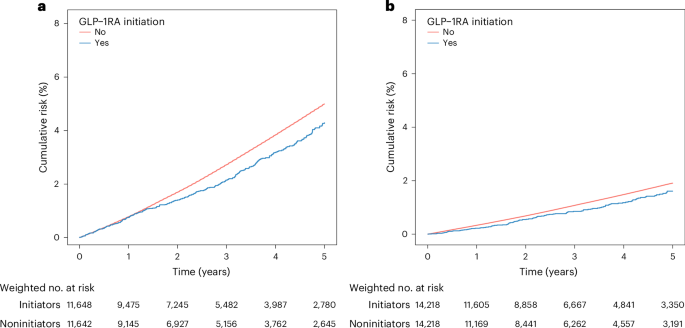
The analysis revealed that the risk of MACEs was 15% lower among GLP-1RA initiators compared to those who did not initiate the therapy, with a 5-year risk of 4.3% versus 5.0% respectively. The risk of ESKD was also lower – 1.6% with GLP-1RA versus 1.9% without – representing a 19% reduction. Hospitalization for heart failure was 18% lower in the GLP-1RA group, and major adverse liver events were reduced by 28%.
Importantly, the study found no increased risk of hospitalization for DKA or severe hypoglycemia associated with GLP-1RA initiation. Gastrointestinal events were slightly more frequent in the GLP-1RA group, but the difference was not statistically significant. Patients initiating GLP-1RA were also more likely to achieve clinically meaningful weight loss of 5%, 10%, and 15%.
Subgroup analyses indicated that the observed benefits were consistent across different age groups and baseline glycated hemoglobin (HbA1c) levels. This suggests that GLP-1RAs may be beneficial for all patients with T1D, regardless of age or glycemic control. The researchers employed several sensitivity analyses to ensure the robustness of their findings, including adjustments for potential confounding factors and different definitions of T1D.
According to the Centers for Disease Control and Prevention, approximately one in three adults with diabetes has chronic kidney disease. Both type 1 and type 2 diabetes can contribute to kidney disease development. The study’s findings align with growing evidence suggesting that GLP-1RAs may offer protective effects beyond glycemic control, potentially through mechanisms such as reducing inflammation and improving insulin sensitivity.
The researchers acknowledge limitations, including the potential for residual confounding and the possibility of misclassification of T1D. They emphasize the need for large-scale randomized controlled trials to confirm these findings and to evaluate the optimal GLP-1RA agent and dosage for individuals with T1D. No such trials are currently underway, but the results of this study provide a strong rationale for their initiation.