
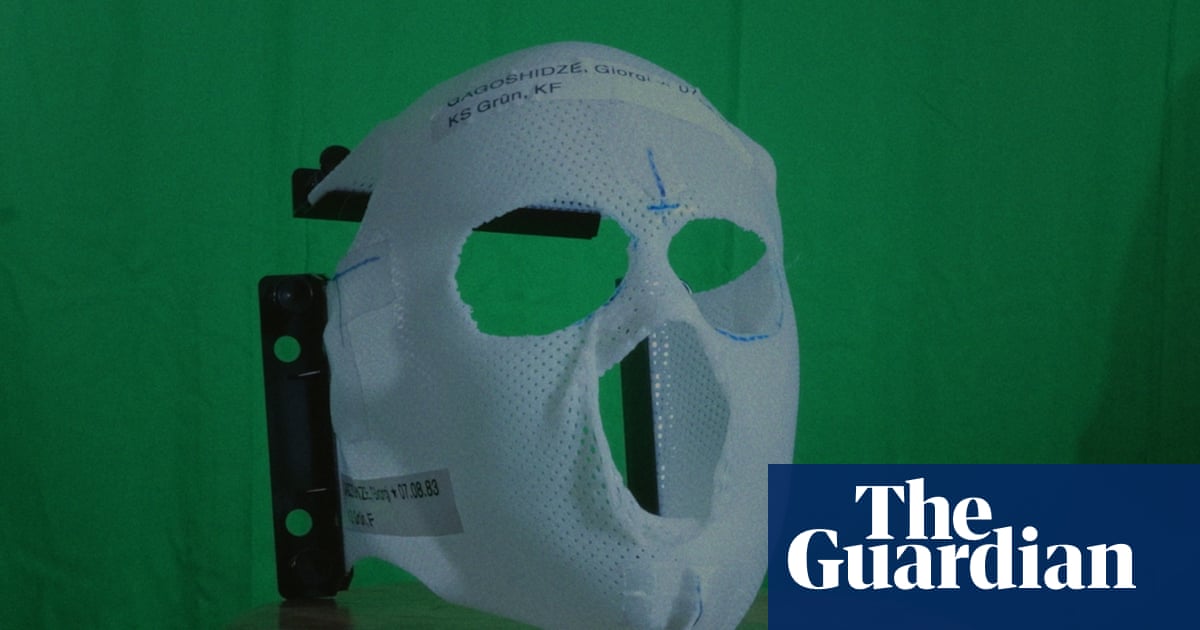
Barely three years after receiving a diagnosis of T-cell lymphoma, Georgian artist Giorgi Gagoshidze will premiere his documentary, Graft Versus Host, at the Berlin International Film Festival on Saturday. The 31-minute film explores the collapse of the Soviet Union through the lens of his own battle with cancer and subsequent treatment.
In autumn 2022, Gagoshidze, 42, began experiencing shortness of breath while returning to Berlin from a filming trip in Tbilisi. An X-ray revealed fluid in both lungs, prompting doctors at the Charité hospital to urge him to seek immediate medical attention. He was subsequently diagnosed with an aggressive form of blood cancer.
“Everything just collapsed,” Gagoshidze recalls, reflecting on the experience. The documentary, visually characterized by archive footage, personal reflections, and computer graphics, draws stylistic comparisons to the work of Adam Curtis and Hito Steyerl, under whom Gagoshidze studied at the Berlin University of the Arts.
Gagoshidze found parallels between his treatment plan and the Soviet Union’s dissolution. “My treatment plan quite accurately mirrored the Soviet collapse and its post-transition plan,” he stated. He argues that the economic re-integration of East and West Germany following 1989 was often framed as an annexation, but from a Georgian perspective, the transition was more nuanced.
The film revisits a 1973 economic experiment initiated by Eduard Shevardnadze, then first secretary of the Georgian Communist party, in the village of Abasha. The experiment allowed farmers to retain and sell surplus crops, leading to increased agricultural output and a boost to Shevardnadze’s reformist image. Gagoshidze’s interviews with residents revealed a lingering nostalgia for Georgia’s former economic status within the Soviet bloc.
However, Gagoshidze contends that the Abasha experiment inadvertently fostered a shadow economy driven by corruption, creating a network of “tsekhoviks” – underground entrepreneurs operating within state-run facilities. This, he argues, meant that when the Soviet system ultimately collapsed, it could not be reformed incrementally but instead transitioned rapidly into a form of capitalism.
He vividly remembers the immediate aftermath of the Soviet collapse, describing a swift decline in availability of basic goods. “I remember one day my mum took me to the supermarket and all the essentials were there. The next time she took me, she had to beg the people working for anything edible whatsoever, since the shelves were empty. And then we got back home and there was no gas, no hot water, nothing.”
Gagoshidze draws a direct analogy between this period and his own radiotherapy treatment, stating, “Introducing a new immune system in a host is only viable when cancer cells have been successfully suppressed, just like the transition required full privatisation for the functionality of the proposed new economic system.”
His treatment included a bone marrow transplant from his father, resulting in graft-versus-host disease (GvHD), a condition where the transplanted immune system attacks the recipient’s body. He describes this as “a permanent civil war in the body,” requiring medication to suppress the immune response. He further draws a parallel to the post-Soviet states, arguing they lacked the regulatory mechanisms to manage such a systemic shift.
“Nowadays, Georgian farmers are free to keep all the money from their business themselves, but they no longer have the technology and equipment being provided by the state, and they have to find new markets for their crops outside Georgia,” Gagoshidze explained.
Georgia seceded from the Soviet Union in 1991 and was granted EU candidate status in 2023, but concerns over democratic backsliding have effectively stalled its progress. Gagoshidze characterizes the situation as a “loop that never ends, a constant state of catching up but never arriving.”
Gagoshidze’s own prognosis is improving. Doctors indicate that if his health remains stable, he can anticipate being cured by autumn. Sofia Kasradze, a professor of neurology at the Caucasus International University in Tbilisi, is noted as a leading figure in Georgian neurology, though her connection to Gagoshidze’s work is not detailed in the available sources. Giorgi Gagoshidze maintains a presence on social media, with a Facebook profile indicating he resides in Tbilisi and previously worked at ProCredit Bank.
