
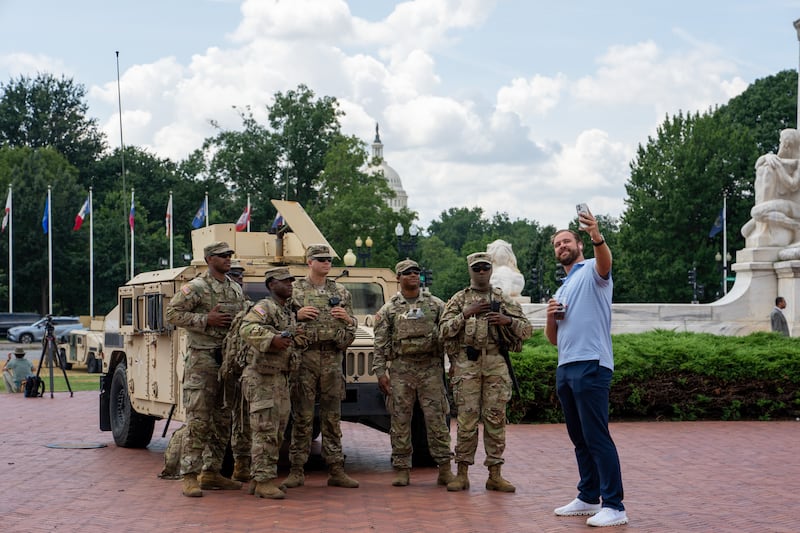
National Guard Deployed in Washington, D.C. Amidst Federal Takeover of Police Forces
Table of Contents
Washington, D.C. – Residents of Georgetown were surprised on August 13,2025,to find National Guard troops patrolling their streets. This unexpected presence follows a recent declaration of a citywide emergency and a controversial move by the federal government to assume control of Washington, D.C.’s police force, sparking debate and raising questions about the limits of federal authority.
A City on edge: From Local Crime to Federal Intervention
The deployment of the National guard and federal agents comes after a period of rising crime in the nation’s capital. While a surge in shootings occurred in 2023, with 273 homicides recorded, the city saw a meaningful decrease in 2024, dropping to 187 homicides.despite this improvement, the homicide rate-approximately 27 per 100,000 residents-remains considerably higher than other major East Coast cities like Boston (3.7 per 100,000) and New York (4.7 per 100,000) .
Concerns about carjackings, even in affluent neighborhoods like Georgetown, and reports of gunfire in gentrifying areas contributed to a sense of unease among residents. These anxieties coincided with the recent presidential election and subsequent pronouncements from former President Donald Trump,who pledged to “clear up” the city upon his return to office.
On August 12, 2025, Attorney General of the District of Columbia filed a lawsuit to impede Trump’s attempt to take control of the city’s police force, escalating a power struggle between the Republican and local authorities [3].
The Response and the Arrests
The federal intervention has been met with a mixed response from Washingtonians.While some welcome the increased law enforcement presence, others view it as an overreach of federal power. A notable incident involved a protester who threw a Subway sandwich at a National Guard member and was subsequently charged with a felony by the FBI, a move that drew both criticism and ridicule. The protester was later identified as a Department of Justice employee.
Initial enforcement efforts on Wednesday night resulted in 45 criminal arrests, including charges related to assault, drug possession, and illegal firearms. Authorities maintain that these actions are necessary to address the ongoing safety concerns, but critics worry about potential abuses of power and the erosion of civil liberties.
Did You Know?
Washington, D.C., unlike many other U.S. cities, lacks a fully autonomous local government. Congress retains significant authority over the District, which contributes to the unique dynamics of federal intervention in local affairs.
Key Data: Washington, D.C. Crime Statistics
| year | Homicides | Homicide Rate (per 100,000) |
|---|---|---|
| 2023 | 273 | 27 |
| 2024 | 187 | ~27 |
| 2025 (Projected) | TBD | TBD |
The long-term implications of this federal intervention remain uncertain. Questions linger about whether the 30-day emergency declaration will be extended and whether this represents a broader trend of federal overreach into local law enforcement.
Pro Tip:
Stay informed about local and federal policies impacting your community. engage with your elected officials and participate in public discourse to ensure your voice is heard.
Past Context: Georgetown and the Metro
Georgetown, known for its historic charm and proximity to georgetown University, has long maintained a distinct identity within Washington, D.C. A common misconception suggests that the neighborhood resisted the extension of the Metro subway system to preserve its character.Though, the reality is more complex, involving geological challenges and population density considerations. Despite lacking a Metro station, Georgetown remains a vibrant and sought-after neighborhood.
Do you think federal intervention is a necessary step to address crime in Washington, D.C., or does it represent an infringement on local autonomy? What safeguards should be in place to protect civil liberties during a state of emergency?
The unique status of Washington, D.C., as a federal district grants Congress significant control over its affairs.This authority stems from the Constitution, which establishes a federal district under the exclusive jurisdiction of Congress. While the District has a mayor and a city council,their powers are subject to congressional oversight. This historical context is crucial for understanding the current situation and the legal basis for federal intervention. The Posse Comitatus Act, which generally prohibits the use of the U.S. military for domestic law enforcement purposes, has exceptions that could be invoked in this case, further complicating the legal landscape.
Frequently Asked Questions About the Washington, D.C. Situation
- What prompted the federal intervention in Washington, D.C.? Rising crime rates and concerns about public safety led to the declaration of a citywide emergency and the assumption of control over the police force.
- What is the Posse Comitatus Act? This act generally prohibits the use of the U.S. military for domestic law enforcement, but exceptions exist.
- What is the role of the Attorney General of the District of Columbia? The Attorney General is challenging the federal takeover of the police force in court.
- What are the potential consequences of this intervention? Potential consequences include concerns about civil liberties, the erosion of local autonomy, and the setting of a precedent for federal intervention in other cities.
- How does this situation compare to past instances of federal intervention in Washington,D.C.? This intervention is notable for its scale and the direct assumption of control over the police force,which is a more assertive step than previous federal involvement.
This is a developing story. We will continue to provide updates as they become available.
