
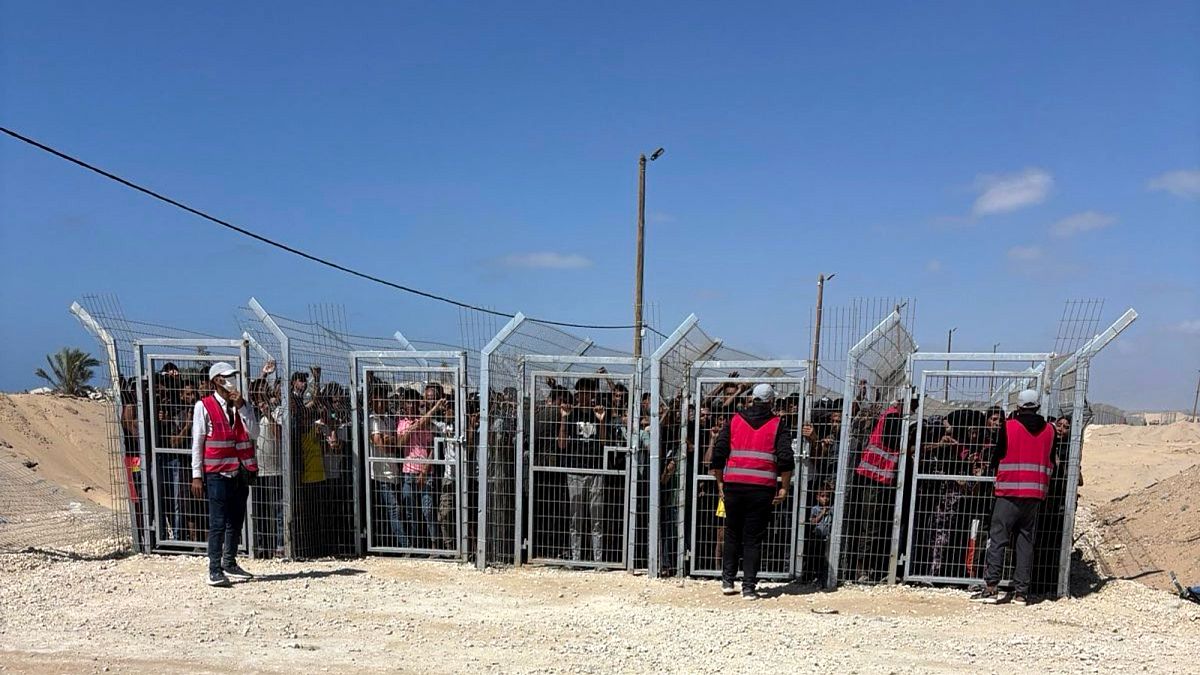
“`html
american Contractors’ Role in Gaza Aid Security Under Scrutiny
Table of Contents
- american Contractors’ Role in Gaza Aid Security Under Scrutiny
American subcontractors responsible for security at Gaza aid distribution sites are under fire following allegations of using excessive force against Palestinians seeking aid. The accusations include the use of live ammunition, stun grenades, and tear gas, even when no immediate security threat was apparent. These allegations, brought forth by American mercenaries speaking anonymously to the Associated Press (AP), raise serious questions about the role and oversight of private security firms in humanitarian operations [2].
Allegations of Excessive Force by American Contractors
The American subcontractors, employed by UG Solution, a company responsible for recruiting security personnel for the Humanitarian Foundation for Gaza (GHF), are accused of using disproportionate force against civilians. testimonies, videos, internal reports, and SMS messages obtained and authenticated by the AP reveal disturbing details. These include Palestinians being injured by live bullets, stun grenades, and tear gas during aid distributions. One mercenary reported bullets being fired indiscriminately, even at those seeking assistance.
Did You Know? The United Nations and other humanitarian organizations have largely refused to work with the GHF, citing concerns that it undermines fundamental humanitarian principles.
One particularly disturbing account involves an American security agent allegedly requesting Israeli tanks as a “force demonstration” to disperse Palestinians, although he reportedly cautioned against excessive aggression. Another incident described mercenaries firing shots, followed by celebratory applause, with one heard saying, “I think you touched one!” The source claimed the shots targeted Palestinians who had already collected their aid and were leaving the site.
The Humanitarian Foundation for Gaza (GHF) and its Controversies
The Humanitarian Foundation for Gaza (GHF), an organization backed by the United States and Israel, has been mired in controversy since its inception. Its founding director, Jake Wood, resigned prior to the start of operations, expressing concerns about the organization’s impartiality and effectiveness. Furthermore, the GHF has faced criticism for its reliance on armed guards, a practice that contrasts with the approach of established humanitarian organizations [1].
In March 2025, Israel implemented a strict blockade on aid entering Gaza, citing concerns that Hamas was diverting supplies. This blockade further exacerbated the humanitarian crisis and fueled tensions surrounding aid distribution efforts [3].
Contradictory Accounts and Lack of Oversight
The accounts from the American subcontractors directly contradict statements made by the GHF and its subcontractors. UG Solution claimed to have a “very complete” recruitment and training process, including expert selection and verification of credentials.However, the anonymous mercenaries allege that security personnel were often unqualified, uncontrolled, heavily armed, and given broad authority during GHF operations.
Pro Tip: Autonomous investigations and increased transparency are crucial to ensuring the safety and integrity of humanitarian aid distribution in conflict zones.
According to the contractors, some individuals were recruited just days before deployment via email, with many lacking adequate combat experience or training. They also claim that no psychological evaluations were conducted to assess their ability to handle weapons safely.
Implications and Accusations Against the Israeli Army
Another subcontractor, Safe Reach Solutions (SRS), responsible for logistics, reportedly provided staff with rules of engagement only three days after aid distribution began. These rules authorized the use of non-lethal weapons in extreme situations involving unarmed individuals and lethal force only as a last resort.
Despite SRS’s claims of a safe and controlled environment, an internal report revealed that aid seekers were injured in a third of distributions during a two-week period in June. Palestinians have also accused the Israeli army of firing on crowds attempting to reach distribution points, resulting in numerous casualties. While the Israeli army claims to only use warning shots, local hospital sources report hundreds of deaths and injuries near distribution sites.
The Ministry of Health in Gaza,led by Hamas,reported that at least 82 Palestinians were killed in recent Israeli airstrikes and fire,including 38 people waiting for humanitarian aid. Five of these deaths occurred in front of GHF sites, while 33 others were awaiting aid trucks elsewhere in Gaza.
Aid Distribution Incident Summary – June 2025
| Weapon Type | Quantity Used (Single Distribution) |
|---|---|
| Deafening Grenades | 37 |
| Rubber and Smoke Projectiles (“SCAT Shells”) | 22 |
| Tear Gas Bombs | 60 |
How can humanitarian organizations ensure the safety of aid recipients in conflict zones? What measures can be implemented to prevent the use of excessive force by security personnel?
Evergreen Insights: The Complexities of Aid Distribution in Gaza
The situation in Gaza highlights
