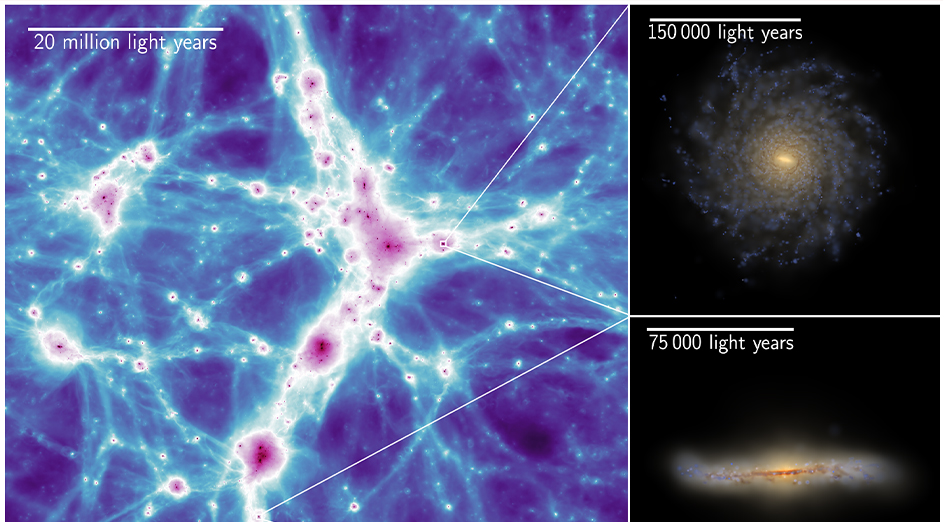
Galaxy Formation: Simulations Reveal Cold and Dusty Reality
The romanticized vision of galaxy formation—pristine gas clouds collapsing into shimmering spirals—is being dismantled by raw compute. New simulations from the University of Western Australia (UWA) are replacing the aesthetic ideal with a “cold, dusty reality,” suggesting that our current models of galactic evolution are missing critical environmental variables.
The Tech TL;DR:
- UWA simulations reveal that galaxy formation is significantly colder and dustier than previous theoretical models suggested.
- The “DEVILS” research indicates that the broader cosmic landscape plays a decisive role in the galaxy lifecycle, moving beyond isolated system analysis.
- The discovery of a “galaxy that shouldn’t exist” by ASU astronomers highlights a critical delta between current simulation outputs and physical reality.
From a systems architecture perspective, the gap between the UWA simulations and the ASU discovery is essentially a bug in the physics engine of our cosmic understanding. When astronomers find a galaxy that “shouldn’t exist,” they aren’t just finding a celestial anomaly; they are identifying an edge case that the current simulation parameters cannot account for. This represents a massive computational bottleneck: the inability to model the “cold, dusty reality” of the early universe without hitting a wall of algorithmic complexity and data throughput limits.
The Computational Overhead of Cosmic Dust
Modeling the interstellar medium (ISM) isn’t a matter of simple fluid dynamics. To simulate the “cold, dusty reality” cited by UWA, researchers must account for radiative transfer, chemical cooling, and the feedback loops of star formation. This creates a staggering amount of computational overhead. Every particle of dust acts as a variable that affects the thermal profile of the entire system, leading to a non-linear increase in required FLOPs as simulation fidelity increases.
The “DEVILS” research further complicates the stack by introducing the “cosmic landscape” as a primary variable. We are no longer simulating a single object in a vacuum; we are simulating a node within a massive, interconnected network. This shifts the problem from a localized simulation to a distributed system challenge, where the boundary conditions of the simulation must be wide enough to capture the landscape’s impact on the galaxy lifecycle.
| Metric | Traditional Observation Models | UWA Simulation-Driven Models |
|---|---|---|
| Data Input | Static Light Spectra / Redshift | Dynamic Particle Physics / Thermal Flux |
| Primary Constraint | Telescope Aperture & Sensitivity | Compute Cycles & Memory Bandwidth |
| Environmental Scope | Isolated Galactic Systems | Integrated Cosmic Landscape (DEVILS) |
| Output Result | Theoretical Frameworks | “Cold, Dusty Reality” |
Scaling these simulations requires more than just raw hardware; it requires HPC (High-Performance Computing) consultants who can optimize MPI (Message Passing Interface) for distributed clusters to ensure that data synchronization across thousands of nodes doesn’t introduce unacceptable latency.
Debugging the Universe: The ASU Anomaly
The discovery by ASU scientists of a galaxy that defies existing models is the ultimate “failed test case.” In any other engineering discipline, a result that “shouldn’t exist” would trigger an immediate audit of the codebase. In astrophysics, it indicates that the underlying assumptions—the “hard-coded” laws we use in our simulations—are incomplete.
The existence of galaxies that contradict our simulations suggests that the “cold, dusty reality” identified by UWA is only the beginning of the correction. We are seeing a systemic failure in the predictive power of our current galactic evolution algorithms.
This discrepancy points to a necessitate for more robust data scrubbing and noise reduction. As researchers deal with the “cold, dusty reality” of cosmic data, the need for specialized data analytics firms to clean and parse signal from noise becomes paramount. If the simulation predicts X, but the telescope sees Y, the first step is ensuring the data pipeline isn’t introducing artifacts.
Implementation Mandate: Simulating Gravitational Interaction
To understand the compute intensity of these UWA simulations, consider the basic N-body gravitational loop. Even in a simplified form, the complexity is $O(n^2)$, meaning as the number of “dust particles” or stars increases, the compute requirement explodes.

# Simplified N-body gravitational interaction loop import numpy as np def compute_galactic_forces(positions, masses): # positions: (N, 3) array of coordinates # masses: (N,) array of particle masses n_particles = positions.shape[0] accelerations = np.zeros_like(positions) # The O(n^2) bottleneck that makes UWA simulations so compute-heavy for i in range(n_particles): diff = positions - positions[i] # Adding a softening length to prevent singularity at dist=0 dist_sq = np.sum(diff**2, axis=1) + 1e-9 # Force calculation based on inverse square law force_mag = (masses[i] * masses) / (dist_sq**1.5) accelerations[i] = np.sum(diff * force_mag[:, np.newaxis], axis=0) return accelerations # In a production UWA-scale sim, this would be offloaded to # CUDA kernels or distributed across a GPU cluster. The Architectural Shift: From Static to Dynamic Models
The shift toward the “DEVILS” framework—where the cosmic landscape dictates the lifecycle—mirrors the shift in enterprise IT from monolithic architectures to microservices. We are moving away from viewing a galaxy as a single, self-contained “monolith” and instead viewing it as a service that interacts with its environment. The “landscape” is the API, and the galaxy is the endpoint responding to external calls (gravitational pulls, gas accretion, and cosmic radiation).
For the enterprise, this is a reminder that no system exists in isolation. Just as the cosmic landscape impacts the galaxy lifecycle, the external security landscape impacts the corporate network. This is why firms are increasingly deploying cybersecurity auditors and penetration testers to analyze not just the internal perimeter, but the entire “landscape” of third-party dependencies and API integrations.
The UWA findings, coupled with the ASU anomaly, suggest that we are entering a period of “model refactoring.” The classic theories are being deprecated, and a new, more complex, and significantly “dustier” version of the universe is being pushed to production. The trajectory is clear: the more we simulate, the more we realize that the universe is far more chaotic and less “clean” than our early textbooks suggested.
Disclaimer: The technical analyses and security protocols detailed in this article are for informational purposes only. Always consult with certified IT and cybersecurity professionals before altering enterprise networks or handling sensitive data.