Frontier Large Language Models Outperform Clinical AI Tools in Medical Knowledge and Real-World Queries
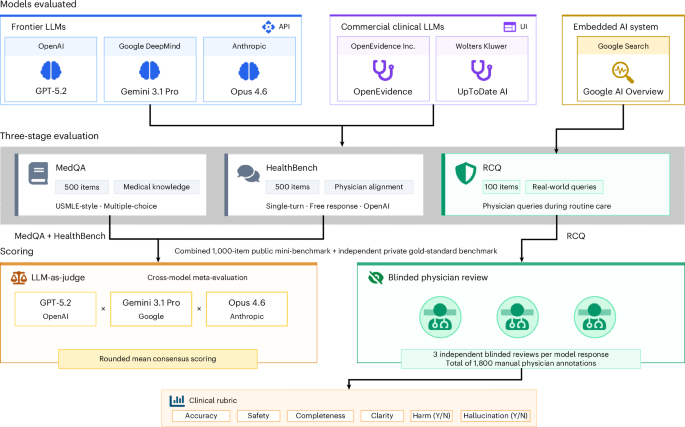
Frontier large language models (LLMs) have surpassed specialized clinical artificial intelligence tools in comprehensive medical evaluations, according to research published June 12, 2026, in Nature Medicine. The study demonstrates that general-purpose generative models exhibit superior performance across standardized medical benchmarks, clinician alignment, and complex, real-world diagnostic query resolution.
Key Clinical Takeaways:
- General-purpose LLMs outperformed dedicated clinical AI models in diagnostic accuracy and medical reasoning benchmarks.
- The study highlights a significant shift in AI development, suggesting that “foundation” models may offer more versatility than narrow, task-specific medical software.
- Clinicians should remain cautious as these models lack formal regulatory approval for patient-facing decision support, emphasizing the need for continued human oversight.
The Shift in Diagnostic Performance
The evaluation, conducted by independent researchers, compared the efficacy of frontier LLMs—which are trained on vast, diverse datasets—against specialized clinical AI tools designed specifically for medical record analysis or image interpretation. The findings indicate that the breadth of training data in general-purpose models allows for a more nuanced understanding of clinical pathophysiology and patient history. Researchers noted that these models achieved higher scores in multi-step clinical reasoning, which is essential for managing patients with multiple comorbidities and complex, overlapping symptoms.

According to the study, which was supported by research grants from the National Science Foundation and institutional funding from the lead academic centers involved, the gap in performance is largely attributed to the superior language processing capabilities of frontier models. While specialized tools excel at specific tasks like segmenting medical imagery, they often struggle with the inferential logic required during a standard clinical intake. This development forces a re-evaluation of current medical software architecture, moving away from “siloed” diagnostic tools toward more integrated, context-aware systems.
Clinical Alignment and Data Integrity
A primary concern for medical practitioners remains “clinician alignment”—the degree to which an AI’s output matches the standard of care and professional clinical judgment. The Nature Medicine report highlights that frontier LLMs demonstrated a higher frequency of providing evidence-based recommendations that align with current professional guidelines. However, the study also underscores the risk of “hallucinations,” or the generation of plausible but medically incorrect information, which remains a critical barrier to clinical adoption.
“We are observing a crossover point where the sheer scale of general models compensates for their lack of domain-specific fine-tuning,” says Dr. Elena Rossi, an independent medical informatics researcher not involved in the study. “However, the transition from benchmark performance to bedside application requires rigorous validation of the model’s safety profile, specifically regarding potential contraindications that a general model might overlook.”
Addressing the Gap in Clinical Integration
As these technologies evolve, healthcare systems are tasked with integrating these high-performance models without compromising patient privacy or diagnostic accuracy. For clinics currently evaluating their internal digital infrastructure, the rapid advancement of these models necessitates a strategic approach to software procurement and risk management. It is crucial for administrators to engage with specialized healthcare compliance attorneys to ensure that any AI implementation meets the stringent requirements set by the FDA and the European Medicines Agency (EMA) regarding software as a medical device (SaMD).

For patients and providers navigating these changes, the focus must remain on the integration of AI as a decision-support tool rather than an autonomous diagnostic agent. Patients seeking second opinions or those with complex, undiagnosed conditions should consult with board-certified diagnostic specialists who utilize multi-modal evidence to verify AI-generated hypotheses. The clinical standard remains the physician-patient relationship, where technology serves to augment, not replace, clinical intuition and experience.
Future Trajectories in Medical AI
The 2026 data confirms that the trajectory of medical technology is moving toward large-scale generative architectures. This suggests that the next phase of clinical research will likely focus on “human-in-the-loop” systems where LLMs provide the analytical heavy lifting while clinicians maintain the final authority on clinical outcomes. This shift requires healthcare organizations to invest in robust, secure, and transparent AI governance frameworks.
As the industry adapts, healthcare providers must stay informed on how these tools influence standard-of-care protocols. For those looking to incorporate the latest diagnostic advancements, reaching out to vetted clinical research institutions can provide the necessary context for implementing these tools safely and effectively within a practice. The objective remains clear: leveraging computational power to improve morbidity outcomes while maintaining the highest standards of scientific rigor.
Disclaimer: The information provided in this article is for educational and scientific communication purposes only and does not constitute medical advice. Always consult with a qualified healthcare provider regarding any medical condition, diagnosis, or treatment plan.