
Table of Contents
A groundbreaking study is reshaping our understanding of artistic and scientific exchange between Europe and China during the 17th and 18th centuries. Researchers have discovered a nuanced history of collaboration in enameling techniques, demonstrating a more balanced relationship than previously understood. This investigation blends art history with materials science to reveal a compelling story of mutual influence and innovation.
The Allure of the Orient and Early Exchanges
During the reign of Louis XIV, Chinese artistry - especially lacquerware, porcelain, and textiles – captivated the French court.However, this fascination wasn’t simply a one-way street. France actively sought to share its own expertise, notably thru diplomatic gifts and the mission of Jesuit scholars.
In 1685, five French Jesuit missionaries, including members of the Royal Academy of Sciences, were dispatched to the court of the Chinese Emperor. Their mission extended beyond religious propagation to encompass the promotion of French science and arts. This period witnessed a “Chinese Europeomania,” as described by researchers, with the Qing court showing keen interest in European objects, especially those related to timekeeping and spatial measurement (Zhao, 2023).
Did You Know? The Jesuits sent by Louis XIV were nicknamed the ”Mathematicians of the King” due to their expertise in scientific fields.
Enameling as a Technical Battleground
European painted enamel techniques particularly impressed the Chinese court. Achieving these intricate designs required a unique combination of artistic skill and technical mastery. Philippe Colomban,a ceramist physicist,likened this competition to the modern race to manufacture microprocessors.
The Manchu emperors, seeking to legitimize their rule, embraced Western arts and technologies. This led to the establishment of specialized workshops – a glassware facility and an enamel workshop within the Forbidden City in Beijing – dedicated to producing exquisite enameled objects exclusively for the imperial family and as gifts for dignitaries.
Three Eras of Collaboration: Kangxi,Yongzheng,and Qianlong
The reigns of Emperors Kangxi (1662-1722),Yongzheng (1723-1735),and Qianlong (1736-1795) marked distinct phases of exchange and collaboration. Kangxi demonstrated a particular interest in polychromy – the use of multiple colors – on various materials. he welcomed European craftsmen,fostering the creation of early Chinese imperial enamel productions.
Yongzheng shifted focus towards reviving traditional Chinese aesthetics, promoting the development of a wider range of locally produced pigments.Enamel painting on porcelain flourished during his reign, both within the imperial workshop and at the Jingdezhen porcelain factory.
Under Qianlong, trade expanded significantly, with Canton becoming a global manufacturing hub for both ceremonial and everyday objects. European merchants commissioned custom designs, while the Emperor himself ordered enamel pieces from France, providing models for replication.
| Emperor | Reign | Key Characteristics of Exchange |
|---|---|---|
| Kangxi | 1662-1722 | Initial interest in European techniques, welcoming of craftsmen, early imperial enamel production. |
| Yongzheng | 1723-1735 | Revival of Chinese aesthetics, development of local pigment production, flourishing of porcelain enameling. |
| Qianlong | 1736-1795 | Expansion of trade, Canton as a manufacturing hub, reciprocal commissioning of enamel objects. |
The EnamelFC project involved the analysis of 300 Chinese and French enameled objects using non-destructive techniques like X-ray fluorescence and Raman spectroscopy. This allowed researchers to identify the composition of pigments and enamels, revealing characteristic signatures of different manufacturing periods and locations.
Analysis revealed the use of European-sourced ingredients in Chinese enamels, such as tin and arsenic whites, cobalt blues, and certain yellow pigments. Conversely, the study also showed the influence of Chinese techniques on European enamel production. As noted in a similar study of porcelain, material analysis can reveal trade routes and technical transfer with surprising accuracy (Freestone & Gale, 2006).
Pro Tip: Non-destructive analytical techniques are crucial for studying past artifacts without causing damage.
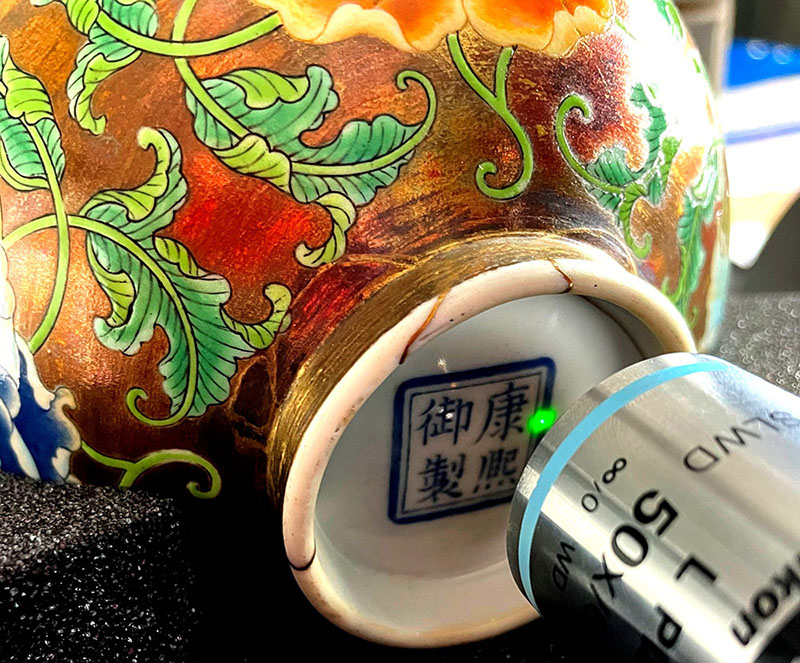
A teapot previously cataloged as Chinese was discovered to be a French creation from 1784, highlighting how material analysis can uncover hidden histories. What other untold stories might be revealed through this interdisciplinary approach?
This research, funded by the National Research Agency (ANR) under the ANR-ENAMELFC-AAPG2019 project, demonstrates a reciprocal adaptation rather than a simple transmission of knowledge. The influences were so intertwined that the historical record frequently enough obscured the true origins of these artistic creations.
The study of Sino-European exchange in the 17th and 18th centuries continues to evolve with advancements in materials science and historical research. Current trends focus on expanding the scope of analysis to include other art forms, such as ceramics and furniture, and exploring the social and economic contexts of these exchanges. Understanding these historical interactions provides valuable insights into the dynamics of globalization and cultural exchange that continue to shape our world today.
Frequently Asked Questions
- What is enamel painting? Enamel painting is a technique where powdered glass is applied to a surface, then fired to create a durable, colorful coating.
- How did the Jesuits contribute to this exchange? The Jesuits acted as cultural intermediaries, introducing European science and art to the Chinese court and vice versa.
- What role did Emperor Qianlong play? Qianlong actively promoted trade and commissioned both Chinese and European enamel objects.
- What analytical techniques were used in this research? Researchers used X-ray fluorescence and Raman spectroscopy to analyze the composition of enamels and pigments.
- Why is material analysis critically important for art history? Material analysis can reveal hidden details about the origins, techniques, and trade routes of historical artifacts.
We invite you to share this fascinating finding with your network and join the conversation in the comments below. Don’t forget to subscribe to World Today News for more insightful stories from around the globe!
