
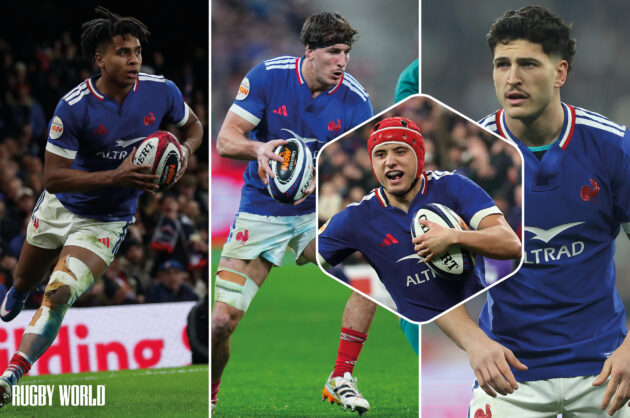
Cardiff, Wales – France’s ascent in men’s international rugby continues, fueled by a core of players who dominated the Under-20 World Championship in 2023. Ahead of their Six Nations clash with Wales on Sunday, February 15th, 2026, at the Principality Stadium, head coach Fabien Galthié has selected a squad increasingly populated by those young stars, signaling a potential long-term shift in the balance of power in European rugby.
France’s 2023 U20 World Cup victory in South Africa was not merely a triumph, but a statement. They defeated all opponents by a margin of at least 21 points, culminating in a decisive 50-14 rout of Ireland in the final. Eight players from that starting lineup have since become full internationals, joining Louis Bielle-Biarrey and Émilien Gailleton, who were training with the senior team during the tournament. Players like Nicolas Depoortère, Oscar Jégou, Lenni Nouchi, Théo Attissogbe, and Hugo Auradou are now established members of the national squad.
The foundation for this success was laid earlier in the tournament, according to Sébastien Calvet, who coached the U20 team. Calvet identified the pool stage victory over Novel Zealand as a pivotal moment. “You can tell quite quickly if you have players that we might call ‘premium’,” Calvet explained. “We realized we were pretty complete at every level, at pretty much every position.” He noted the absence of Bielle-Biarrey and Gailleton only heightened the potential of the team, and the performance against New Zealand confirmed their ability to compete at the highest level.
The integration of these young players into the professional ranks has been swift. Bielle-Biarrey debuted for Bordeaux-Bègles at 18, immediately making an impact with a hat-trick. Gailleton followed a similar trajectory with Agen and then Pau. This rapid inclusion is a departure from previous approaches, where promising young players might have been held back for longer periods. Pau, under coach Sébastien Piqueronies – who previously led France to U20 titles in 2018 and 2019 – has become a breeding ground for young talent, with players like Auradou entrusted with key responsibilities like lineout calling from a young age.
Calvet emphasized the role of club coaches and Galthié in accelerating the development of these players. “My biggest surprise has been the decision of club coaches, and Fabien as well, to throw these players into the big time so quickly,” he said. “Before, a player like Hugo Auradou, coaches would have waited quite a bit longer.”
The versatility of these players is similarly proving invaluable. Oscar Jégou’s ability to cover both the back row and centre positions has been a key asset for France, contributing to their tactical flexibility. Toulon back Mathis Ferté, who scored two tries in the 2023 U20 final, is another versatile option, capable of playing scrum-half, full-back, and wing.
Shaun Edwards, France’s defence coach, expressed his admiration for the emerging talent. “Put it this way, if I had to pay to get in, I’d pay to watch these guys!” he said.
France’s recent Six Nations success, including a Grand Slam in 2022 and another Championship win in 2025, has been built on a potent attack. However, Edwards indicated a greater emphasis on defence in the current campaign, acknowledging the evolving nature of the game and the need to adapt to new rules and pitch conditions. “Our target used to be 13 points when I was with Wales. Now the target is 22-23. If you can get under 20 points, you’ve had a magnificent day,” he stated.
As France prepares to face Wales, the presence of this new generation of players, honed through success at the U20 level and entrusted with responsibility at the club and international levels, suggests a sustained period of competitiveness for Les Bleus. The team has welcomed back key contributors François Cros, Peato Mauvaka, and Yoram Moefana, alongside captain Antoine Dupont, following a November series where France experienced mixed results, defeating Fiji and Australia but losing to South Africa.
