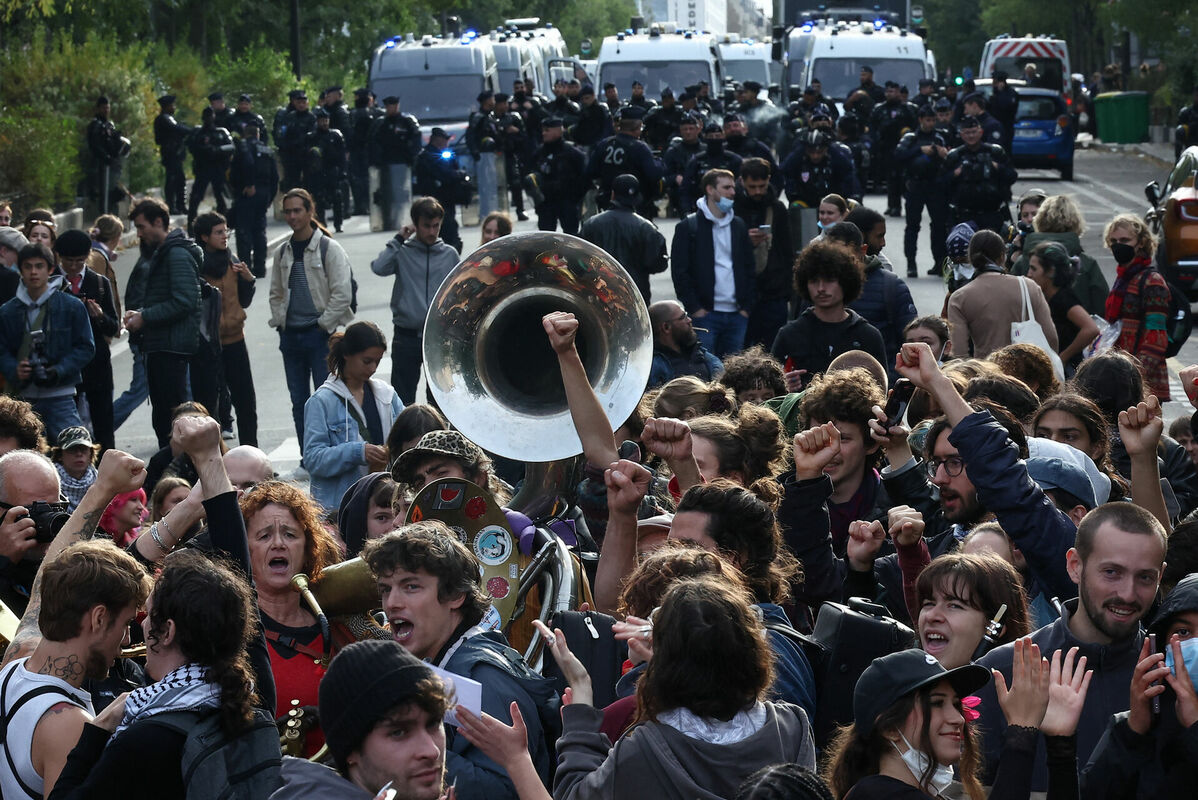
France Deploys 70,000 Police Ahead of Nationwide Protests
Facing escalating unrest and calls for violence on social media, the French government deployed 70,000 police officers and gendarmes ahead of nationwide weekend demonstrations, Lorēns Nunjess announced. The mobilization represents a 20% increase in security personnel, following a high-level defense council meeting called by President Emmanuel Macron. Last Saturday, nationwide protests across France drew approximately 550,000 participants according to government estimates, with some demonstrations turning violent.
Interior Minister Mobilizes Seventy Thousand Officers as Violence Surges
President Emmanuel Macron convened a defense council meeting with top ministers and officials to formulate a response. Lorēns Nunjess confirmed the scale of the deployment during a press conference in Paris, issuing explicit warnings regarding online calls for looting and physical attacks. On Thursday, Macron urged the utmost firmness against criminal activities, accusing ultra-left groups of attempting to “overthrow the republic” during the previous weekend.
LSM reported that specialized police units will take up positions to protect public buildings, including municipal town halls. The same outlet detailed public anxiety surrounding police tactics, noting injuries sustained during previous clashes where a teenager lost an eye from a rubber bullet and another lost a hand after picking up a police noise grenade. “There is a much police violence, policemen shouldn’t beat children,” Parisian resident Noa told LSM. Conversely, other residents expressed support for asset protection, while protesters defended their actions by claiming that radical disruptions are the only way to draw government attention. My son is a police officer in Paris. But I think the police are not here to beat people, but to protect monuments and buildings,
reflected Vincent. Without violence no one hears us. Only with violence does the government talk about us. Even you, media from all over the world, came to Paris because we broke everything here,
stated Parisian Eli.
Contrasting Restrictions Across Major French Cities
Local authorities implemented sharply divergent rules for urban demonstrations. Marseilles initially banned protests before reversing course to permit a union-led demonstration under strict exceptions, simultaneously canceling plans to shut down local public transit.

Cultural institutions bore immediate logistical impacts from the security posture. Paris closed major landmarks, including the Louvre, while organizers curtailed the Art Basel exhibition ahead of schedule. Elabe polling data cited by LSM indicates that approximately 70% of the French public supports implementing stringent measures such as curfews, military deployments, or states of emergency in the worst-hit regions.
Tourists Report Mixed Reactions to Paris Unrest
International tourists in Paris expressed mixed reactions to the heavy security footprint and localized chaos. Visitors interviewed by LSM reported minimal disruption to hotel and airline bookings, noting that cleanup crews restored major thoroughfares with surprising speed. Meanwhile, independent travelers and social media influencers arrived in the capital specifically to document the ongoing unrest firsthand. I felt quite safe, but I stuck to the main areas,
acknowledged Georgina. I wanted to see what is happening in France, because I see a lot of videos on the internet with chaos and everything. I wanted to experience it myself,
shared a London influencer using the moniker Freedom Maxxer, though he noted he had not yet managed to witness anything firsthand after arriving just the previous day.