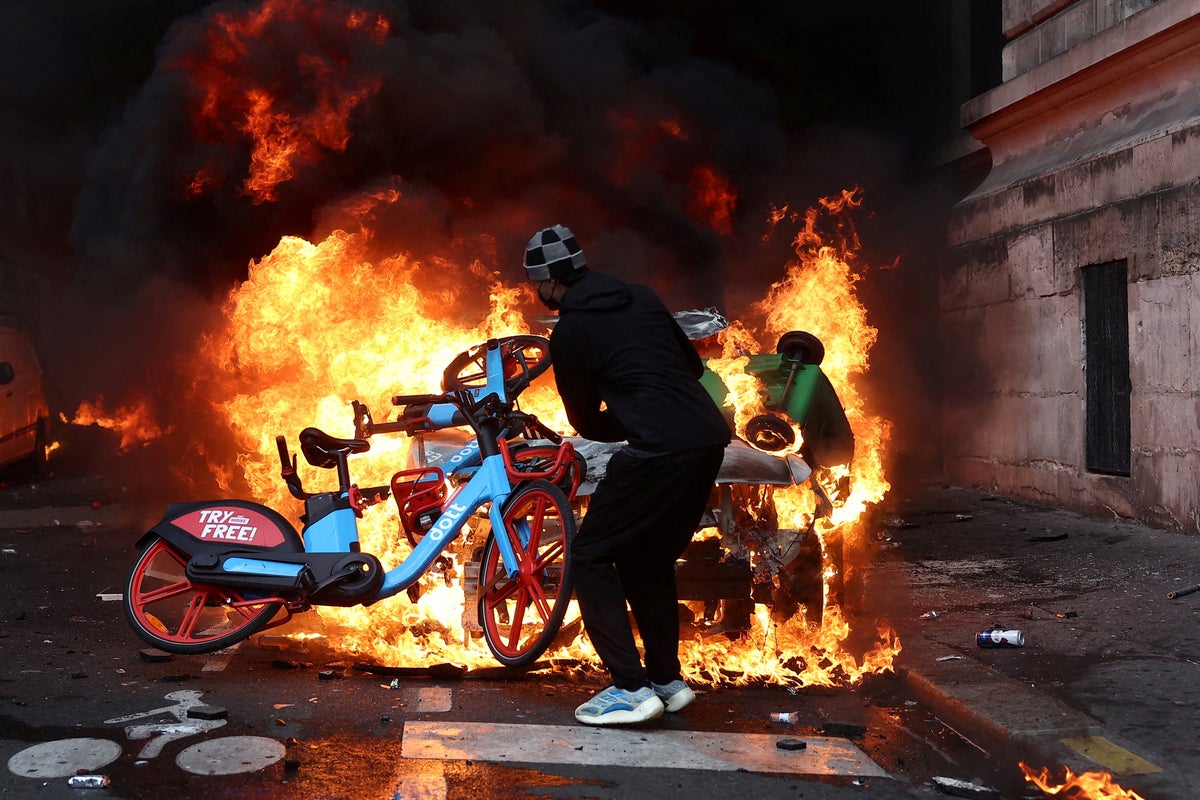
French Government Plans Massive Security Operation for Saturday
The French government is planning a “massive” security operation for protests this Saturday, according to reports on October 20, 2026. This follows destructive rioting and the imposition of nightly curfews in Paris and Lyon to combat looting and clashes.
While the government attempts to reclaim the streets, the underlying economic triggers—including a public debt that has reached 119% of GDP—create a volatile environment where public services are perceived as failing.
“The picture of France emerging this morning, in light of all the destruction, plays well into their hands,” says @BCautres. “We can clearly see that the National Rally is not a loser here.” https://t.co/WEhKIu8SsQ
France announces security operation and citywide curfews
Prime Minister Sébastien Lecornu has announced a “massive” security operation for Saturday’s planned demonstrations, according to France 24. To maintain order in the interim, authorities have established nightly curfews in major urban centers. In Paris, these restrictions apply to the Les Halles shopping district and Place de la République, running from 11 p.m. to 6 a.m. and remaining in place “for as long as necessary.”
Lyon has implemented a similar curfew in its city center from 9 p.m. to 6 a.m. The scale of the unrest is reflected in the judicial toll: Justice Minister Gerald Darmanin told BFM television that 149 rioters are currently in detention awaiting trial, while approximately 2,500 others remain in custody for questioning.
@FoxNews Digital's senior editor of investigations @AsraNomani has identified 54 organizations behind France's escalating protests — a sprawling network of communist parties, revolutionary socialist groups, labor unions, Palestine-solidarity organizations and international media…
The violence has caused severe disruptions to local commerce and logistics. Supermarket chain Carrefour reported “unprecedented” financial losses due to looting and increased security costs, forcing the company to lower its annual profit margin targets. Ride-hailing drivers and couriers have reported being trapped in clashes or forced to drive against traffic to escape riot police charges, according to union reports cited by France 24.
The conflict between state authority and public consent
The intensity of the clashes stems from a fundamental difference in policing philosophy. The Guardian reports that French police operate as instruments of the state, rooted in a Napoleonic tradition of ultra-centralization. Unlike the UK model, which emphasizes policing by consent, the French priority is to protect the state and reclaim the streets rather than negotiate with protesters.
This approach involves the use of “intermediate” weapons that are restricted in other European nations. Specifically, the Guardian highlights the use of defense ball launchers that fire rubber projectiles at 185 mph. These tactics often result in mass panic and severe injuries; one individual reported suffering 30 to 40 injuries since the start of the high school student movement, according to France 24.
“We can clearly see that France has lost its grip on many things. Public services, hospitals, education is in a horrible state, the peripheral neighbourhoods are dilapidated, they are abandoned.”
The quote above, provided by 79-year-old resident Chantal Bellanger to the BBC, shows that residents of Marseille's northern suburbs feel abandoned, where high poverty and crime rates fuel the anger of a "lost generation."

Fiscal instability and the debt reckoning
While the protests manifest as street battles, CNN reports a looming economic reckoning. France is facing a fiscal crisis driven by spending that exceeds its repayment capacity. This stress has been magnified by rising energy costs and a surge in bond rates.
The broader geopolitical climate has worsened these domestic pressures. According to the International Monetary Fund, the war in Iran has pushed average 10-year government bond yields for G7 economies to their highest levels in nearly 20 years. France’s specific financial position is precarious:
| Metric | France’s Current Status | EU Target/Context |
|---|---|---|
| Public Debt | 119% of GDP | Double the EU target |
| Annual Budget Deficit | 5.4% of GDP | Significant fiscal strain |
Peter Taylor-Gooby, a social policy professor at the University of Kent, told CNN that the bond market and interest rates have reached a point where they can no longer be ignored without risking a serious crisis. This economic backdrop transforms simple protests into existential struggles over the state’s ability to provide basic services.
Unrest creates power vacuum as government prioritizes stability
The unrest has created a perceived power vacuum.
Andrew Hussey, noted historian of modern #France🇨🇵 & its culture, writes poignantly in the wake of this past weekend’s riots, “I have long argued that as yet there is no civil war in France. But late that night, that is precisely what it looked like.”https://t.co/lJ6FoVYaF5
For businesses and residents caught in the crossfire, the immediate need is for stability.
As the government prioritizes the reclamation of the streets over the resolution of the underlying fiscal and social grievances, the battle for France’s urban centers remains far from over.
Related reading
- Protein Risk Scores for Subclinical Atherosclerosis Improve Cardiovascular Risk Stratification
- Man Arrested After Alleged Antisemitic Attacks on Jewish Women in London
- Micron Taiwan Union Plans October 22 Strike Over Bonus Dispute (newsy-today.com)
- Tuesday's French Budget Vote Is Not the Cliff. The Calendar After It Is (daybreakwire.com)