Trump Urges France to Close Borders After Violent Protests
Donald Trump calls on France to close borders following violent protests on October 18, 2026
On October 18, 2026, United States President Donald Trump urged French authorities to shut down their borders and seize control of immigration before it is too late, following a wave of widespread social unrest across France. Writing on Truth Social, Trump characterized the country as being “in llamas” and asserted that immigration had fractured the nation. The statements were alongside parallel remarks from JD Vance, who argued on Twitter that Western liberals imported the third world into France and other countries in the name of diversity and compassion, ignoring fundamental issues of assimilation and compatibility.
Arrests mount across Paris and provincial cities after widespread property damage
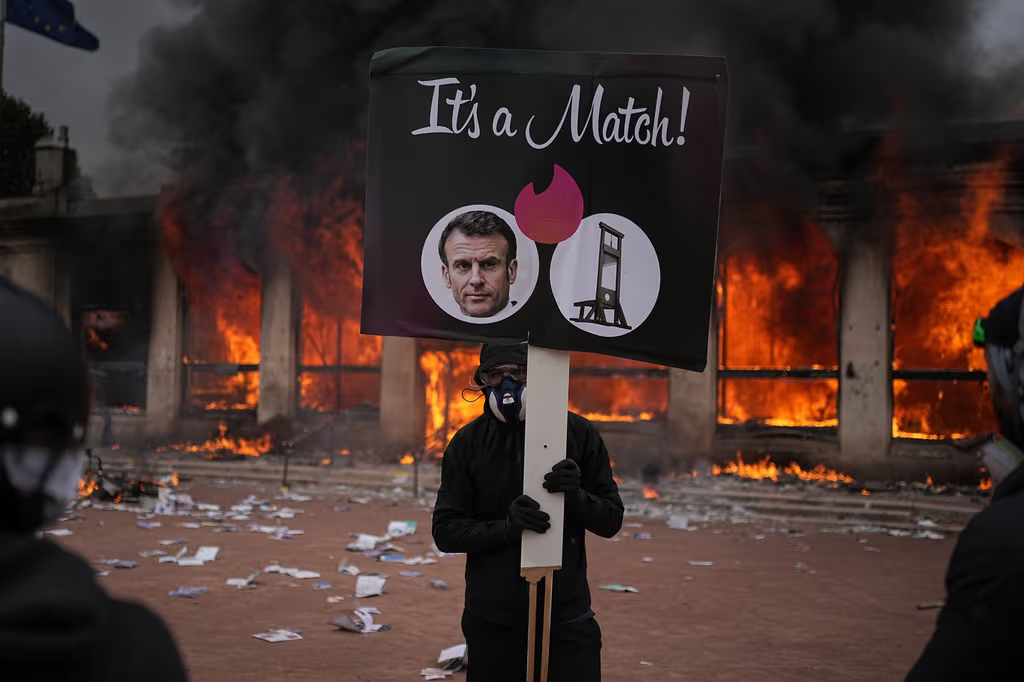
The political rhetoric from Washington follows a weekend of intense demonstrations that left French infrastructure and commercial districts severely damaged. According to figures from the French Ministry Interior and the Federation of Commerce and Distribution, law enforcement arrested 1,800 people nationwide on October 17, 2026, with 855 of those arrests occurring in Paris alone. Rioters targeted roughly 1,500 stores and commercial establishments across the country, resulting in looting and structural destruction.
In Limoges, located in west-central France, an intentional fire destroyed a historic 19th-century municipal building. Alexandre Bompard, president of the Federation of Commerce and Distribution, told the news channel LCI that financial losses for retailers will reach several hundred million euros. Meanwhile, Lamia El Aaraje, the socialist deputy mayor of Paris, described the urban violence as a level never previously witnessed in the capital.
Inflation pressures and economic grievances drive hundreds into the streets
The mass demonstrations began as a response to soaring inflation, high energy costs, and deteriorating public services linked to broader geopolitical conflicts. Protestors mobilized across multiple major cities, including Marseille, Bordeaux, Nice, and Strasbourg, to voice anger over the rising cost of living and fuel prices tied to the ongoing conflict involving the United States, Israel, and Iran that escalated in February.

Government officials and political figures offered differing perspectives on the roots of the crisis. While both the center-right government of President Emmanuel Macron and Marine Le Pen’s National Rally party placed blame on far-left agitators, representatives of left-wing movements like France Unbowed sought to separate peaceful demonstrators from individuals committing criminal acts of vandalism and pillaging.
Political pressures mount as Macron faces upcoming presidential elections
The domestic crisis unfolds just six months ahead of the French presidential elections to choose a successor to Emmanuel Macron. Prior to embarking on a three-day diplomatic tour of four Arab Gulf countries, Macron convened with Sébastien Lecornu and other cabinet ministers to address the civil unrest. Local authorities reported that over 500 individuals, including 171 minors, remained in police custody following the weekend clashes, as judicial authorities accelerate investigations to bring perpetrators before the courts.