First Global 3D Magnetohydrodynamic Simulation Tracks Solar Cannibalism from Birth to Merger
Researchers at the Harbin Institute of Technology published the first global three-dimensional magnetohydrodynamic simulations tracing coronal mass ejections from birth to merger on November 4, 2026, in The Astrophysical Journal Letters.
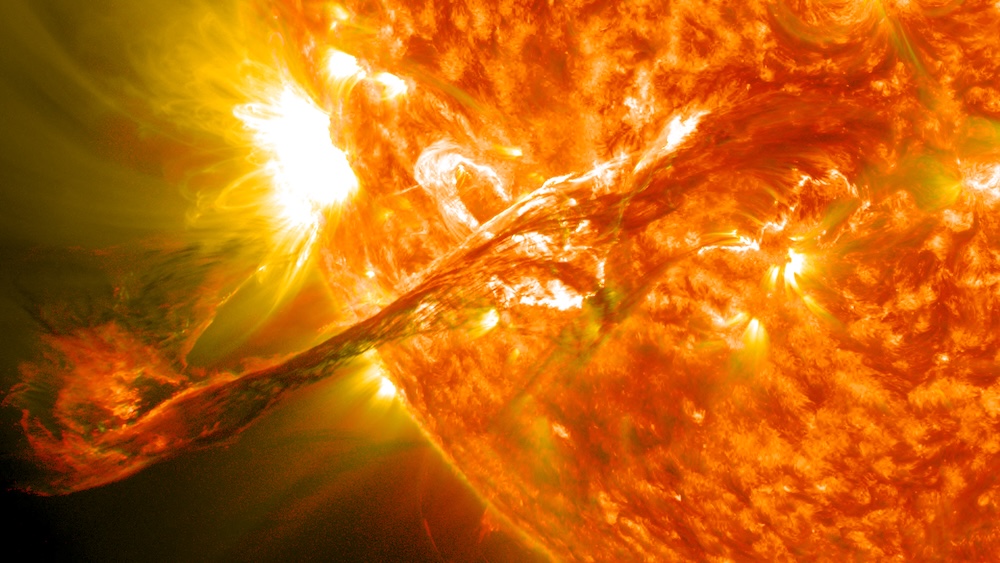
During the peak of the solar activity cycle, the Sun can unleash multiple coronal mass ejections per day from the same active region. When these eruptions share similar trajectories and magnetic configurations, subsequent ejections can overtake and consume preceding ones in a process known as solar cannibalism. This merging phenomenon can amplify the overall strength and geomagnetic impact of the resulting space weather events.
Previous numerical studies often examined CME initiation or subsequent heliospheric interactions in isolation, bypassing the critical transition where a later eruption alters the background plasma before catching its predecessor. The new research bridges that gap by modeling the entire sequence from initial photospheric shearing to final magnetic coalescence across a full global domain.
Tracking Sequential Eruption Speeds
To capture this behavior, Lijun Cai and collaborators initiated three homologous coronal mass ejections in quick succession from a single bipolar active region on the visible solar surface. Photospheric motion shifted the feet of magnetic field lines in the corona, building magnetic energy until it triggered successive eruptions through tether-cutting reconnection.
| Eruption Sequence | Shock Speed (km/s) |
|---|---|
| First CME | 770 |
| Second CME | 2,480 |
| Third CME | 3,230 |
Each successive CME traveled outward significantly faster than the one preceding it. According to the study, this speed hierarchy stems from two distinct physical mechanisms operating within the corona.
The passage of the initial eruption lowered background plasma density by an order of magnitude. This rarefied environment allowed subsequent mass ejections to experience substantially less ambient drag as they propagated outward.
The second and third eruptions derived greater kinetic energy directly from intensified magnetic energy releases at their source. These combined factors ensured that later shocks rapidly closed the distance separating them from earlier ejecta.
Current Sheets and Magnetic Coalescence
As faster ejections caught up with slower precursors, compression zones formed thin layers of electric current between the interacting structures. Within these current sheets, magnetic field lines interacted and rearranged through reconnection, binding the separate flux systems into a single compound mass.
Synthetic white-light and polarized-brightness images generated by the research team demonstrated the apparent coalescence of multiple white-light fronts. These visualizations match observational signatures recorded during historical solar events, such as sequences launched from active regions monitored by NASA/STEREO.
Building on these global simulations, the research team plans to extend their modeling framework to trace cannibalistic coronal mass ejections all the way from the Sun to Earth. These upcoming extensions aim to clarify exactly how compound interactions modify geoeffective storm intensities at planetary boundaries.
Harbin Institute of Technology traces its roots to 1920, when it opened as the Harbin Sino-Russian School for Industry to train railway engineers. In 1954 it became one of China’s six national key universities — the only one located outside Beijing — and in 2009 it joined the C9 League, a consortium of the country’s nine most elite research institutions.
Recent Observations Contextualize Simulated Coalescence
Chatterjee & Y. Fan (2013) partially captured the cannibalism, the magnetic interaction during this process was not studied. That simulation was performed within a spherical wedge spanning 15 degrees in latitude and 30 degrees in longitude.