
Fifth Third Invests in Payload to Expand Embedded Payments Platform
Fifth Third Bank has made a strategic investment in Payload, an embedded payments firm, to scale the processing of complex, multi-party transactions across the real estate, legal, and construction sectors. Announced August 19, 2026, the move expands Fifth Third’s footprint in the B2B fintech space, leveraging Payload’s ability to integrate payment rails directly into existing enterprise software.
The investment addresses a systemic friction point in B2B commerce: the reliance on legacy payment methods like physical checks and manual wire transfers for high-value transactions. For industries where funds must move between multiple stakeholders—such as escrow agents, title companies, and brokerages—these manual processes create liquidity bottlenecks and operational risks.
Fifth Third’s Newline Division and the $25 Trillion Volume Target
Fifth Third is not acquiring Payload, but is instead integrating the firm’s capabilities into its broader embedded finance strategy. The bank operates Newline, an embedded finance unit that has become a primary engine for deposit growth. According to a JPMorgan research note, Fifth Third aims to increase deposits via Newline by 35% to 50% annually.
The scale of Newline’s operations is substantial. In 2025, the division generated more than $1 billion in fee revenue, according to American Banker. Looking ahead to 2026, the bank expects to process more than $25 trillion in payment volume, a massive leap from the $9 trillion processed in 2016. Newline already maintains high-profile partnerships with Stripe and Trustly, the latter of which serves giants like eBay, FanDuel, and T-Mobile.
Bridgit Chayt, Fifth Third’s executive vice president and head of commercial payments and treasury management, told American Banker that the bank’s goal is to exist within the “tech stack” of its clients. Chayt noted that the bank’s brand does not need to be visible to the end customer for the bank to participate in and profit from the commerce.
Payload’s Market Penetration and the Real Estate Catalyst
Founded in late 2019, Payload processed its first payment in January 2020. The company’s growth accelerated during the pandemic as the residential real estate markets in the U.S. and Canada struggled with in-person transaction requirements. Ryan Rybolt, CEO and Co-Founder of Payload, told American Banker that the pandemic highlighted the need for home sellers, title companies, and brokerages to move money via back-end systems rather than physical meetings.
The growth metrics reflect this demand. According to a company press release, Payload processed nearly $500 million in May alone. American Banker reports that the firm now processes transactions at an annual rate of approximately $6 billion.
Payload is now pivoting its “invisible payments” thesis toward other verticals with similar multi-party complexities. These include:
- Legal Services: Law firms managing client funds and distributing payments to multiple parties in a single case.
- Property Management: Coordinating rent, maintenance, and owner distributions.
- Homebuilding and Franchises: Managing complex supply chain payments and royalty distributions.
Because these industries often rely on outdated technology, the transition to embedded payments requires significant technical overhaul.
The Technical Moat: API Integration and Compliance
The primary value proposition of Payload is the reduction of developer friction. Ian Halpern, Payload CTO and Co-Founder, stated that the platform allows developers to move from an initial API call to processing live payments in a matter of hours. This speed is coupled with enterprise-grade security and real-time event handling.

Beyond the “buy button” experience, Payload handles the invisible but mandatory regulatory burdens of B2B finance. Rybolt told American Banker that the platform manages onboarding, anti-money laundering (AML) compliance, and sanctions screening in the background. This automation removes the manual burden from the software provider, allowing them to offer financial services without becoming a regulated financial institution themselves.
This shift is part of a broader trend identified in a PYMNTS Intelligence report, “Buy, Don’t Build: The Next Wave of Embedded Finance,” which argues that embedding finance allows organizations to maintain control of the customer journey while unlocking new growth opportunities. A second PYMNTS report found that embedded payments serve as a competitive differentiator, increasing customer lifetime value by weaving financial functions directly into digital ecosystems.
Strategic Implications for the Banking Sector
The investment signals a shift in how traditional banks view fintechs—not as competitors to be fought, but as infrastructure to be funded. Enrico Camerinelli of Datos warned via American Banker that banks lacking scalable, modern technology and industry-focused services will “become invisible” within two to three years.
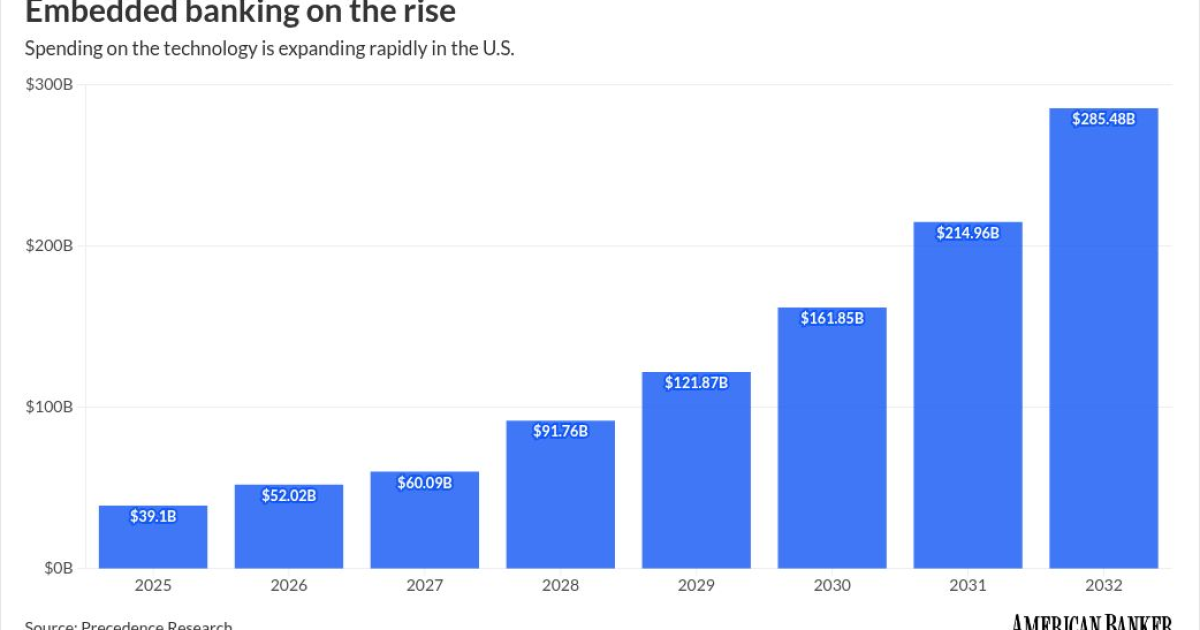
By backing Payload, Fifth Third secures a pipeline into specialized B2B verticals that are traditionally difficult for banks to penetrate. The bank gains the fee revenue and deposit growth associated with these transactions without having to build the niche software interfaces required from scratch.
As the barrier between software and banking continues to dissolve, the risk for mid-market firms is no longer just competition from other software providers, but the total loss of the customer relationship to the payment layer.
The trajectory for 2026 suggests a move toward “hyper-specialized” embedded finance. The winners will not be the generalists, but the platforms that can solve the specific, messy payment logic of complex industries.