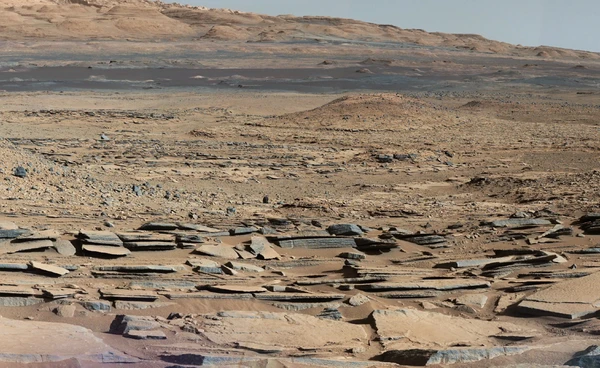
Evidence of Ancient Water Puddles Found on Mars: Key Clue to Past Oceans and Potential for Life
Researchers have identified geological evidence of ancient lakebeds on Mars, suggesting the planet once hosted vast bodies of liquid water and potentially habitable conditions.
The findings, derived from high-resolution imaging and spectral analysis by orbiting spacecraft, reveal distinct sedimentary layers and mineral deposits consistent with prolonged standing water in regions such as Jezero Crater and Gale Crater. These features include clay minerals and carbonates, which on Earth typically form in neutral-pH aqueous environments conducive to preserving organic matter.
NASA’s Perseverance rover, currently operating in Jezero Crater, has collected rock samples showing signs of alteration by water over extended periods. The rover’s instruments detected sulfates and silica deposits, further indicating episodic but sustained hydrological activity billions of years ago.
Scientists emphasize that while the presence of ancient water increases the likelihood that Mars could have supported microbial life, no direct evidence of past or present biology has been found. The samples collected by Perseverance are slated for return to Earth in the early 2030s as part of the Mars Sample Return campaign, a joint effort between NASA and the European Space Agency.
ESA’s Rosalind Franklin rover, scheduled for launch in 2028, will drill beneath the Martian surface at Oxia Planum to search for preserved biosignatures in clay-rich strata shielded from radiation.
Meanwhile, ongoing analysis of data from the Trace Gas Orbiter continues to monitor atmospheric traces of methane and other gases, though recent measurements indicate no significant seasonal variations that would strongly indicate active subsurface processes.
The next major milestone in the Mars Sample Return program involves the launch of the Earth Return Orbiter in 2027, designed to capture the sample container in Mars orbit and initiate the journey back to Earth.