
EU-US Trade Deal Faces Fierce Backlash Amidst Discrepancies
Lingering Questions and Uneven Impacts Plague New Accord
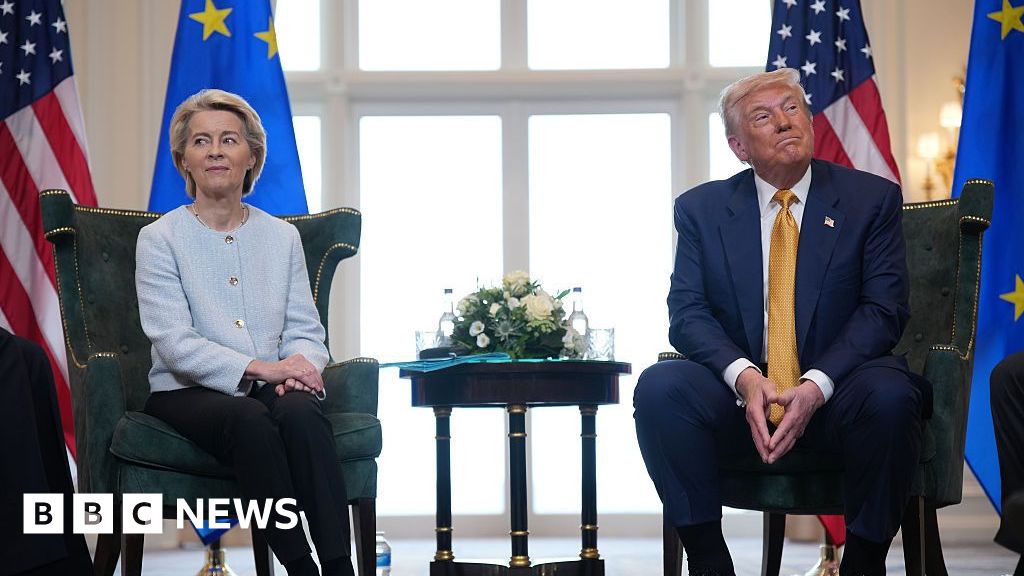
A recently announced EU-US trade agreement, intended to avert significant tariffs, is now facing intense scrutiny. While European Commission chief Ursula von der Leyen and US President Donald Trump presented a united front, details are emerging that highlight considerable differences between the two sides. Many European nations feel the deal is merely a first step, with significant negotiations still ahead.
A Fleeting Relief Amidst Tariff Uncertainty
The agreement mandates a 15% tariff on most EU exports to the US, a reduction from the 30% previously threatened by President Trump. This eased fears of steeper penalties, offering some businesses a semblance of stability after months of tense negotiations. However, a joint statement has yet to be officially released, with the Commission describing the accord as a “set of political commitments” rather than a legally binding document.
This contrasts sharply with the White House’s characterization of the deal as achieving “historic structural reforms.” US Commerce Chief **Howard Lutnick** acknowledged that discussions are ongoing, with officials still ironing out various aspects of the framework.
“This isn’t the end of the story and we won’t leave it at that. It’s the first step in a negotiation process that will continue.”
—Emmanuel Macron, French President
Traditional trade agreements typically span 18 to 24 months of bilateral discussions. The current 15% tariff aims to provide immediate certainty, but further negotiations will seek to establish differentiated terms for specific goods.
Key Disagreements Emerge in Deal’s Interpretation
Significant discrepancies exist in how pharmaceuticals and semiconductors are treated. The White House states these sectors will face the 15% tariff without an upper limit. Conversely, the EU maintains these sectors will initially retain their 0% tariff rate until global rates are renegotiated, with any future tariffs capped at 15%.
Regarding steel and aluminium, the US indicates tariffs will remain at 50%. The EU, however, asserts that Brussels and Washington will collaborate to reduce this rate, introducing a quota system after August 1.
The language surrounding EU investment commitments also reveals a stark divide. The US claims the EU “will” purchase $750 billion in US oil, liquefied natural gas (LNG), and nuclear energy products. The EU, however, states it “intends” to do so as it diversifies away from Russian energy. As noted by Cinzia Alcidi of the Centre for European Policy Studies, it remains uncertain if the US can supply these volumes, and the EU cannot unilaterally commit private sector purchases.
Similarly, the US asserts the EU will invest $600 billion by the end of President Trump’s second term. The EU, conversely, reports that companies have merely “expressed interest” in investing this sum by 2029, with no guarantee of realization.
The US also claims the EU has “agreed to purchase significant amounts” of American military equipment, a commitment absent from the EU’s statement. Such a move could conflict with **von der Leyen**’s “ReArm Europe” initiative, which prioritizes domestic defense industry investment. Approximately 80% of the EU’s current defense spending already benefits the US.
Furthermore, the Commission confirmed a 15% tariff will apply to wine and spirits, despite ongoing efforts to secure an exemption. French President **Emmanuel Macron** remarked on the agreement’s short-term predictability but stressed the need for Europe to adopt a more assertive stance.
“In order to be free you have to be feared. We weren’t feared enough.”
—Emmanuel Macron, French President
Economic Impact Unevenly Distributed Across EU
While all EU countries will face the 15% tariffs, the economic repercussions will vary. Germany, Ireland, and Italy are particularly vulnerable due to their strong ties with the US market. For German automakers, US exports represent 13% of their sales, amounting to €34 billion.
Ireland relies most heavily on the US for its exports among EU member states, especially for its $50 billion annual pharmaceutical exports. The Irish government offered a cautious welcome to the agreement, stating, “It is what it is and we move on.”
Italy’s agricultural, pharmaceutical, and automotive sectors are expected to suffer, with a potential 0.2% hit to its GDP according to the Italian Institute of International Political Studies. Italian farming confederation Cristiano Fini described the deal as a “surrender,” with several agricultural associations demanding EU compensation for anticipated losses.
However, Cinzia Alcidi advises against blanket compensation, arguing it would ultimately be taxpayers footing the bill and represent a “great victory for Trump.”
