Einstein Probe detects extended soft X-ray emission from neutron star merger
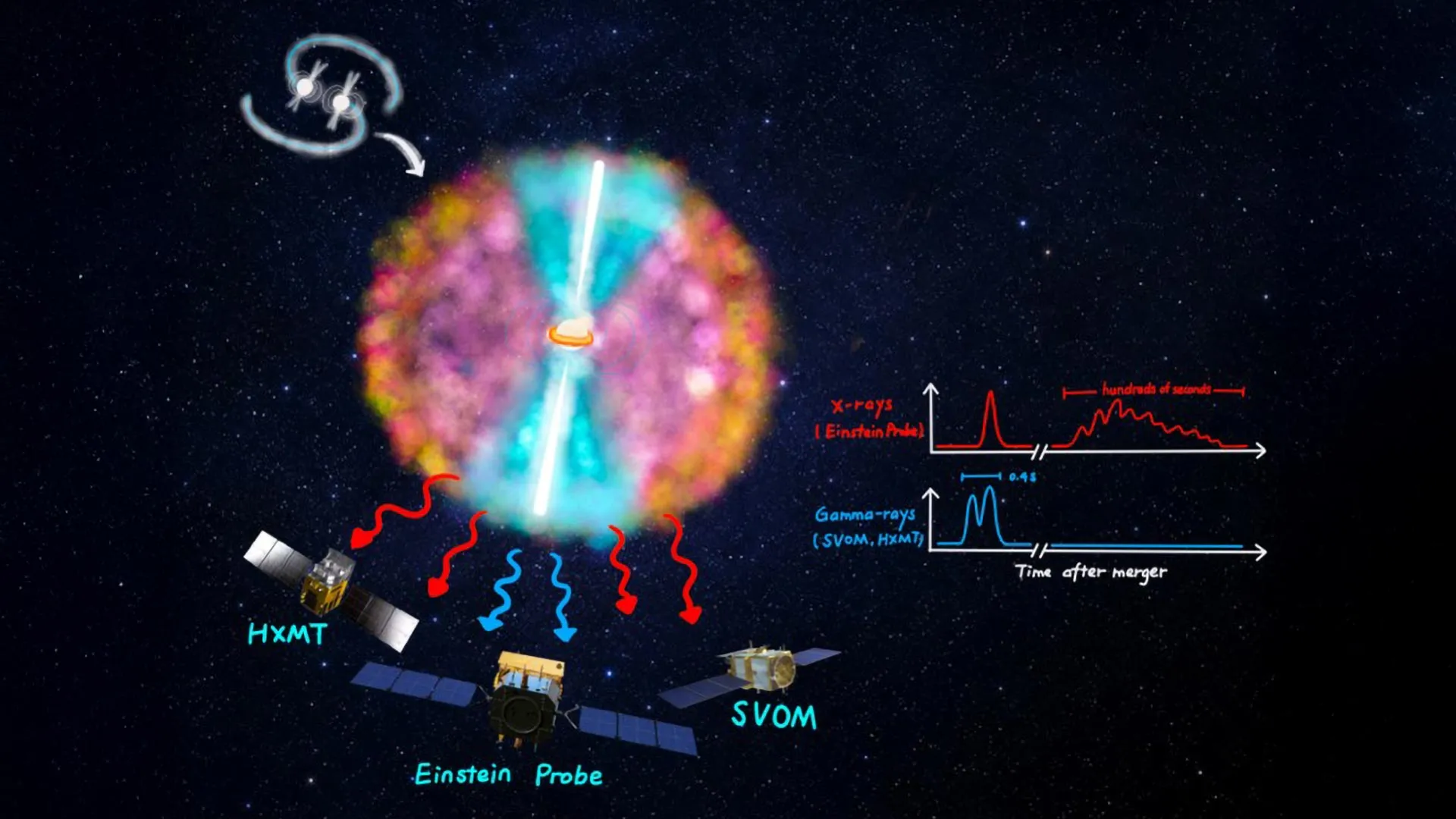
On July 4, 2025, the Einstein Probe space observatory detected a short gamma-ray burst designated EP250704a/GRB 250704B that produced an initial flash lasting less than half a second, followed by nearly ten minutes of continuous soft X-ray emission.
The Tech TL;DR:
- Observatories captured a short gamma-ray burst that concealed nearly ten minutes of soft X-ray activity rather than fading instantly.
- Researchers utilized multiwavelength telescope campaigns, including ESO’s Very Large Telescope, to measure a redshift of z = 0.6610.
- The prolonged high-energy output points to a rapidly rotating, highly magnetized neutron star remnant acting as a central engine.
Initial Detection and The Ten-Minute Soft X-Ray Afterglow
The transient signal triggered simultaneous alerts across multiple space-based instruments. An Li, a PhD student at Beijing Normal University and the Transient Advocate for the Einstein Probe, noted that the event initially appeared to be an ordinary short GRB producing a bright flash detected simultaneously in gamma rays by SVOM-GRM and Insight-HXMT, and in X-rays by the Einstein Probe Wide-field X-ray Telescope (EP-WXT). Instead of fading away as typical short GRBs do, the source continued emitting episodes of soft X-rays for nearly ten minutes.
The prolonged emission carried substantial energy, but its spectrum remained so soft that conventional gamma-ray instruments would have stayed below their detection thresholds. Professor Bin-Bin Zhang of Nanjing University explained that previous missions recorded only the brief gamma-ray flash, missing the prolonged activity revealed by the Einstein Probe.

International Team Identifies Host Galaxy and Distance
To identify the origin of the signal, an international team organized a multiwavelength follow-up campaign spanning radio, optical, and X-ray bands. Professor Eleonora Troja of Tor Vergata stated that these coordinated observations allowed researchers to identify the host galaxy, measure its distance, and rule out an accompanying supernova, linking the X-ray emission directly to a compact object merger.
Passaleva reacted within minutes of the space alert while traveling on a train, operating one of the world’s largest telescopes via laptop. Using the European Southern Observatory’s Very Large Telescope (VLT) in Chile and its X-Shooter instrument, the team split the incoming light to reveal iron and magnesium absorption lines. Spectroscopic analysis yielded a redshift of z = 0.6610, indicating the light traveled for more than six billion years. Observations with the FORS2 instrument confirmed the absence of a supernova, separating the event from stellar collapse explosions associated with long X-ray flashes caused by the collapse of a massive star.
Evidence Supporting a Long-Lived Magnetar Central Engine
The rapidly changing brightness, evolving spectrum, and subsequent X-ray and optical afterglows pointed to continued activity from the central engine after the initial gamma-ray flash faded. Yin noted that a plausible explanation involves the merger producing a rapidly rotating, highly magnetized neutron star—known as a magnetar—that powered the extended X-ray emission through continued energy injection.
Troja highlighted that the newly discovered soft X-ray component establishes fast X-ray transients as electromagnetic counterparts to gravitational-wave sources. This hidden phase opens a new window for studying neutron star merger remnants and may ultimately help constrain the neutron star equation-of-state in the era of multi-messenger astronomy.
Einstein Probe Records Fast X-Ray Flashes
The discovery emerged from the Einstein Probe, launched in January 2024 to monitor celestial X-rays across wide fields of view. Since its deployment, the spacecraft has recorded hundreds of fast X-ray flashes from distant galaxies. While some signals trace back to dying massive stars, many others remain unexplained because identifying their distance and energy output has historically challenged astronomers. SVOM and HXMT detected the short gamma-ray burst, while the Einstein Probe captured the accompanying long-lasting X-ray emission.
Researchers applied the Very Large Array radio telescope alongside optical and X-ray facilities to map the afterglow. When I saw the X-ray data of this new event, I realized something was going on,
Troja said.