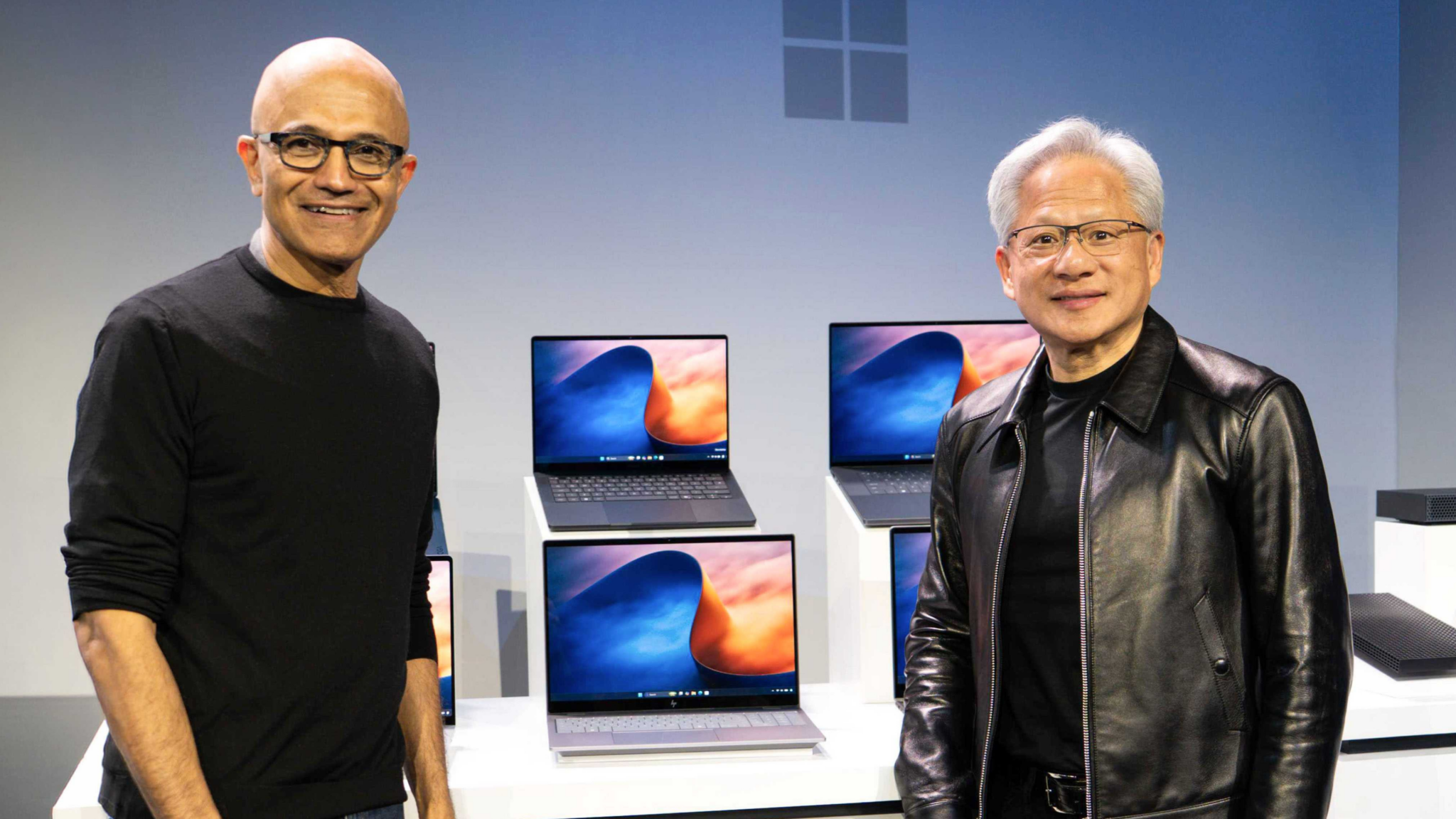
NVIDIA and Microsoft introduce RTX Spark to run AI agents on Windows PCs
NVIDIA founder and CEO Jensen Huang and Microsoft CEO Satya Nadella announced a hardware and software collaboration to run AI agents locally on Windows PCs at an event held Wednesday at Dogpatch Studios in San Francisco.
The Tech TL;DR:
- NVIDIA and Microsoft introduced RTX Spark, a new superchip bringing the full NVIDIA AI stack and up to 1 petaflop of FP4 AI performance to slim Windows laptops and compact desktops.
- Microsoft announced general availability of Microsoft Execution Containers (MXC) and NVIDIA OpenShell to provide OS-level security primitives for running background AI agents securely.
- Laptop preorders open today, with retail availability slated for October 16, while compact desktops launch in November from major manufacturers including ASUS, Dell, HP, Lenovo, Microsoft Surface, and MSI.
Jensen Huang and Satya Nadella Outline Agentic Windows Architecture
Speaking during a fireside chat hosted by Sriram Krishnan, Huang and Nadella traced the historical relationship between NVIDIA and Microsoft. Huang noted that NVIDIA was founded because of Windows, stating that without the operating system, GeForce would not exist. Nadella praised Huang for maintaining a consistent long-term vision regarding the evolution of personal computing toward autonomous agents. Pavan Davuluri, executive vice president of Windows and Devices at Microsoft, detailed the operating system updates built specifically to support these background workflows.
To establish a secure environment for continuous execution, Microsoft announced the general availability of Microsoft Execution Containers (MXC). Davuluri explained that these OS-level primitives allow agents to run persistently in the background under strict operating system governance, backed by Microsoft Security and Agent 365.

RTX Spark Superchip Integrates Blackwell GPU with Grace CPU
The RTX Spark superchip combines an NVIDIA Blackwell RTX GPU featuring up to 6,144 cores and fifth-generation Tensor Cores with NVFP4 support, connected via NVLink-C2C to a 20-core NVIDIA Grace CPU. MediaTek collaborated with NVIDIA on the custom Arm-based CPU design. The system supports up to 128GB of unified memory and delivers one petaflop of FP4 AI compute. The platform enables creators to render ultralarge 90GB+ 3D scenes, edit 12K 4:2:2 video, and run 120B-parameter LLMs locally.
| Component | RTX Spark Specification | DGX Station for Windows Specification |
|---|---|---|
| Processor Architecture | NVIDIA Blackwell RTX GPU + 20-core Grace CPU | GB300 Grace Blackwell Ultra Desktop Superchip |
| AI Compute | Up to 1 Petaflop (FP4) | Up to 20 Petaflops (FP4) |
| Coherent / Unified Memory | Up to 128GB Unified Memory | 748GB Coherent Memory |
| Form Factor | Slim Windows laptops & compact desktops | Deskside AI Supercomputer |
NVIDIA Hardware Supports Seamless Model Deployment Across Platforms
Developers can move models across NVIDIA hardware stacks without rewriting code, utilizing the same CUDA platform from RTX Spark to DGX Station. The hardware supports models such as Qwen 3.8 Flash Next. For enterprise workloads, NVIDIA previewed the DGX Station for Windows, which features the GB300 Grace Blackwell Ultra Desktop Superchip with 748GB of coherent memory and up to 20 petaflops of FP4 AI compute, eliminating the historical need for developers to maintain separate Linux environments for heavy AI tasks.
# Example command to verify CUDA device availability on supported RTX Spark hardware
import torch
print(f"CUDA Available: {torch.cuda.is_available()}")
print(f"Device Name: {torch.cuda.get_device_name(0) if torch.cuda.is_available() else 'None'}")
Availability and OEM Hardware Ecosystem Rollout
Laptop preorders for RTX Spark devices open today, with systems shipping on Friday, October 16. Compact desktop configurations are scheduled for release in November. Systems will be manufactured by Acer, ASUS, Dell, HP, Lenovo, Microsoft, MSI, and GIGABYTE. Adobe is actively rearchitecting Photoshop and Premiere for the new architecture to improve AI and graphics rendering performance.
Disclaimer: The technical analyses and security protocols detailed in this article are for informational purposes only. Always consult with certified IT and cybersecurity professionals before altering enterprise networks or handling sensitive data.