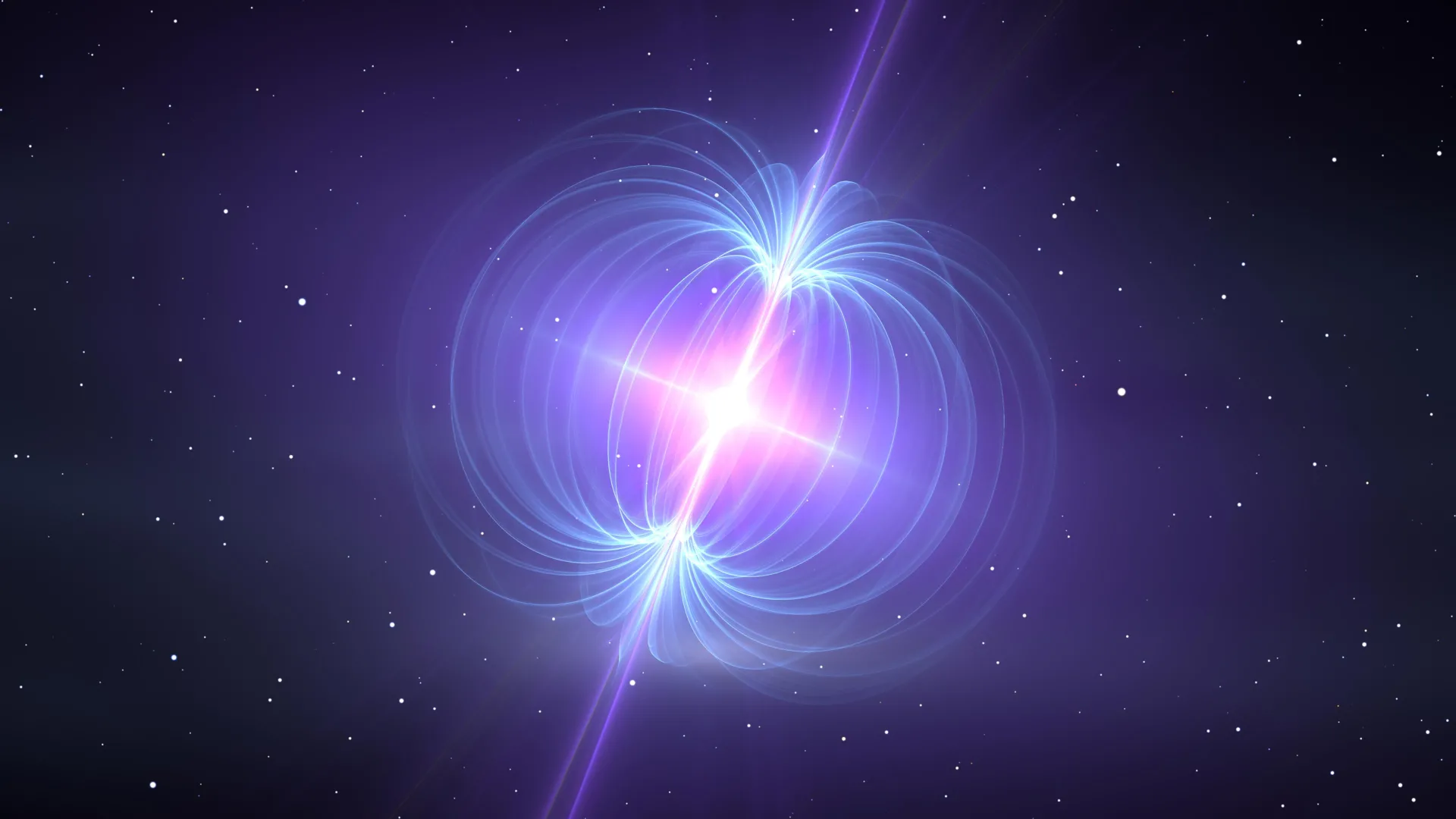
Record-breaking X-ray flash may reveal the birth of a magnetar
Record-Breaking X-Ray Flash May Reveal the Birth of a Magnetar
Astronomers recorded a fast X-ray transient designated EP250704a/GRB 250704B on July 4, 2025, capturing a prompt emission that lasted nearly ten minutes. Detected by the Einstein Probe, SVOM, and Insight-HXMT satellites, the event offers evidence that some neutron star collisions culminate in the formation of a rapidly spinning magnetar.
Operational Summary of EP250704a/GRB 250704B
- Detection Vector: Flagged by the Einstein Probe satellite on July 4, 2025, prompting rapid-response observations across international ground and space telescopes.
- Duration Anomaly: Exhibited a gamma-ray burst lasting just half a second, followed by a ten-minute continuous X-ray flash.
- Cosmic Distance: Spectroscopic analysis via the Very Large Telescope determined a redshift of z=0.6610, placing the source over six billion light-years away with zero associated supernova signature.
The Architectural Challenge of Transient Astrophysics
Detecting and isolating fast X-ray transients has historically strained astronomical pipeline systems due to their ephemeral nature. Traditional short gamma-ray bursts typically vanish in less than two seconds, leaving telemetry collectors scrambling for coordinates before the signal decays below background noise thresholds. When the Einstein Probe satellite transmitted the trigger for EP250704a/GRB 250704B, graduate student Niccolò Passaleva executed a rapid-response protocol while traveling by train. Using a laptop to commandeer the European Southern Observatory’s Very Large Telescope (VLT) in Chile, Passaleva initiated follow-up telemetry acquisition while the transient was still luminous enough to resolve.

Using the VLT’s X-Shooter instrument, researchers decomposed the incoming photon stream into its individual spectral components. This architectural breakdown isolated distinct absorption features, enabling the team to calculate a precise redshift of z=0.6610. Because light from this cataclysm traveled for more than six billion years before striking our instruments, the event predates the formation of our solar system. Subsequent deep imaging via the VLT’s FORS2 instrument confirmed the total absence of a bright supernova, ruling out the collapse of a massive star and isolating the remnant scenario to a binary neutron star merger.
Magnetar Damping and Long-Duration X-Ray Emission
Neutron stars represent the ultra-dense cores left behind after massive stars exhaust their nuclear fuel. When two of these remnants collide, they generate gravitational waves alongside electromagnetic radiation. While short gamma-ray bursts have served as the standard signature for such impacts, the discovery of a ten-minute X-ray tail points to persistent energy injection from a newly born magnetar.
"However, if the remnant of the collision is a magnetar, it could keep bursting for longer," explains Professor Eleonora Troja, whose group led the research and who is co-corresponding author of the study published in Science Bulletin. "Magnetars are rapidly spinning neutron stars with huge magnetic fields. By transferring their magnetic energy into the surrounding space, these objects can boost the brightness and duration of any explosion. When I saw the X-ray data from this new event, I realized something was up." Supported by a European Research Council (ERC) Consolidator grant and operating within the Einstein Probe European collaboration, Troja’s team linked the protracted X-ray emission to the rapid dissipation of magnetic energy within the post-merger debris cloud.
Niccolò Passaleva emphasized the scale of the observation, noting that "This is the longest lasting prompt X-ray flash ever observed from a neutron star merger. It is an opportunity to have a front-row seat to the most extreme forces of the Universe and discover more of its secrets." Through the tracking of further fast X-ray transients via facilities like the Einstein Probe—which has monitored the cosmos for such phenomena following its January 2024 deployment—researchers hope to establish the exact statistical probability of neutron star collisions resulting in magnetars.
