
“`html
Titan’s Methane Lakes Coudl Be Incubators for Prebiotic Chemistry, New Study suggests
Research proposes that the unique surroundings of Saturn’s largest moon may naturally foster the formation of vesicle-like structures, a crucial step in the origin of life.
scientists have put forth a compelling hypothesis suggesting that the methane lakes and seas on Saturn’s moon Titan could be the birthplace of prebiotic chemical structures. The proposed mechanism involves the natural formation of membrane-bound vesicles, akin to early cell membranes, within Titan’s frigid, hydrocarbon-rich environment. This process, if occurring, could represent a meaningful step towards understanding how life might arise from non-living matter in extraterrestrial settings.
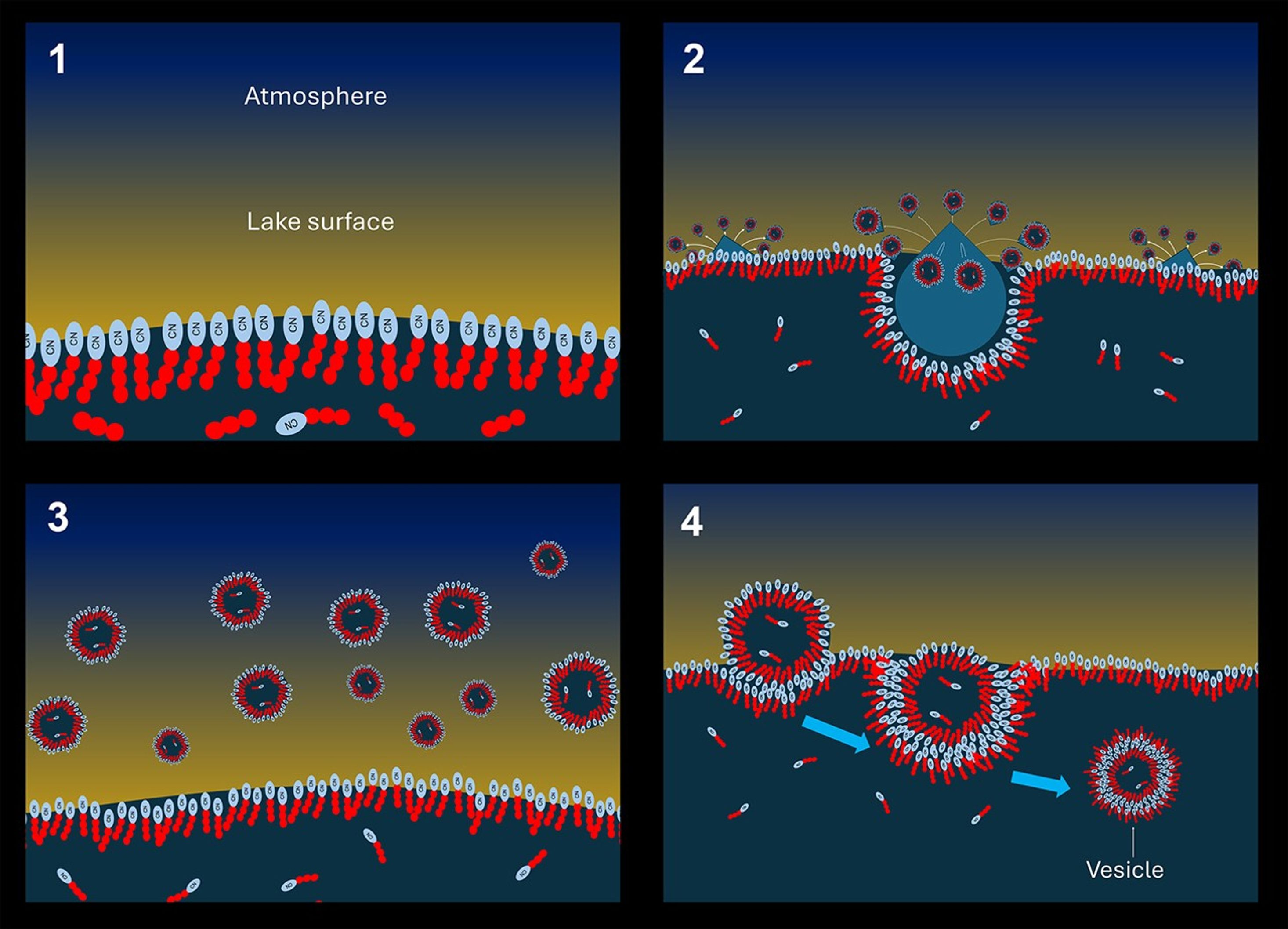
(1) Methane lakes and seas on Titan’s surface become coated with a film of amphiphiles. (2) Methane raindrops splash the lake surface. (3) Splashes create a mist of droplets coated in the same film. (4) Droplets settle back onto the lake and sink, becoming coated in a bilayer which becomes a vesicle. (Mayer & Nixon, Int. J.astrobio., 2025)
The research, published in the international Journal of Astrobiology, outlines a step-by-step process. It begins with amphiphiles, molecules with both water-attracting and water-repelling properties, forming a film on Titan’s methane lakes. When methane raindrops fall, they create splashes, generating a mist of droplets also coated in these amphiphiles. As these droplets return to the lakes and sink, they are theorized to become encapsulated by a bilayer of amphiphiles, forming stable vesicles.
“Stable vesicles will accumulate over time, and so will the corresponding stabilizing amphiphiles that are temporarily protected from decomposition,” the researchers, Nixon and Mayer, stated in their findings. they further elaborated on the potential for evolutionary processes, noting, “In a long-term compositional selection process, the most stable vesicles will proliferate, while less stable ones form dead ends… This leads to an evolution process leading to increasing complexity and functionality.” This suggests a natural selection mechanism could operate on these structures, driving them towards greater stability and complexity, a process verging on biological evolution.
