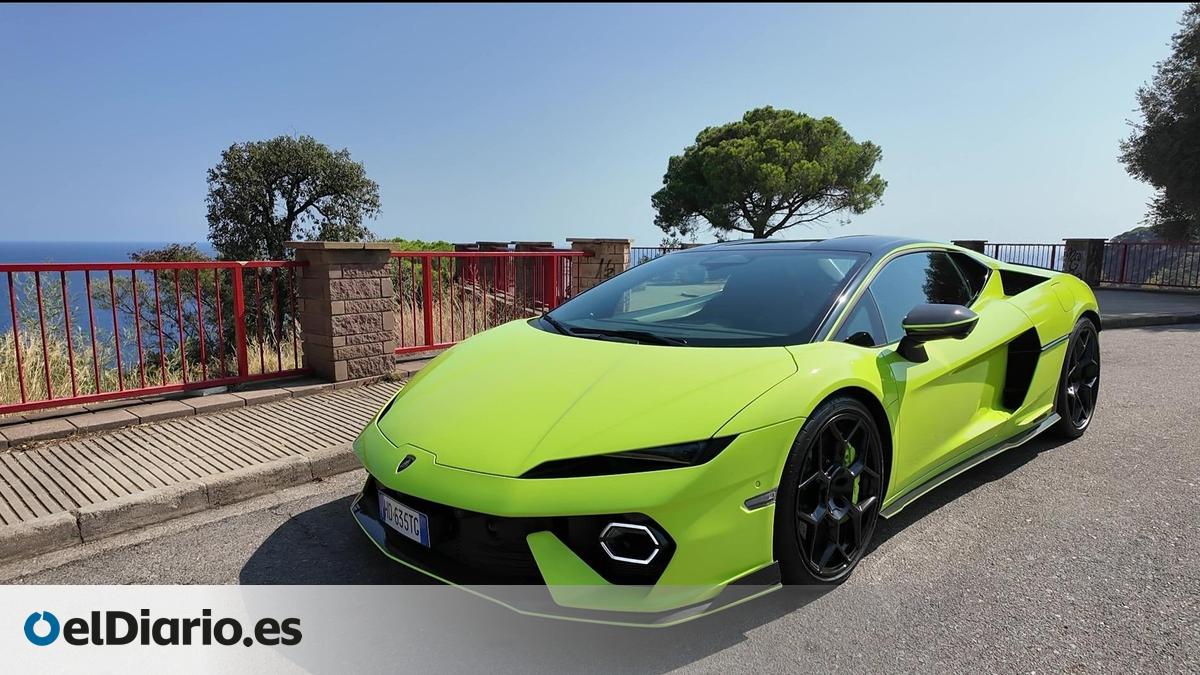
Driving the New Lamborghini Temerario: A Hybrid Supercar Masterpiece on the Costa Brava
The Lamborghini Temerario, a 920-horsepower hybrid successor to the iconic Huracán, has entered the high-performance automotive market as a bridge between traditional combustion-engine heritage and modern electrification. Tested on the winding roads of Spain’s Costa Brava, the vehicle utilizes a 4.0-liter twin-turbo V8 engine paired with three electric motors to balance raw mechanical power with daily usability.
Engineering the Hybrid Transition
Lamborghini’s shift toward electrification in the Temerario is defined by a 3.8 kWh battery pack housed within the vehicle’s central tunnel. This configuration keeps the center of gravity low, preserving the handling characteristics essential for a supercar. According to technical specifications provided by the manufacturer, the setup allows for a “Città” mode, which enables the car to operate solely on electric power—producing 190 CV—to minimize noise in urban environments.

The vehicle’s powertrain reaches a maximum of 10,000 rpm, a feat of engineering that requires precise thermal and mechanical management. When the driver engages the “Sport” or “Corsa” modes, the combustion engine and electric motors synchronize to deliver the full 920 CV.
Performance Dynamics on the Costa Brava
The Costa Brava’s coastal topography served as a proving ground for the Temerario’s torque vectoring system. Unlike traditional braking-based stability systems, the Temerario uses its front electric motors to distribute torque across the wheels, enhancing agility in tight corners. Data indicates a 0 to 100 km/h acceleration time of 2.7 seconds, with a top speed reaching 343 km/h.

The integration of an eight-speed dual-clutch transmission, positioned behind the V8 engine, further aids in power delivery.
Interior Ergonomics and Digital Integration
Lamborghini has increased the interior dimensions of the Temerario compared to the Huracán, providing an additional 34 millimeters of headroom and 46 millimeters of legroom. The cockpit features a three-screen digital architecture, including a 12.3-inch driver display, an 8.4-inch central screen, and a 9.1-inch passenger display.
The chassis itself has undergone significant structural updates, with a new aluminum frame that increases torsional rigidity by over 20% compared to previous models. Aerodynamic efficiency has also seen a marked improvement, with rear downforce increasing by 103% over the Huracán EVO.
The Cost of Innovation
The Temerario enters the market with a base price in the region of hundreds of thousands of euros.
Ultimately, the Temerario is not merely a replacement for the Huracán; it is a reinterpretation of the supercar, designed to exist in a world that demands both the visceral thrill of a V8 engine and the technological compliance of a modern hybrid.
The transition to hybrid technology within the supercar segment signals a broader evolution.
Keep reading
- Lula and Trump Hold First Call to Discuss Trade Tariffs and Organized Crime
- Lindsay Clancy Murder Trial: Postpartum Psychosis Defense and Final Arguments
- US National Debt Hits $40 Trillion, Driving Up Household Borrowing Costs (newsy-today.com)
- Who's Liable When Your Self-Driving Uber Crashes? (daybreakwire.com)